Choosing among DMX controllers with MIDI is easier when you match the console to your lighting workflow rather than focusing on channel count alone. A compact controller may suit a mobile DJ, while a larger wireless console can better handle moving heads, fog machines, and multi-scene shows.
This roundup covers 10 options ranging from portable 192-channel units to 384-channel consoles and dedicated MIDI-to-DMX interfaces. Use the guide below to compare programming features, connectivity, portability, and setup requirements before buying.
Best 10 Dmx Controllers with Midi Picks for 2026
MIDI Bridge Pick
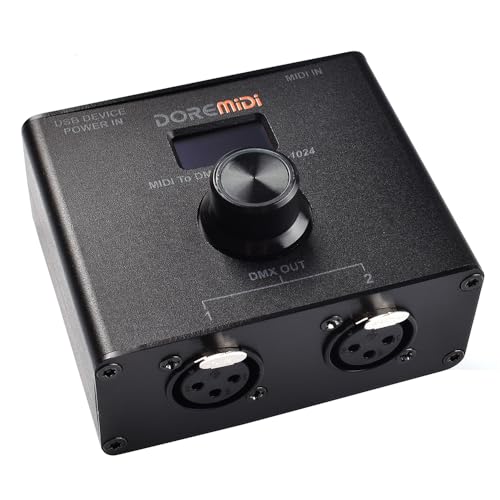
- Converts MIDI messages to DMX
- Works with Windows and Ableton Live
- Backup-file configuration support
Best For: Computer-based MIDI lighting control
Wireless Console Pick
384-Channel MIDI DMX Controller

- 384 channels for 12 fixtures
- 2.4G wireless and 3-pin XLR modes
- Stores 240 scenes and six chases
Best For: Live concerts, weddings, and DJ events
Stage Control Pick

- Controls up to 24 intelligent lights
- MIDI, music mode, and blackout control
- Metal housing with LED display
Best For: DJs, clubs, and stage lighting setups
Compact Console Pick
Monoprice 16-Channel DMX Controller

- Controls up to 12 intelligent lights
- MIDI DIN, USB, and XLR connectivity
- Supports scenes, chases, and tap sync
Best For: Compact small-system lighting control
Best Wireless Bundle
Rockforce 384-Channel DMX Controller
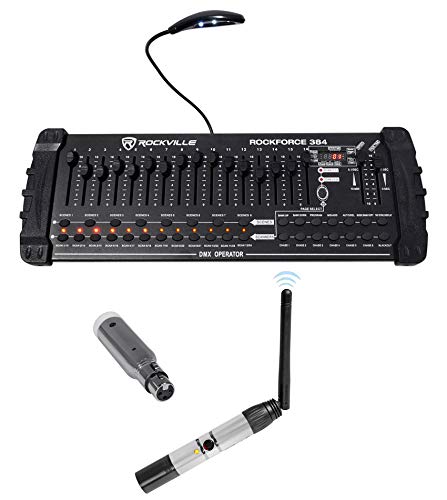
- 384 channels with MIDI and built-in music modes
- Includes wireless transmitter and receiver
- Receiver provides approximately nine-hour battery runtime
Best For: Wireless DJ, club, theater, and event lighting rigs
Best Portable Pick
Mini-192 Battery DMX Controller

- Built-in battery rated for up to 72 hours
- Controls up to 12 16-channel lights
- MIDI beat activation, tap sync, and automatic operation
Best For: Portable DJ and small-event lighting setups
Best Rackmount Option
Rockforce W4 Wireless DMX Controller
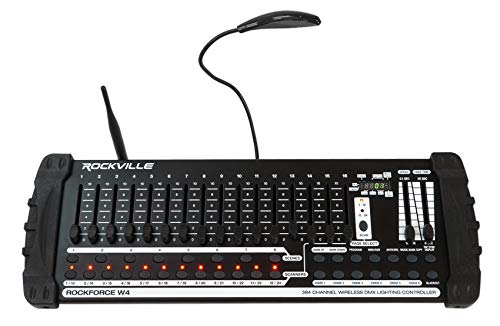
- 384 channels control up to 24 intelligent lights
- Built-in 2.4GHz transmitter supports seven groups
- Rackmount design with wired DMX in/out and MIDI
Best For: Professional and mobile wireless lighting systems
Wireless MIDI Performance Pick

- 384 channels with 30 scene banks and six chases
- MIDI, music-trigger, and manual control modes
- Built-in wireless transmitter and rechargeable receiver
Best For: Mobile DJs and event setups needing wireless MIDI lighting control
Compact Budget MIDI Pick
MINI 192W Wireless DMX Controller
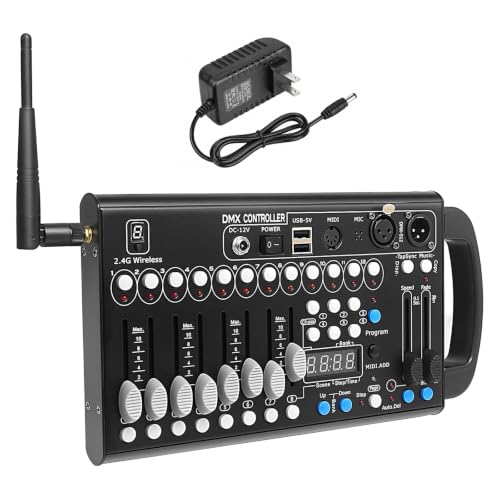
- 192-channel control for up to 12 smart lights
- MIDI beat activation, tap sync, and automatic operation
- 240 scenarios and six programmable chases
Best For: Small DJ, party, bar, and event lighting rigs
Programmable MIDI Stage Pick
384-Channel DMX Operator Console

- Controls 24 fixtures with 16 channels each
- 30 scene banks, six chases, and 240 scenes
- MIDI, sound activation, and reversible DMX channels
Best For: Stage and club users programming complex wired DMX shows
MIDI Bridge Pick – Compact MIDI-to-DMX Converter
DOREMiDi MIDI To DMX Controller (MTD-1024) Can Convert MIDI Messages To DMX Messages
Check Price On AmazonFor users seeking dmx controllers with midi, the MTD-1024 takes MIDI messages from an instrument or Windows software such as Ableton Live and converts them into DMX messages. Its knob-based configuration and USB connection make it a focused option for computer-based lighting control.
Best For: MIDI instrument or Ableton Live users who need a compact MIDI-to-DMX interface.
Pros:
- Converts MIDI messages to DMX messages for lighting control.
- Supports MIDI instrument and software-based operation.
- Configuration data can be uploaded as a backup file.
- Includes an XLR cable and weighs about 0.27 kg.
Cons:
- Designed for Windows platforms rather than broadly specified operating-system support.
- Provides a focused conversion interface instead of a large fader console.
The MTD-1024 is a practical choice when the MIDI-to-DMX conversion itself matters more than built-in scenes, chases, or wireless operation.
Wireless Console Pick – 384-Channel MIDI DMX Controller
This 384-channel console combines MIDI triggering with wired 3-pin XLR and 2.4G wireless operation. For buyers comparing dmx controllers with midi, its physical faders, scene memory, and live-event controls make it suited to hands-on stage lighting.
Best For: DJs, wedding operators, and live-event users controlling multiple intelligent fixtures.
Pros:
- Controls 384 DMX channels across up to 12 intelligent fixtures.
- Includes MIDI input, speed and fade-time faders, and 16 physical faders.
- Stores 240 scenes across 30 banks and supports six chases.
- Offers both 2.4G wireless and standard 3-pin XLR wired modes.
Cons:
- Wireless mode requires fixtures equipped with a 2.4G receiver.
- Its 4.16-pound console form is less compact than a simple converter.
With substantial scene storage and dual connectivity, this controller is a strong fit for operators who want MIDI-assisted triggering without giving up physical live control.
Stage Control Pick – Rockforce 384 MIDI Controller
The Rockville ROCKFORCE 384 is a traditional stage console for dmx controllers with midi, pairing MIDI control with 16 sliders, programmable scenes, and chases. Its metal housing, LED display, and built-in microphone support hands-on operation in club, DJ, and stage environments.
Best For: Stage and club operators who need MIDI, manual sliders, and music-triggered lighting modes.
Pros:
- Controls up to 24 intelligent lights with 16 channels each.
- Stores 30 banks of scenes and six programmable chases.
- Supports MIDI control of banks, chases, and blackout functions.
- Includes a built-in microphone, LED display, and gooseneck lamp.
Cons:
- Its 5.3-pound metal console is less portable than a compact interface.
- Uses a 3-pin XLR wired DMX connection rather than a listed wireless mode.
Choose the ROCKFORCE 384 when durability and direct console control are priorities, especially for programmed shows that also benefit from MIDI or sound activation.
Compact Console Pick – Monoprice 16-Channel DMX Controller
The Monoprice Stage Right controller offers MIDI compatibility alongside USB, MIDI DIN, and XLR connectivity. Among dmx controllers with midi, it is a compact option for controlling up to 12 intelligent lights and running programmed scenes or chases.
Best For: Users who want a compact controller for smaller intelligent-lighting systems and automated shows.
Pros:
- Controls up to 12 intelligent lights with up to 16 channels each.
- Provides six chase sets containing up to 240 scenes.
- Supports MIDI DIN, USB, and XLR connections.
- Includes beat activation, tap sync, and auto-run functions.
Cons:
- Its 16-channel-per-fixture design is less expansive than 384-channel consoles.
- Uses a compact push-button control layout rather than a larger fader bank.
This Monoprice model makes sense for buyers who value a smaller footprint and multiple connection options while still needing MIDI-compatible scene and chase control.
Best Wireless Bundle – Rockforce 384-Channel DMX Controller
For shoppers comparing dmx controllers with midi, this Rockville bundle combines a 384-channel console with wireless DMX transmission hardware. It can control up to 24 fixtures, offers MIDI and music-triggered modes, and includes a transmitter and receiver for cable-free setups.
Best For: DJs, clubs, theaters, and event rigs needing a controller plus wireless DMX hardware in one package.
Pros:
- 384 channels, 16 sliders, 30 banks, and six programmable chases
- Includes a 2.4GHz transmitter and receiver with a stated range of up to 600 meters
- MIDI control, built-in microphone, blackout master, and power-failure memory
- Receiver battery offers approximately nine hours of runtime
Cons:
- The bundle is a larger purchase if wireless DMX hardware is not needed
- Its 24-fixture capacity may exceed the needs of smaller lighting setups
This is the most complete option here for building a wireless-capable control system around MIDI-compatible lighting workflows. The included receiver battery adds flexibility for temporary or mobile installations.
Best Portable Pick – Mini-192 Battery DMX Controller
This portable option stands out among dmx controllers with midi because its built-in battery is rated for up to 72 hours of operation. The 192-channel console controls up to 12 16-channel intelligent lights and supports MIDI beat activation, tap synchronization, automatic operation, and multiple chases.
Best For: DJs, bands, bars, weddings, and house parties that need a compact controller with extended battery operation.
Pros:
- Built-in battery rated for up to 72 hours of operation
- 192 channels control up to 12 smart lights with 16 channels each
- Provides 240 scenarios, six chases, MIDI beat activation, and tap sync
- Compact aluminum design measures 11.42 by 6.3 by 1.77 inches
Cons:
- Its 192-channel capacity is lower than the 384-channel Rockville models
- It is designed for 3-pin DMX connections and may require compatible cabling
Choose this model when portability and battery life matter more than maximum fixture count. Its scenario, chase, and synchronization features provide useful automation for mobile performances and smaller venues.
Best Rackmount Option – Rockforce W4 Wireless DMX Controller
The Rockville ROCKFORCE W4 is a strong choice for buyers seeking dmx controllers with midi and integrated wireless capability. Its 384 channels control up to 24 intelligent lights, while the built-in 2.4GHz transmitter supports up to seven groups and 25 receivers.
Best For: Professional or mobile operators who want a rackmountable controller with wired DMX, wireless transmission, and hands-on control.
Pros:
- 384 channels, 16 sliders, 30 banks, and six chases with 240 scenes
- Built-in 2.4GHz frequency-hopping transmitter with up to 1,968 feet of stated range
- MIDI control, music synchronization, manual override, and blackout control
- Rugged 4U rack-mountable design with wired DMX input and output
Cons:
- The 4U rackmount format is less compact than a small portable console
- Wireless operation may require compatible receivers for each remote fixture group
With both wireless and wired DMX connections, the W4 offers flexible deployment for larger or changing event layouts. Its rackmount construction and manual override also suit users who want physical control during live operation.
Wireless MIDI Performance Pick – AGVYBE DMX384 Controller
For shoppers comparing dmx controllers with midi, the AGVYBE DMX512 console combines MIDI control with wireless DMX operation. Its 384 channels, rechargeable receiver, and multiple scene and chase options make it suited to setups that need flexible live control.
Best For: Mobile DJs, stage productions, clubs, weddings, and event lighting setups that benefit from wireless control.
Pros:
- MIDI control covers banks, chases, and blackout functions.
- Built-in microphone supports music-synchronized lighting.
- Built-in 2.4GHz transmitter supports remote operation up to 100 meters, with longer range possible in optimal conditions.
- Offers 384 channels, 30 banks of eight scenes, and six chases.
Cons:
- The controller weighs 6.91 pounds, so it is less portable than smaller consoles.
- Wireless operation requires pairing receivers by signal group.
This is the most feature-rich option here for users who want MIDI, music-triggered effects, and wireless receiver control in one rack-mountable unit. It also retains wired 3-pin DMX512 compatibility when wireless operation is not practical.
Compact Budget MIDI Pick – MINI 192W Wireless DMX Controller
If you want dmx controllers with midi in a smaller, simpler format, this 192-channel console provides MIDI beat activation alongside tap synchronization and automatic operation. It can control up to 12 smart lights with 16 channels each and includes a 3-pin DMX cable.
Best For: DJs, bands, bars, clubs, house parties, weddings, and smaller stage-lighting systems.
Pros:
- Controls up to 16 lights with 12 channels each, according to the supplied specifications.
- Provides 23 banks of eight scenarios for 240 total scenarios.
- Includes six chases, built-in microphone activation, MIDI beat activation, tap sync, and automatic operation.
- Compact rack-mount design measures 11.42 by 6.3 by 1.77 inches.
Cons:
- Its 192-channel capacity is lower than the 384-channel alternatives.
- The supplied details specify corded electric operation rather than built-in wireless transmission.
This controller is a practical choice when you need core MIDI and automatic lighting features without moving up to a larger 384-channel board. Its compact dimensions also suit portable or space-constrained rigs.
Programmable MIDI Stage Pick – 384-Channel DMX Operator Console
This 384-channel DMX operator console is one of the dmx controllers with midi aimed at programming and live operation. It supports MIDI control for banks, chases, and blackout, while its scene capacity and reversible channels give stage and club users room for more complex lighting sequences.
Best For: DJs, theaters, clubs, parties, weddings, and users programming multiple 3-pin DMX fixtures.
Pros:
- Controls 24 intelligent lights with 16 channels each.
- Includes 30 banks of eight programmable scenes and six chases with 240 scenes.
- Supports MIDI, music-triggered operation through a built-in microphone, and live chase control.
- Comes with a power cable and LED gooseneck lamp for operation in dark environments.
Cons:
- The supplied package details do not list a DMX cable.
- It uses a wired 3-pin DMX connection and does not specify wireless transmission.
Choose this model if programming capacity matters more than wireless convenience. Its 384 channels, reversible DMX channels, and extensive scene-and-chase structure make it a strong fit for repeatable stage or event looks.
How We Picked These Dmx Controllers with Midi
We focused on controllers that explicitly support MIDI alongside DMX512 output or conversion. The selection spans 192- and 384-channel consoles, dedicated MIDI-to-DMX hardware, wireless DMX systems, and portable units. We also considered practical features such as sliders, scene and chase storage, wireless transmission, receiver compatibility, music synchronization, and suitability for moving-head fixtures.
Because product configurations can vary, verify the current specifications before ordering. Pay particular attention to whether MIDI is used for triggering scenes, controlling channels, or converting MIDI messages directly into DMX data.
Quick Comparison
| Best For | What to Prioritize |
|---|---|
| MIDI integration | Reliable MIDI input, message mapping, and compatibility with your keyboard, sequencer, or software |
| Mobile DJs | Portable construction, straightforward scene programming, and music or sound activation |
| Moving-head rigs | At least 192 channels, joystick or slider access, and enough banks for fixture presets |
| Wireless installations | Built-in transmission, included receiver support, and clear range requirements |
| Fixed stage setups | Higher channel capacity, repeatable chase programming, and dependable wired DMX output |
Key Buying Factors for Dmx Controllers with Midi
Channel Capacity and Fixture Compatibility
Count the DMX channels required by every fixture, not just the number of lights. Moving heads can consume many channels for pan, tilt, color, gobo, focus, dimming, and effects. Leave headroom for future additions instead of buying a controller that operates at its limit.
MIDI Functionality
“MIDI compatible” can mean different things. Some consoles use MIDI to trigger scenes and chases, while a dedicated interface converts MIDI notes or control messages into DMX commands. Confirm the connectors, supported message types, and whether programming requires a computer or can be done directly on the unit.
Programming and Live Control
Look for accessible sliders, scene banks, chase controls, blackout functions, and speed or fade-time adjustments. A large memory capacity matters for recurring shows, while direct controls are more important when you need to make changes during a performance.
Wired, Wireless, and Portable Operation
Wireless DMX can reduce cable runs, but transmitter and receiver compatibility, interference, and line-of-sight may affect reliability. Battery-powered or compact models are useful for mobile work, although they may provide fewer controls than full-size consoles.
Who Should Buy Which Dmx Controllers with Midi?
Choose a dedicated MIDI-to-DMX converter if your main goal is integrating lighting with a keyboard, DAW, sequencer, or automated show system. DJs and small performers should favor portable 192-channel controllers with simple scene, chase, and music-trigger functions. For moving-head-heavy rigs or larger mobile productions, a 384-channel console offers more programming space and control flexibility.
Wireless models make the most sense when cable reduction is a priority and the fixtures support the same wireless ecosystem. For permanent venues or technically demanding shows, prioritize robust wired DMX connections, generous channel headroom, clear MIDI mapping, and repeatable programming over convenience features alone.