Choosing among DMX controllers for beginners can be confusing when consoles differ in channel count, programming style, wireless support, and fixture compatibility. The right controller should make basic scenes and live adjustments easier—not add unnecessary complexity.
We compared ten entry-level options for DJs, bands, entertainers, content creators, and small venues, focusing on practical control, setup requirements, expandability, and value.
Best 10 Dmx Controllers for Beginners Picks for 2026
Best Hands-On Starter
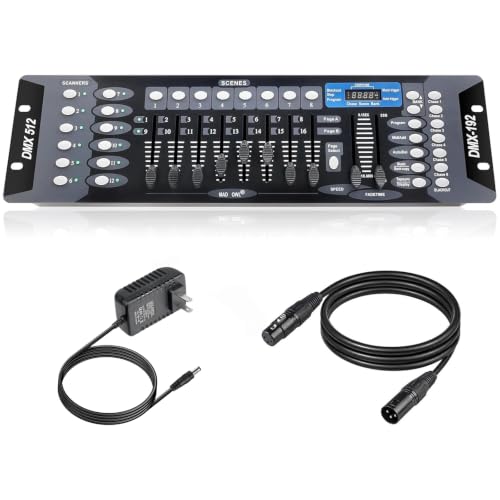
- Controls up to 12 compatible fixtures
- Stores 23 banks of eight scenes
- Includes a 6.6-foot DMX cable
Best For: Beginners who prefer physical faders and buttons
Best Easiest Setup

- Controls lighting from an iPad or Android tablet
- Includes 50 presets and 21 automatic effects
- Supports a library of more than 15,000 fixtures
Best For: Beginners seeking tablet-based, low-programming control
Best Traditional Upgrade

- Provides 384 DMX channels
- Controls up to 12 lights with up to 32 channels
- Stores 240 scenes and six chases
Best For: Users learning programmed shows with higher-channel fixtures
Best Flexible Features
384-Channel Wireless DMX Console

- Combines wired and optional 2.4G wireless DMX
- Stores 240 scenes and six chases
- Adds MIDI, music, and auto modes
Best For: Beginners wanting multiple control and automation options
Flexible 192-Channel Starter

- Controls up to 12 fixtures across 192 channels.
- Stores up to 240 programmable scenes.
- Organized controls plus voice-control support.
Best For: Beginners managing expanding DJ, party, or small-stage lighting setups
Compact Manual Pick

- Controls up to 12 DMX512 channels.
- Portable aluminum design with simple sliders.
- Includes blackout control and three-pin DMX output.
Best For: Small stages and portable setups using 12-channel-or-fewer fixtures
Scene-Programming Value
192 DMX Stage Light Controller

- Controls 12 devices across 192 channels.
- Programs up to 240 scenes and six chases.
- Includes manual sliders and automatic fade controls.
Best For: Beginners building repeatable lighting scenes for parties and shows
Best for Larger Setups
384-Channel DMX512 DJ Controller

- 384 channels for expanded fixture control
- 30 banks with eight scenes each
- Includes handles and LED gooseneck light
Best For: Beginners planning club, bar, or live-show lighting systems
Best for Voice Control
192-Channel DMX512 Stage Console

- Controls up to 12 intelligent lights
- Stores 240 scenes with 40 steps each
- Adds voice-activated scene changes
Best For: Amateur DJs and event users wanting hands-free lighting control
Best Hands-On Starter – 192-Channel DMX Controller
For beginners comparing dmx controllers for beginners, this corded 192-channel board offers a traditional fader-and-button layout that is straightforward to learn. It controls up to 12 fixtures with 16 channels or fewer and includes a 6.6-foot DMX cable.
Best For: Beginners who want physical controls for stage, DJ, or small performance lighting.
Pros:
- Controls up to 12 compatible lighting fixtures.
- Stores 23 banks of eight scenes.
- Supports six programmable chases with up to 240 steps.
- Includes a 6.6-foot DMX cable.
Cons:
- Limited to fixtures using 16 channels or fewer.
- Uses a corded, hands-on control format rather than app control.
This is a practical entry point if you prefer learning DMX with dedicated faders and buttons, while its scene and chase memory leaves room to grow.
Best Easiest Setup – ADJ MyDMX Go App Controller
Among dmx controllers for beginners, the ADJ MyDMX Go stands out for its app-based approach. It works with an iPad or Android tablet, offers Wi-Fi and USB connectivity, and avoids traditional programming by providing presets and automatic effects.
Best For: Beginners who want tablet-based lighting control with minimal programming.
Pros:
- 256-channel control through an iPad or Android tablet.
- Library includes more than 15,000 fixtures.
- Offers 50 user presets and 21 automatic effects.
- Supports a standard 3-pin XLR connection and USB power.
Cons:
- Requires a compatible iPad or Android tablet for app control.
- Wireless mode depends on Wi-Fi and compatible setup.
Its zero-programming design can shorten the learning curve considerably, making it a strong choice for users who would rather shape effects on a touchscreen than program scenes manually.
Best Traditional Upgrade – Chauvet DJ Obey 70
The Chauvet DJ Obey 70 is a traditional console for beginners who want substantial programming capacity without moving to a computer-based system. It provides 384 DMX channels, controls up to 12 intelligent lights with up to 32 channels, and uses dedicated programming controls for scenes and chases.
Best For: Beginners and advancing users building programmed shows with higher-channel fixtures.
Pros:
- Controls up to 12 lights with as many as 32 channels each.
- Stores up to 240 scenes across 30 banks.
- Provides six chases containing up to 240 scenes.
- Allows fade and speed times to be programmed into each step.
Cons:
- Its larger channel and scene capacity may take longer to learn.
- Uses a traditional corded console rather than app-based control.
Choose the Obey 70 if your fixtures need more than a basic 16-channel layout and you want room for detailed scene timing and chase programming.
Best Flexible Features – 384-Channel Wireless DMX Console
For dmx controllers for beginners who want both conventional and modern control options, this 384-channel console combines physical faders with wired DMX, optional 2.4G wireless operation, MIDI input, and automatic modes. Its layout is suited to live concerts, weddings, and DJ events.
Best For: Beginners who want physical controls plus wireless, MIDI, and sound-activated options.
Pros:
- Controls 12 intelligent fixtures across 384 DMX channels.
- Offers both standard 3-pin XLR and 2.4G wireless modes.
- Stores 240 scenes in 30 banks and supports six chases.
- Includes speed, fade-time, MIDI, music, and auto modes.
Cons:
- Wireless operation requires fixtures with a 2.4G receiver.
- The broad feature set may be more than a first-time user needs.
- Requires a 9V battery according to the supplied specifications.
This is a versatile learning platform for users who expect their setup to expand, especially when wired control, wireless fixtures, MIDI triggering, and automatic effects may all be useful.
Flexible 192-Channel Starter – CO-Z 192 DMX 512 Controller
The CO-Z 192 DMX controller is a practical choice for beginners who want room to expand beyond basic dimming. It controls up to 12 intelligent lights with up to 16 channels each, while supporting up to 240 scenes for more involved shows. Its labeled control sections and voice-control feature may make initial setup less intimidating.
Best For: Beginners running DJ sets, parties, weddings, church gatherings, or small venue shows with multiple fixtures.
Pros:
- Controls up to 12 fixtures and 192 total channels.
- Supports up to 240 scenes for programmed lighting changes.
- Includes a three-pin connection for compatible equipment such as fog machines and par lights.
- Separate light, scene, channel, display, speed, and function areas help organize operation.
Cons:
- Its larger feature set may take more time to learn than a simple manual dimmer.
- Operation requires corded power and compatible DMX equipment.
Choose this model if you want beginner-friendly controls without giving up programmable scenes. It is especially appealing when your lighting setup may grow over time.
Compact Manual Pick – MAD OWL 12-Channel DMX Dimmer
The MAD OWL 12-channel DMX dimming controller is one of the more approachable options for beginners who need straightforward manual control. Its six sub-control push rods and one main control push rod operate up to 12 DMX512 channels, and the compact aluminum housing is suited to portable setups.
Best For: Small stages, travel setups, and users controlling DMX fixtures with 12 channels or fewer.
Pros:
- Simple layout with six sub-control sliders, a main control slider, and one-key blackout.
- Compact, lightweight design is convenient for travel and quick installation.
- Uses a standard three-pin XLR DMX output.
- Smooth push rods and aluminum construction support regular handling.
Cons:
- Cannot control stage lighting equipment with more than 12 channels.
- It is a manual controller rather than a larger scene-programming console.
- Requires a compatible DMX512 dimming power supply for a permanent control system.
This controller makes sense when simplicity and portability matter more than extensive programming. Confirm your fixtures use 12 channels or fewer before choosing it.
Scene-Programming Value – 192 DMX Stage Light Controller
This 192-channel DMX controller is designed for beginners who want to learn scene and chase programming. It controls up to 12 devices with 16 channels each, offers 23 sets of programmable scenarios, and supports six programmable chases with up to 240 scenes. Eight sliders also provide manual channel control.
Best For: Beginners creating programmed lighting for parties, music shows, festivals, concerts, and seasonal events.
Pros:
- Provides 192 channels across 12 scanners with 16 channels each.
- Supports up to 240 scenes and six programmable chases.
- Combines manual sliders with automatic speed and fade-time controls.
- Three-pin connectivity works with compatible moving heads, fog machines, par lights, and other stage fixtures.
Cons:
- Its programming functions may require practice for first-time users.
- It needs a compatible power source and DMX fixtures to use its full feature set.
- The product listing contains differing warranty-duration details, so verify coverage before purchase.
For beginners comparing DMX controllers for beginners, this model offers a useful balance of guided layout, manual control, and programmable effects. It is a strong fit when repeatable scenes and chases are more important than a minimal control panel.
Best All-Around Pick – MINGJIE 192-Channel DMX Controller
For beginners comparing DMX controllers for beginners, the MINGJIE DMX512 console offers a practical balance of straightforward controls and room to grow. Its organized layout supports up to 12 intelligent fixtures, while automatic, sound-activated, and programmable modes cover everything from casual parties to live events.
Best For: Beginners, mobile DJs, and small-to-medium lighting setups that need manual control plus programmable scenes.
Pros:
- Controls 192 channels and up to 12 intelligent fixtures.
- Stores up to 240 scenes in 30 banks and supports six chases.
- Includes a 3-pin DMX cable and uses a rugged alloy chassis.
- Offers sound-activated operation alongside manual programming.
Cons:
- Its 192-channel capacity may be limiting for larger, more complex rigs.
- The console is relatively large for simple home setups.
The clearly divided control sections make this a strong starting point for learning traditional DMX operation, while its scene memory and chase functions provide useful flexibility as your setup expands.
Best for Larger Setups – 384-Channel DMX512 DJ Controller
If you are shopping for DMX controllers for beginners but want more channel capacity from the start, this 384-channel console provides substantial control headroom. It supports 30 banks of eight programmable scenes, making it suitable for users learning scene programming on a broader stage-lighting system.
Best For: Beginners moving toward club, bar, or live-show setups that require more channels and extensive scene storage.
Pros:
- Provides 384 DMX channels for detailed lighting control.
- Offers 30 banks with eight programmable scenes each.
- Compact lightweight design includes side handles and an LED gooseneck light.
- Supports 110–240V AC power and DMX512 control.
Cons:
- Its larger channel count may be more than needed for a basic beginner rig.
- The supplied notes do not specify an included DMX cable.
This controller is a sensible choice when a beginner expects to add fixtures over time. Its higher channel count and scene-bank structure favor more ambitious lighting projects than a simple plug-and-play party setup.
Best for Voice Control – 192-Channel DMX512 Stage Console
For beginners seeking DMX controllers for beginners with an accessible operating layout, this 192-channel stage console combines organized manual controls with voice control. It can manage up to 12 fixtures, store up to 240 scenes, and connect to compatible equipment through its 3-pin DMX512 output.
Best For: Amateur DJs, home gatherings, weddings, churches, and users who want voice-activated scene changes.
Pros:
- Controls up to 12 intelligent lights with 192 channel groups.
- Stores up to 240 scenes and supports up to 40 steps per scene.
- Voice control can switch lighting scenes without manual operation.
- Includes a 3-pin cable and durable upgraded controls.
Cons:
- Its 192-channel capacity is less suitable for very large installations.
- Voice-control usefulness may depend on the environment and operating conditions.
The combination of scene programming, adjustable transition timing, and voice control makes this a flexible beginner-friendly option. It is particularly appealing when hands-free changes matter as much as traditional fader control.
How We Picked the Best Dmx Controllers for Beginners
We focused on controllers that support common DMX512 lighting fixtures and offer a manageable learning curve. Key considerations included channel capacity, fixture and scene programming, fader layout, portability, connectivity, included accessories, and whether the unit supports wireless or app-based control.
Because beginner setups vary widely, the list includes straightforward 12- and 192-channel consoles alongside more capable 384-channel models. We also considered whether each format suits hands-on operation, mobile setups, or users who prefer software control.
Quick Comparison
| Controller type | Best suited to | Main advantage | Potential limitation |
|---|---|---|---|
| 12-channel dimmer | Very small lighting rigs | Simple operation | Limited fixture control |
| 192-channel console | DJs and small stages | Good balance of price and capability | Manual programming takes practice |
| 384-channel console | Growing rigs and moving heads | More room for fixtures and scenes | More complex workflow |
| App-based controller | Wireless and mobile users | Flexible software interface | Depends on compatible hardware and device connectivity |
Key Buying Factors for Dmx Controllers for Beginners
Channel Count and Fixture Capacity
Check how many DMX channels your fixtures use, not just how many lights you own. A basic RGB fixture may need a few channels, while moving heads can require many more. Leave capacity for future additions whenever possible.
Programming and Live Control
Look for dedicated faders, scene buttons, banks, and chases if you want hands-on control during performances. App-based systems can be more visual, but traditional consoles may be faster once you learn their layout.
Connections and Compatibility
Confirm that the controller uses the appropriate DMX input or output, typically a 3-pin or 5-pin XLR connection. You may need adapters, terminators, or DMX cables. Wireless models still require compatible receivers or fixtures.
Portability and Reliability
For mobile DJs and entertainers, compact construction, clear controls, and included cables can matter more than advanced features. For installed venues, prioritize channel headroom, stable operation, and straightforward access to programmed scenes.
Who Should Buy Which Dmx Controllers for Beginners?
Choose a small dimmer-style controller if you operate a few simple fixtures and want the shortest learning curve. A 192-channel console is usually the most practical starting point for DJs, parties, small bands, and basic stage shows. It provides useful room for several fixtures without the added complexity of a larger desk.
Consider a 384-channel controller if you already use moving heads, multiple fixture types, or programmed chases and expect your rig to grow. An app-based wireless controller is a strong fit for users who value mobility, visual setup, and control from a phone or tablet, provided their fixtures and wireless equipment are compatible.
Before buying, list every fixture, its DMX channel requirement, and the functions you need to control. That simple inventory will help you choose among the best Dmx Controllers for Beginners without paying for capacity or features you will not use.