Moisture can turn otherwise good filament into a source of stringing, popping, weak layers, and inconsistent extrusion. The right dryer helps hobbyists restore damp spools and keep moisture-sensitive materials ready to print.
We compared 10 filament dryers for hobbyists across capacity, temperature control, heating design, storage convenience, and everyday usability, including compact units and multi-spool systems.
Best 10 Filament Dryers for Hobbyists Picks for 2026
Best for Multi-Spool Printing
SUNLU S4 3D Printer Filament Dryer

- Holds four 1 kg spools
- Three fans with 360-degree heating
- 35–70°C control with 0–99-hour timer
Best For: High-volume hobbyists and multi-printer setups
Best for Sealed Storage
Creality Space Pi X4 Filament Dryer

- Holds four 1 kg or two 2 kg spools
- Dual 200W chambers reach 85°C
- Sealed enclosure helps prevent reabsorption
Best For: High-capacity drying and moisture-conscious storage
Best All-Around Compact Pick

- Dries while functioning as a spool holder
- 35–70°C temperature range
- Translucent lid and rotating spindle
Best For: Routine hobby printing with common filament types
Best Simple Low-Temperature Option
Comgrow SH01 Filament Dryer Box

- Holds two 1 kg spools
- 40–50°C adjustable temperature
- LCD temperature and humidity monitoring
Best For: Basic drying and storage for common filaments
Best Budget Pick

- Fan-assisted drying with visible temperature, time, and humidity readings
- Adjustable 35°C–55°C range for common filament materials
- Supports drying while printing and multiple filament diameters
Best For: Everyday hobby printing with PLA, PETG, ABS, TPU, and similar materials
Best High-Temperature Option

- Reaches up to 85°C for high-temperature filament types
- Automatically rotates spools for more uniform drying
- Includes active dehumidification and a TPU/fiber-material outlet
Best For: Hobbyists using PA, PC, TPU, and other demanding FDM materials
Best for Multiple Spools

- Two independent chambers support up to four 1KG spools
- Separate controls allow different materials to dry simultaneously
- 85°C maximum, automatic drying mode, and 360° circulation
Best For: High-volume hobby workspaces managing several filament materials
Best Dual-Spool Touchscreen Dryer

- Dries two 1 kg spools at once
- 160W double PTC, 360° hot air
- Presets for 12 filament types
Best For: Multi-printer hobbyists who want touchscreen controls
Best Sealed Storage Design
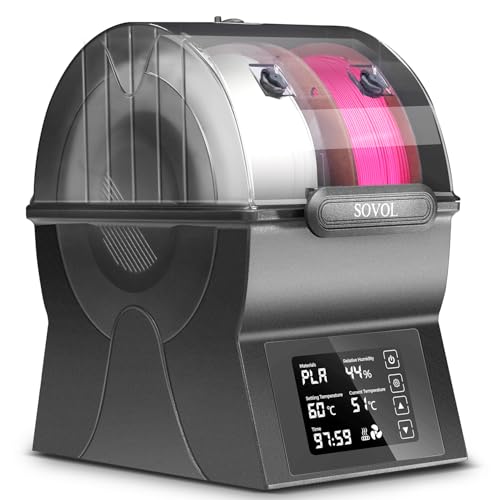
- Dries two 1 kg spools together
- 150W PTC heating with 40–70°C range
- Improved seal protects powered-off filament
Best For: Hobbyists needing drying plus moisture-resistant storage
Best High-Capacity Engineering-Filament Dryer
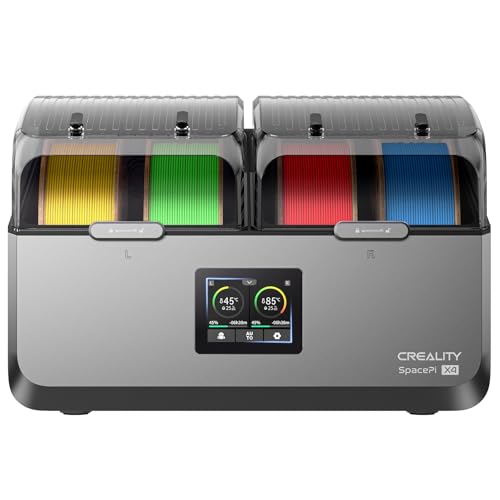
- Dries and feeds four spools
- Independent dual-chamber temperature control
- Reaches up to 85°C for engineering filaments
Best For: Advanced multi-printer hobbyists and high-temperature materials
Best for Multi-Spool Printing – SUNLU S4 3D Printer Filament Dryer
For hobbyists who print with several materials or run multiple printers, the SUNLU S4 is a high-capacity option among filament dryers for hobbyists. It holds up to four 1 kg spools, supports drying while printing, and offers broad temperature and timer controls.
Best For: High-volume hobbyists who need four-spool capacity, multiple filament outlets, and support for materials from PLA and PETG to nylon and PC.
Pros:
- Holds up to four 1 kg spools and includes eight filament exit holes.
- Three circulation fans and 360-degree surround heating promote more even drying.
- 350W PTC heating, 35–70°C temperature control, and a 0–99-hour timer.
- Supports 1.75mm, 2.85mm, and 3.00mm filament diameters.
Cons:
- Its 460 × 220 × 310mm exterior makes it relatively large for a hobby workspace.
- At 4kg, it is less convenient to move than smaller dryers.
The S4 is the strongest fit when capacity and flexibility matter more than a compact footprint. Its multiple outlets and broad material compatibility make it particularly practical for multi-printer setups.
Best for Sealed Storage – Creality Space Pi X4 Filament Dryer
The Creality Space Pi X4 combines active drying with sealed storage, making it a compelling choice among filament dryers for hobbyists who want to reduce moisture reabsorption. Its dual chambers can hold four standard spools or two larger 2 kg spools.
Best For: Hobbyists who want high capacity, independent heating chambers, and humidity-conscious storage during printing pauses.
Pros:
- Holds four standard 1 kg spools or two 2 kg spools.
- Dual independent 200W heating chambers reach up to 85°C.
- Silicone-sealed storage helps maintain a dry environment between printing sessions.
- Touch controls and an illuminated window support convenient monitoring.
Cons:
- The supplied notes do not specify the unit’s external dimensions.
- Its four-spool capacity may be more than needed for occasional single-spool printing.
Choose the Space Pi X4 if storage is as important as drying. The sealed enclosure and high-temperature capability give it a broader role than a basic dryer, especially for users working with advanced materials.
Best All-Around Compact Pick – SUNLU Filament Dryer S2
The SUNLU S2 is a straightforward option for hobbyists who need to dry and feed filament from one unit. As filament dryers for hobbyists go, it balances a relatively manageable size with adjustable 35–70°C temperatures, a 0–99-hour timer, and support for common filament diameters.
Best For: Everyday hobby printing with PLA, PETG, TPU, ABS, and similar materials, especially in humid locations.
Pros:
- Can dry filament while it serves as a spool holder.
- Adjustable temperature from 35–70°C and drying time from 0–99 hours.
- Built-in spindle rotates the filament for more even drying.
- Translucent lid allows viewing without opening the dryer.
Cons:
- Its capacity is smaller than four-spool models.
- The supplied notes do not state a specific spool count.
The S2 is a practical middle ground for hobbyists who want simple controls and drying during printing without moving to a large multi-spool machine. Its broad temperature range also makes it more versatile than low-temperature storage boxes.
Best Simple Low-Temperature Option – Comgrow SH01 Filament Dryer Box
The Comgrow SH01 is a simple two-spool dryer and storage box for hobbyists using common materials. Compared with more powerful filament dryers for hobbyists, it focuses on modest 40–50°C heating, sealed storage, and temperature and humidity monitoring.
Best For: Hobbyists who primarily use PLA, PETG, ABS, or silk filament and want basic drying and dry storage for up to two 1 kg spools.
Pros:
- Stores two 1 kg spools and supports 1.75mm and 2.85mm filament.
- Provides real-time temperature and humidity monitoring through a 2-inch LCD.
- Sealed outlet design with silicone cable sheath and Teflon tube helps limit moisture exposure.
- Touch controls allow 40–50°C temperature adjustment and 6–12-hour settings.
Cons:
- Its 50°C maximum is lower than the other listed dryers.
- Drying time is limited to 6–12 hours according to the supplied notes.
- Instructions require opening the sealing hole during drying and closing it afterward.
The SH01 makes sense for users who need basic moisture management rather than high-temperature drying. Its two-spool capacity and monitoring features suit a smaller hobby setup, provided the supported temperature range matches the materials being used.
Best Budget Pick – SUNLU S1 Plus Filament Dryer
For hobbyists seeking filament dryers for hobbyists, the SUNLU S1 Plus is a straightforward option for improving storage and print consistency. Its fan-assisted design helps remove excess moisture, while the LCD shows temperature, time, and humidity at a glance.
Best For: Hobbyist makers who want a compact dryer for common 1.75mm, 2.85mm, and 3.00mm filaments.
Pros:
- Adjustable temperature from 35°C to 55°C.
- Fan design supports faster moisture discharge.
- Works with PLA, PETG, ABS, TPU, Nylon, and PA.
- Can dry filament while printing.
Cons:
- Its 55°C maximum temperature is lower than some high-temperature dryers.
- Capacity is limited to a spool area of approximately 210 × 89 mm.
The S1 Plus emphasizes simple controls, broad filament compatibility, and visible operating data. It is a practical fit for everyday materials and routine hobby printing rather than specialized high-temperature drying.
Best High-Temperature Option – ELEGOO H1 HT Filament Dryer
Among filament dryers for hobbyists, the ELEGOO H1 HT stands out for its 85°C maximum temperature and automatic spool rotation. It is designed to handle everyday materials as well as higher-temperature filaments that need more demanding drying conditions.
Best For: Hobbyists working with PA, PC, and other temperature-sensitive materials alongside PLA, PETG, TPU, ABS, and ASA.
Pros:
- Reaches temperatures up to 85°C.
- Rotates the spool for more even heat exposure.
- Dual automatic vents release humid air and help seal the chamber afterward.
- Dedicated bypass outlet supports TPU and fiber-reinforced materials.
Cons:
- At 5.06 pounds, it is less lightweight than simpler dryer boxes.
- The supplied notes do not specify capacity or drying-time controls.
The H1 HT is a versatile choice when a hobbyist needs higher heat and more controlled moisture management. Its open compatibility also makes it suitable for mixed-printer setups without requiring a proprietary ecosystem.
Best for Multiple Spools – Comgrow SH03 Four-Spool Dryer
For makers comparing filament dryers for hobbyists, the Comgrow SH03 is built around high capacity and flexible control. Its two independent chambers can hold up to four 1KG spools, with separate temperature controls for drying different materials at the same time.
Best For: Busy hobbyists who keep several filament types ready and want simultaneous, independently controlled drying.
Pros:
- Holds up to four 1KG spools across two independent chambers.
- Each chamber has separate temperature control and on/off operation.
- Adjustable 45°C–85°C range with 360° hot-air circulation.
- Automatic drying mode and multiple temperature, fan, and overheat protections.
Cons:
- Its large multi-spool design is likely less compact than single-spool dryers.
- The extensive controls may be more than needed for occasional users.
- The supplied notes do not provide full physical dimensions.
The SH03 is aimed at capacity-focused workflows rather than minimal setups. Independent chambers, long operation times of up to 98 hours, and automatic humidity-based drying make it particularly useful for organized, multi-material printing stations.
Best Dual-Spool Touchscreen Dryer – Space Pi Plus
For hobbyists comparing filament dryers for hobbyists, the CREALITY Space Pi Plus stands out when you need to dry two 1 kg spools at once. Its dual 160W PTC heating system, 360° hot-air circulation, and touchscreen controls are designed for even heating and straightforward setup.
Best For: Hobbyists who run two printers or regularly work with a broad mix of standard and composite filaments.
Pros:
- Holds and dries two 1 kg spools simultaneously.
- Uses double PTC heating and 360° hot-air circulation for more uniform warming.
- Offers one-key settings for 12 filament types, with adjustable temperatures from 45°C to 70°C.
- Includes a 4-inch LCD touchscreen and support for 1.75 mm and 2.85 mm filament.
Cons:
- Its 70°C maximum temperature may be limiting for some higher-temperature engineering filaments.
- The larger dual-spool design may take more workspace than a single-spool dryer.
The Space Pi Plus is a feature-rich choice for hobbyists who value capacity and easy controls. Its presets and dual-spool layout make it especially practical for routine multi-material printing.
Best Sealed Storage Design – Sovol SH02
The Sovol SH02 is a practical option among filament dryers for hobbyists who want both active drying and passive moisture protection. It accommodates two 1 kg spools, uses a 150W PTC heater, and has a revised seal intended to protect filament even when the unit is switched off.
Best For: Hobbyists who want a two-spool dryer that can also serve as a sealed storage box between prints.
Pros:
- Dries two 1 kg spools simultaneously and includes two filament outlet holes.
- Reaches 50°C in about 7 minutes and 70°C in about 25 minutes according to the supplied specifications.
- Provides one-key settings for nine filament types with a selectable range of 40°C to 70°C.
- Improved sealing helps protect filament from moisture and dirt when powered off.
Cons:
- Desiccant bags are not included.
- The 70°C maximum temperature may not suit every high-temperature material.
- The supplied details mention a touchscreen as an item highlight but do not describe its size or interface.
Choose the SH02 if storage protection matters as much as drying. Its combination of dual-spool capacity, quick PTC heating, and stronger sealing gives hobbyists a useful all-in-one workflow.
Best High-Capacity Engineering-Filament Dryer – Space Pi X4
For hobbyists seeking filament dryers for hobbyists with maximum capacity, the Creality Space Pi X4 can dry and feed four spools at the same time. Its two independently controlled chambers, dual 200W PTC heaters, and 85°C maximum temperature make it the most capable option here for larger setups and demanding materials.
Best For: Advanced hobbyists running several printers or drying engineering filaments such as PA, PAHT, and PC.
Pros:
- Holds four spools and supports drying and printing on four printers simultaneously.
- Dual chambers allow two filament types to be dried at different temperatures.
- Dual 200W PTC heaters provide a maximum temperature of 85°C.
- Single-chamber operation can save up to 40% energy compared with using both chambers.
Cons:
- Its four-spool capacity may be excessive for occasional or single-printer users.
- Other brands’ plastic trays should be checked for heat resistance.
- The supplied notes recommend using Creality high-quality RFID filament with plastic trays.
The Space Pi X4 is best viewed as a high-capacity workstation rather than a basic hobby dryer. Independent chamber control and the 85°C ceiling provide flexibility, while the single-chamber mode helps avoid running unnecessary capacity.
How We Picked the Best Filament Dryers for Hobbyists
We focused on features that matter in a home workshop rather than headline specifications alone. Our comparison considers spool capacity, usable temperature range, heating consistency, controls, sealing and storage design, noise, portability, and whether filament can feed directly from the dryer while printing. We also included options for different workloads, from occasional PLA users to hobbyists running several spools or higher-temperature materials.
Temperature claims should be treated as a starting point, since actual results depend on spool material, ambient humidity, airflow, and how evenly heat reaches the filament. A dryer with clear controls and stable operation is generally more useful than one with a high maximum temperature but limited practical adjustment.
Quick Comparison
| Type | Best for | Main advantage | Potential trade-off |
|---|---|---|---|
| Single-spool dryer | Occasional printing | Compact and usually simpler to operate | Limited capacity |
| Two-spool dryer | Regular hobby printing | Good balance of capacity and footprint | May require careful spool spacing |
| Four-spool dryer | Multiple printers or frequent users | Dries and stores more filament at once | Larger and potentially more power-hungry |
| High-temperature model | ABS, ASA, and other moisture-sensitive materials | More drying flexibility | Usually costs more and needs closer monitoring |
Key Buying Factors for Filament Dryers for Hobbyists
Capacity and Footprint
Choose capacity based on how you actually print. A single-spool unit is easier to place beside a printer, while four-spool models suit users who rotate materials or operate several machines. Check the stated spool dimensions as well as the number of spools.
Temperature Range and Control
PLA and PETG typically need different drying approaches, while TPU, ABS, and ASA may benefit from higher temperatures. Look for adjustable settings, a readable display, and a timer. Do not assume the maximum setting is appropriate for every filament.
Printing Directly from the Dryer
A sealed path, outlet port, or spool-holder design can let you print while the filament remains warm and protected. This is especially useful in humid rooms, but the feed path should be smooth enough not to add drag to the extruder.
Storage and Moisture Management
Drying is only half the job. A dependable lid or enclosure helps prevent the spool from reabsorbing moisture after treatment. For long-term storage, consider using the dryer with desiccant when supported.
Who Should Buy Which Filament Dryers for Hobbyists?
Choose a compact single-spool model if you print occasionally, have limited bench space, or mainly use PLA and PETG. Choose a two-spool dryer if you want a versatile everyday option without the footprint of a large cabinet. Choose a four-spool model if you frequently change materials, run multiple printers, or want to prepare several spools in one cycle. Choose a higher-temperature dryer if your routine includes ABS, ASA, TPU, or other materials that demand more careful moisture control.
Before buying, confirm the unit’s spool compatibility, power requirements, temperature settings, and available space. The best option is the one that matches your materials and printing habits—not necessarily the model with the largest capacity or highest advertised temperature.