Wireless video receivers with HDMI make it easier to send video from a laptop, camera, streaming device, or media player to a distant display without running long HDMI cables.
This roundup compares 10 options with different transmission ranges, receiver counts, output capabilities, and installation features, so you can choose a setup that fits your room, office, classroom, or entertainment system.
Best 10 Wireless Video Receivers with Hdmi Picks for 2026
Best Multi-Screen Kit
G9R Pro 1TX + 4RX Wireless HDMI

- Drives up to four displays simultaneously
- 1080p at 60Hz with dual-band transmission
- Includes USB-C-to-HDMI adapter
Best For: Multi-display presentations and commercial spaces
Best Long-Range Value

- Up to 328 feet in open areas
- 1080p/60Hz output with 4K decoding
- Includes Micro and Mini HDMI adapters
Best For: Portable presentations and outdoor viewing
Best Dual-Display Bundle

- Feeds two displays at the same time
- 1080p/60Hz playback with 4K decoding
- Dual antennas and included HDMI adapters
Best For: Two-screen home, classroom, and meeting-room setups
Best for IR Control

- Up to 820 feet in open-field conditions
- Loop-out supports a local monitoring display
- IR support enables remote source control
Best For: Long-range setups needing remote control and loop-out
Long-Range Plug-and-Play Pick

- Up to 328 feet/100 meters of wireless transmission
- Plug-and-play operation with no Wi-Fi, app, or Bluetooth
- 1080p/60Hz output with 4K decoding
Best For: Simple home, classroom, and office HDMI connections
Professional Monitoring Pick
1300-Foot Wireless HDMI System

- Up to 1300 feet in an open field
- 1080p/60Hz video with stated 0.05-second latency
- Loop-out, dual HDMI output, and IR control
Best For: Remote camera, event, and multi-screen monitoring
Multi-Display Pick
VENTION 393-Foot HDMI Extender Kit

- Supports expansion to multiple HDMI displays
- 393-foot/120-meter rated transmission range
- LED status indicators and heat-control design
Best For: Multi-screen presentations, classrooms, offices, and venues
Best for Multi-Viewer Production
7-Inch Monitor Wireless HDMI System
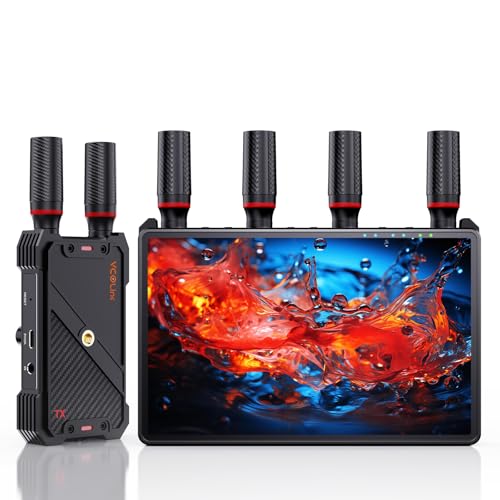
- Built-in 7-inch screen with HDMI output
- 1080p/60Hz transmission up to 1,312 feet line of sight
- Supports one transmitter with up to five receivers
Best For: Film crews, live production, and on-set monitoring
Best Portable Plug-and-Play Pick
165-Foot Wireless HDMI Extender

- Pre-paired setup needs no apps, drivers, or network
- 4K decoding with 1080p/60Hz output
- Includes micro and mini HDMI adapters
Best For: Presentations, classrooms, and home entertainment
Best for Long-Range Coverage

- Claimed 360-foot open-space transmission range
- 4K decoding with 1080p/60Hz output
- Supports up to eight transmitters per receiver
Best For: Large spaces, events, and multi-source installations
Best Multi-Screen Kit – G9R Pro 1TX + 4RX Wireless HDMI
If you need wireless video receivers with HDMI for several displays, the G9R Pro stands out with one transmitter and four receivers. It can send 1080p video at 60Hz to four TVs or monitors simultaneously, with pre-paired plug-and-play setup and no Wi-Fi or Bluetooth requirement.
Best For: Conference rooms, classrooms, churches, restaurants, and other spaces needing synchronized content on multiple screens.
Pros:
- Includes four receivers for simultaneous multi-screen expansion.
- Supports 1080p at 60Hz with claimed ultra-low latency.
- Dual-band 2.4GHz/5.8GHz transmission and included USB-C-to-HDMI adapter.
Cons:
- The transmitter must connect to an HDMI-output source, not directly to a TV.
- Transmission through walls is limited to about 50 feet, according to the notes.
- The transmitter supports 1080p output only, despite receiver 4K decoding support.
This is a strong choice when the priority is driving several displays from one source. Confirm that the source can output 1080p and that each unit has a stable 5V/1A power supply.
Best Long-Range Value – 328ft Wireless HDMI Extender
This wireless HDMI transmitter and receiver kit is a practical option among wireless video receivers with HDMI when range and portability matter. It supports 1080p/60Hz output, 4K decoding, dual-band transmission, and a claimed open-area range of up to 328 feet.
Best For: Presenters, teachers, event planners, home-theater users, and outdoor movie setups.
Pros:
- Claims up to 328 feet outdoors and 165 feet indoors.
- Supports duplicate and extended display modes.
- Compact design includes Micro HDMI and Mini HDMI adapters.
- Plug-and-play operation requires no app, Bluetooth, or Wi-Fi connection.
Cons:
- Walls and obstacles can reduce the stated range and transmission speed.
- Both transmitter and receiver require separate power.
- 1080p is the maximum stated output resolution.
Choose this model if you want a lightweight wireless setup with broad source compatibility and long claimed line-of-sight range. For indoor installations, plan around the shorter range expected through walls.
Best Dual-Display Bundle – 1TX + 2RX Wireless HDMI
For buyers comparing wireless video receivers with HDMI for two screens, this bundle includes one transmitter and two receivers. It supports simultaneous 1080p/60Hz playback, 4K decoding, dual-band transmission, and point-to-point connectivity without software or a traditional Wi-Fi network.
Best For: Home theaters, meeting rooms, classrooms, churches, bars, restaurants, and two-screen presentations.
Pros:
- Sends video and audio to two displays simultaneously.
- Supports 1080p/60Hz playback and claims low-latency transmission.
- Dual antennas and 2.4GHz/5GHz bands support stable connections.
- Includes Micro HDMI and Mini HDMI adapters for broader compatibility.
Cons:
- Through-wall range is listed at about 100 feet, shorter than the 500-foot open-area claim.
- TV-to-TV transmission is not supported.
- Each transmitter and receiver needs an independent 5V/1A-or-higher USB power supply.
This kit offers a useful middle ground between a single-display extender and a larger multi-receiver system. It is especially suitable when two displays need the same source without running long HDMI cables.
Best for IR Control – 820ft Wireless HDMI Extender
This wireless HDMI extender is a compelling option among wireless video receivers with HDMI for long open-area runs. It supports 1080p at 60Hz, includes transmitter-side loop-out for local monitoring, and adds IR support so compatible source devices can be controlled from the receiver location.
Best For: Conference rooms, churches, home entertainment, DSLR setups, projectors, and installations needing remote source control.
Pros:
- Claims up to 820 feet of open-field transmission for one transmitter and one receiver.
- Transmitter loop-out allows a local display alongside the remote screen.
- IR cables support remote control of the HDMI source from the secondary display.
- Supports up to four receivers, with optional expansion.
Cons:
- Walls, brick, and glass can significantly reduce signal coverage.
- The stated range decreases as additional receivers are added.
- It supports Full HD 1080p rather than 4K output.
This model is best when remote-control functionality and local monitoring are more important than 4K resolution. Its long line-of-sight claim is useful for larger venues, but installation conditions will strongly affect actual range.
Long-Range Plug-and-Play Pick – 328-Foot Wireless HDMI Kit
If you need wireless video receivers with HDMI for a straightforward home, classroom, or office setup, this transmitter-and-receiver kit emphasizes fast installation and long-range coverage. It supports 1080p at 60Hz, requires no Wi-Fi, app, or Bluetooth, and can connect compatible laptops, cameras, TV boxes, and other HDMI sources to a larger display.
Best For: Users seeking a simple point-to-point wireless HDMI connection for presentations, home theater viewing, or classroom use.
Pros:
- Wireless range is rated up to 328 feet/100 meters in suitable conditions.
- Plug-and-play setup can establish a connection in under 10 seconds.
- Supports 1080p/60Hz video and audio, with 4K decoding and backward compatibility.
- Supports screen mirroring and extension from several HDMI-equipped source devices.
Cons:
- Both the transmitter and receiver require power through the included USB-to-USB-C cables.
- Walls and other obstacles can reduce transmission distance and speed.
- Phone and tablet use requires a device with HDMI signal output, with listed compatibility limitations.
This is a practical choice when easy setup matters more than advanced multi-receiver features. Its 1080p output and broad source compatibility suit everyday streaming and presentations, provided you can supply power to both units and maintain a reasonably clear signal path.
Professional Monitoring Pick – 1300-Foot Wireless HDMI System
Among wireless video receivers with HDMI, this system stands out for its extended open-field range, low stated latency, and monitoring-friendly outputs. It transmits 1080p video at up to 60Hz, includes transmitter loop-out, provides dual HDMI output on the receiver, and supports IR control for compatible source devices.
Best For: Camera operators, event teams, and users who need remote monitoring, flexible power options, or more than one display.
Pros:
- Rated for transmission up to 1,300 feet in an unobstructed open field.
- Supports 1080p/60Hz with a stated 0.05-second delay.
- Transmitter loop-out and receiver dual HDMI output support local and multi-screen monitoring.
- Can use USB-C power, adapters, or compatible NP-F series batteries.
Cons:
- Walls, metal, brick, and glass can substantially reduce signal coverage.
- Batteries are not included.
- Adding more receivers can reduce the available transmission distance.
This kit offers more production-oriented flexibility than a basic wireless HDMI pair. Its loop-out, IR support, dual receiver outputs, and varied power options are useful for monitoring workflows, although the headline range depends heavily on an open, interference-free environment.
Multi-Display Pick – VENTION 393-Foot HDMI Extender Kit
For buyers comparing wireless video receivers with HDMI for several screens, the VENTION kit focuses on multi-display expansion and easier troubleshooting. Its LED indicators show connection and power status, while the system supports 1080p at 60fps, 4K decoding, and transmission rated up to 393 feet/120 meters in suitable conditions.
Best For: Offices, venues, classrooms, and homes that need to distribute one HDMI source to multiple compatible displays.
Pros:
- Supports output to multiple displays, with the supplied configuration including one transmitter and two receivers.
- Rated for transmission up to 393 feet/120 meters under favorable conditions.
- LED indicators provide real-time connection, signal, output, and power information.
- Includes thermal design features and a 24-month replacement warranty promise.
Cons:
- Each unit needs a stable power source meeting the stated 5V/2A minimum.
- Walls and other obstacles can reduce range; thick walls should be avoided.
- Smartphone and tablet use requires HDMI output, and some HDMI ports may not provide enough power.
This is the strongest fit here for distributing presentations, video, or other HDMI content across several screens. The LED feedback and heat-control design are useful for longer sessions, but planning for external USB power and a clear signal path is essential.
Best for Multi-Viewer Production – 7-Inch Monitor Wireless HDMI System
This is a feature-rich option among wireless video receivers with HDMI, combining a built-in 7-inch monitoring screen with HDMI output and long-range 1080p transmission. It is designed for camera work, live production, and situations where several viewers need the same feed.
Best For: Film crews, live-streaming setups, studios, and on-set monitoring.
Pros:
- Built-in 7-inch HD screen, HDMI output, headphone jack, and adjustable brightness and volume.
- Transmits 1080p at 60Hz up to 1,312 feet line of sight with less than 0.05-second latency.
- One transmitter can connect with up to five receivers for multi-viewer collaboration.
- Includes HDMI loop out, IR remote control, flexible power options, and 1/4-inch mounting.
Cons:
- The HDMI cable needed for external display output is not included.
- Smartphone and tablet use requires a Type-C-to-HDMI cable.
- The extensive production features may be more than needed for basic home viewing.
Choose this model when integrated monitoring and expandable receiver support matter more than keeping the setup minimal. Its screen, loop out, and mounting options make it particularly practical for organized production workflows.
Best Portable Plug-and-Play Pick – 165-Foot Wireless HDMI Extender
For straightforward home, office, or classroom use, this compact kit is one of the simpler wireless video receivers with HDMI. The pre-paired transmitter and receiver support 4K decoding while delivering 1080p at 60Hz, without requiring drivers, apps, or a network connection.
Best For: Presentations, home entertainment, classrooms, and portable display setups.
Pros:
- Pre-paired plug-and-play design requires no drivers, apps, or Wi-Fi network.
- Supports up to 165 feet outdoors and up to 100 feet indoors under stated conditions.
- Provides 4K decoding with 1080p/60Hz output and mirror or extended display modes.
- Includes micro HDMI and mini HDMI adapters for broader device compatibility.
Cons:
- Walls, floors, ceilings, and other obstacles can reduce the transmission range.
- It outputs at 1080p rather than native 4K.
- The kit uses separate USB power cables for the transmitter and receiver.
This is a sensible choice if convenience and portability are priorities. It offers useful display modes and broad compatibility, while its range is better suited to typical rooms and open indoor layouts than very large installations.
Best for Long-Range Coverage – 360-Foot Dual-Band HDMI Kit
This long-range kit stands out among wireless video receivers with HDMI for its claimed 360-foot open-space reach, dual-band transmission, and status display. It outputs 1080p at 60Hz, supports mirror and extend modes, and is designed for larger homes, offices, events, and other demanding environments.
Best For: Large spaces, events, conferences, classrooms, and home theaters.
Pros:
- Claims up to 360 feet in open spaces and 165 feet indoors, depending on obstacles.
- Uses 2.4G and 5.8G dual-band transmission with a cooling design intended to improve stability.
- Supports 4K decoding, 1080p/60Hz output, near-zero-latency operation, and mirror or extend modes.
- One receiver can connect with up to eight transmitters, and up to three sets can operate simultaneously.
Cons:
- Walls can reduce the stated transmission distance and speed.
- The system decodes 4K but outputs at 1080p.
- The supplied notes do not specify the full included accessory list or exact device limitations.
Consider this model when coverage, multi-source flexibility, and status visibility are more important than the smallest possible footprint. Its claimed range and multi-transmitter support make it a strong fit for larger or more structured installations.
How We Picked the Best Wireless Video Receivers with Hdmi
We focused on the specifications that most affect real-world use: supported resolution, claimed transmission distance, wireless-band support, latency, receiver capacity, loop-out functionality, and setup requirements. We also considered whether each kit is designed for one display or can distribute a source to multiple screens.
Because wireless range claims are measured in open conditions, walls, furniture, signal interference, and the source and display hardware can reduce performance. The best choice is therefore the one whose capabilities match your environment rather than simply the model with the longest advertised range.
Quick Comparison
- For simple room-to-room use: Choose a plug-and-play 1080p kit with a moderate range and a single transmitter and receiver.
- For multiple displays: Look for kits supporting two or more receivers, such as the models designed for one-to-four, one-to-five, or up to six receivers.
- For longer installations: Prioritize dual-band operation, clear status displays, and a strong line of sight.
- For source monitoring: A receiver with HDMI loop-out can pass the signal to a nearby display while transmitting it elsewhere.
- For newer equipment: Check whether “4K” means 4K input decoding only or genuine 4K output; several products in this category output at 1080p.
Key Buying Factors for Wireless Video Receivers with Hdmi
Resolution and Compatibility
Confirm the output resolution before buying. Many wireless HDMI systems accept or decode a 4K source but deliver 1080p to the receiving display. Check refresh-rate limits, HDMI version requirements, HDCP compatibility, and whether your source uses standard HDMI.
Range and Signal Conditions
Advertised distances can vary widely, from roughly 165 feet to more than 1,000 feet. Longer-range systems are most useful with a clear path and minimal interference. For apartments, offices, or installations with several walls, treat maximum range as an optimistic reference rather than a guarantee.
Latency and Reliability
Low delay matters for gaming, live camera monitoring, presentations, and interactive demonstrations. For movies and ordinary signage, reliability and stable image quality may matter more than achieving the lowest quoted latency.
Receiver Count and Expansion
If you need to show one source on several screens, select a kit built for multiple receivers. Verify whether extra receivers are included, sold separately, or limited by the transmitter’s pairing capacity.
Installation and Controls
Plug-and-play pairing, LED displays, heat management, remote controls, and loop-out ports can simplify setup. Also check power requirements: most units need USB or wall power at both the transmitter and receiver locations.
Who Should Buy Which Wireless Video Receivers with Hdmi?
Home users and renters should favor compact 1080p kits that are easy to move and do not require permanent cable installation. Businesses and classrooms may benefit from multi-receiver systems for sharing one presentation source with several displays. Event, signage, and production users should prioritize long-range stability, loop-out, status indicators, and low latency. Gamers and live-video users should verify measured delay and output behavior before relying on any advertised specification.
Before ordering, measure the actual distance between devices, count walls and obstructions, confirm every HDMI device’s resolution, and decide whether you need one display or a scalable multi-screen system.