A heated chamber can make a major difference when printing demanding materials such as ABS, ASA, nylon, and polycarbonate. By keeping the surrounding air warm and stable, it helps reduce warping, layer separation, and other temperature-related failures.
We compared 10 enclosed 3D printers across chamber heating, build volume, tool-changing or multicolor capability, speed, automation, filtration, and overall practicality. The right choice depends on your materials, print size, workflow, and budget.
Best 10 3d Printer with Heated Chamber Picks for 2026
Best Industrial Multicolor Pick

- 65°C active chamber for engineering materials
- Four independent extruders for clean multicolor printing
- HEPA13 filtration and 600mm/s printing
Best For: Engineering materials and high-throughput multicolor work
Best Ready-to-Use Enclosed Pick

- Enclosed design for advanced filaments
- Automatic bed leveling and 15-minute setup
- Up to 500mm/s; optional 16-color printing
Best For: Hobbyists prioritizing convenience and speed
Best Large-Format Heated Chamber
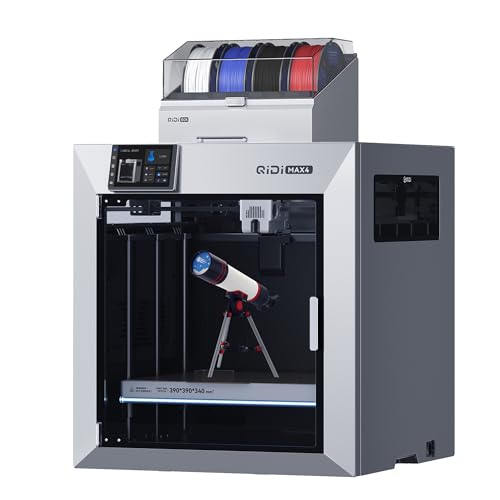
- 390 × 390 × 340mm build volume
- 65°C chamber for high-temperature materials
- 800mm/s speed with AI failure monitoring
Best For: Large prototypes and demanding industrial materials
Best Reliable Enclosed Choice

- Active-heated chamber with automatic ventilation
- Fully assembled with automatic calibration
- CoreXY design and strong Prusa support
Best For: Reliable home, studio, and business printing
Best High-Temperature Workhorse

- 65°C actively heated chamber and 370°C nozzle
- Large 12 x 12 x 11-inch build volume
- Supports PPS-CF, PPA, ABS, ASA, PC, PA, and more
Best For: Large engineering prints and high-temperature materials
Best for Multi-Color Engineering Prints

- Four independent toolheads for color and material changes
- 65°C heated chamber and 120°C heated bed
- HEPA 13 and activated carbon filtration
Best For: Low-waste multi-color prototypes and engineering parts
Best Plug-and-Play Multicolor Option

- Includes CFS for four-color printing, expandable to 16 colors
- 600 mm/s speed with automatic leveling and AI camera
- Pre-assembled and supports PLA, PETG, ABS, and PLA-CF
Best For: Fast, convenient multicolor printing for makers
Best Industrial Multimaterial Pick

- 65°C actively heated chamber
- Four preheated toolheads
- 320°C hardened nozzle
Best For: Engineering prototypes and production-oriented multimaterial parts
Best High-Speed Color Value

- Four-color printing included
- Up to 600mm/s speed
- 49-point auto leveling
Best For: Home, school, and makerspace multicolor printing
Best Fast Toolchanger Workflow

- Five-second tool changes
- 270mm cube CoreXY volume
- Supports rigid and flexible materials
Best For: Workshops and makers seeking low-waste multimaterial printing
Best Industrial Multicolor Pick – Creator 5 Pro
For demanding users seeking a 3d printer with heated chamber capability, the FLASHFORGE Creator 5 Pro combines a 65°C active chamber with four independent extruders. Its sealed build area, high speed, and engineering-material support make it suited to more controlled, production-oriented printing.
Best For: Engineering-grade materials, multicolor production, and users who want active chamber heating with enclosed air filtration.
Pros:
- 65°C active heated chamber helps reduce warping with ABS, ASA, PC, and Nylon.
- Four independent extruders support multicolor and multimaterial printing without shared-nozzle color mixing.
- CoreXY architecture, automatic leveling, and speeds up to 600mm/s support high-throughput workflows.
- Sealed enclosure and HEPA13 filtration help manage particles and odors.
Cons:
- Its industrial feature set may be more than casual users need.
- The supplied notes do not specify the exact maximum build dimensions beyond the listed 256mm³ build-volume figure.
The Creator 5 Pro stands out when active temperature control and clean, separated multicolor output matter more than simplicity. It is a strong fit for advanced workshops, offices, and educational environments.
Best Ready-to-Use Enclosed Pick – Bambu Lab P1S
The Bambu Lab P1S is a practical enclosed FDM option for buyers who want quick setup and automated bed leveling. While it does not list an active heated chamber, its enclosed design improves performance with several advanced filaments and it can expand to multicolor printing with the optional AMS.
Best For: Beginners and hobbyists who want a fast, enclosed printer with a simple setup and optional multicolor capability.
Pros:
- Fully enclosed design supports printing with advanced filaments.
- Automatic bed leveling helps simplify setup and improve print consistency.
- Up to 500mm/s printing speed and 20,000mm/s² acceleration enable quick output.
- Can support up to 16 colors when connected to a Bambu Lab AMS.
Cons:
- It is not described as having an active heated chamber.
- AMS is required for multicolor printing and is not included in the supplied product description.
- Carbon- and glass-fiber-reinforced polymers are not recommended.
The P1S is better viewed as an enclosed alternative than as a dedicated 3d printer with heated chamber. Its strengths are convenience, speed, and an approachable ready-to-use design.
Best Large-Format Heated Chamber – QIDI Max4 Combo
The QIDI Max4 Combo is a compelling 3d printer with heated chamber for large industrial parts, molds, and prototypes. Its 390 × 390 × 340mm build volume and 65°C active chamber support high-temperature materials, while closed-loop motors and AI monitoring add control for demanding jobs.
Best For: Large-format prototypes and professionals printing ABS-CF, PC, PPS-CF, and other demanding materials.
Pros:
- Large 390 × 390 × 340mm build volume accommodates substantial parts in one piece.
- 65°C active chamber and full-surface heated bed help support high-temperature printing.
- Closed-loop X/Y motors, 800mm/s speed, and 30,000mm/s² acceleration target fast, precise output.
- AI camera can detect failures and pause printing to help reduce wasted material.
Cons:
- At 120 pounds, it is a substantial printer to place and move.
- The Polar Cooler is sold separately.
- QIDI BOX is required for the expandable 16-color and multimaterial workflow.
Choose the Max4 Combo when build size is a priority alongside chamber heating. It offers an unusually broad material and feature set, but its accessories and large footprint should be included in the buying decision.
Best Reliable Enclosed Choice – Prusa CORE One+
The Original Prusa CORE One+ combines a fully enclosed active-heated chamber with a compact CoreXY platform. Automatic ventilation, calibration, tested print profiles, and a ready-to-print setup make it a practical 3d printer with heated chamber for users who value repeatable operation across materials such as ASA, PC, and Nylon.
Best For: Home workshops, studios, and businesses seeking reliable enclosed printing with strong support and a straightforward workflow.
Pros:
- Active chamber temperature management helps reduce warping and improve layer adhesion.
- Automatic ventilation adapts airflow for lower- and higher-temperature materials.
- Fully assembled, tested, and automatically calibrated for a quick start.
- Rigid steel construction, Prusa profiles, lifetime technical assistance, and 24/7 support add long-term value.
Cons:
- Its 250 × 220 × 270mm build volume is smaller than the QIDI Max4 Combo.
- The supplied notes do not provide a specific chamber temperature maximum.
- The printer weighs 56.8 pounds and has a relatively tall 28.1-inch product dimension.
The CORE One+ is a balanced choice for buyers who want chamber control without giving up ease of use. Its support ecosystem and ready-to-print approach are particularly useful for repeat workflows.
Best High-Temperature Workhorse – QIDI PLUS4
If you need a 3d printer with heated chamber for larger engineering parts, the QIDI PLUS4 combines a 65°C actively heated chamber with a 370°C hotend and a 12 x 12 x 11-inch build area. Its CoreXY design, high-temperature material support, and reinforced motion components make it suited to demanding prints.
Best For: Professionals, makers, and beginners who want large-format printing with high-temperature filaments such as PPS-CF, PPA, ABS, ASA, PC, and PA.
Pros:
- 65°C active chamber heating with 400W heating power, air circulation, and dual-layer insulation.
- 370°C integrated nozzle supports a broad range of engineering materials.
- Large 12 x 12 x 11-inch build volume and fast CoreXY architecture.
- Includes remote monitoring, a camera, filament detection, and an easy setup workflow.
Cons:
- Its 59.4-pound weight and large footprint require substantial workspace.
- Multi-color printing requires the separately referenced QIDI BOX accessory.
The PLUS4 is a strong choice when chamber temperature, material flexibility, and build size matter more than compactness. Its reinforced bed and dual-motor Z-axis further support consistent, high-precision printing.
Best for Multi-Color Engineering Prints – Flashforge Creator 5 Pro
The Flashforge Creator 5 Pro is a 3d printer with heated chamber designed around multi-material production. Four independent toolheads enable color and material changes without traditional purge waste, while the enclosed 65°C chamber and 120°C heated bed support engineering-grade filaments.
Best For: Users who want fast, automated multi-color or multi-material printing with reduced filament waste and built-in air filtration.
Pros:
- Four independent toolheads support simultaneous multi-color and multi-material printing.
- Dedicated nozzles eliminate the need for conventional purge waste during color changes.
- 65°C heated chamber and 120°C bed support ABS, ASA, PC, and Nylon.
- Automatic calibration, flow compensation, HEPA 13 filtration, and activated carbon filtration simplify operation.
Cons:
- The four-toolhead system and fully enclosed design may be more than needed for basic single-color printing.
- Its approximately 20.35 x 21.06 x 19.5-inch footprint requires dedicated space.
Choose the Creator 5 Pro if efficient color changes and material separation are priorities. It pairs production-oriented speed with automatic setup features and filtration, making it particularly appealing for prototypes and finished parts.
Best Plug-and-Play Multicolor Option – Creality K2 Combo
The Creality K2 Combo is a practical choice for users seeking fast, automated multicolor printing in a ready-to-use package. It includes a CFS unit for up to four colors, offers a 260 x 260 x 260 mm build volume, and supports materials including PLA, PETG, ABS, and carbon-fiber blends.
Best For: Makers who prioritize easy setup, multicolor capability, fast printing, and automated monitoring over a specifically heated-chamber-focused design.
Pros:
- Combo package includes a CFS unit, with expansion potential for up to 16 colors using four CFS units.
- Pre-assembled design, automatic leveling, and an AI camera support a simpler setup.
- Up to 600 mm/s printing speed with a sturdy frame and step-servo motor system.
- Quiet operation, with silent mode and dynamically balanced fans.
Cons:
- The supplied notes do not specify an actively heated chamber temperature.
- Its 260 mm cubed build volume is smaller than the QIDI PLUS4’s stated build area.
- The included CFS supports four colors; reaching 16 colors requires additional CFS units.
The K2 Combo stands out for convenience and color flexibility rather than being the most specialized heated-chamber machine. It is a compelling fit for users who want quick setup, automated calibration, and fast multicolor printing across common and selected composite materials.
Best Industrial Multimaterial Pick – Creator 5 Pro
If you need a 3d printer with heated chamber for demanding engineering materials, the FLASHFORGE Creator 5 Pro stands out with an actively heated 65°C chamber, a 320°C hardened nozzle, and four independent toolheads. Its enclosed CoreXY design is aimed at stronger, flatter, and more consistent large prints.
Best For: Engineering prototypes, production-oriented parts, and users who want fast multimaterial changes without filament purging.
Pros:
- Four preheated toolheads enable rapid material changes.
- Supports engineering materials including PA-CF, PPA-CF, PPS-CF, and more.
- Active chamber heating can improve layer bonding and reduce warping.
- Adaptive airflow helps control prints made with low-temperature filaments.
Cons:
- Its 30.8-pound build and industrial feature set may be more than casual users need.
- The available features may require a larger workspace and more involved setup than a basic printer.
The Creator 5 Pro is the most purpose-built option here for serious engineering work. Its heated chamber and hardened nozzle expand material compatibility, while the toolchanger simplifies mixed-material workflows.
Best High-Speed Color Value – Anycubic Kobra X
The Anycubic Kobra X is a strong choice for users prioritizing native multicolor printing, quick setup, and high speed. It supports four colors out of the box, can expand to 19 colors with additional ACE 2 Pro units, and offers a 260mm cube build volume.
Best For: Home users, schools, and makerspaces that want accessible multicolor printing, remote monitoring, and flexible filament support.
Pros:
- Native four-color printing with expansion potential up to 19 colors.
- Up to 600mm/s printing speed and reduced filament travel paths.
- 49-point auto bed leveling supports consistent first layers.
- Supports PLA, PETG, TPU, PVA, and ASA with a hardened steel nozzle.
Cons:
- It does not list an actively heated chamber, so it is not the best match for shoppers specifically seeking a 3d printer with heated chamber.
- Filament is not included.
- Expanded 19-color printing requires additional ACE 2 Pro units.
The Kobra X is compelling for colorful, fast, and relatively approachable printing, but buyers needing chamber heating for demanding engineering materials should consider a different model.
Best Fast Toolchanger Workflow – Snapmaker U1
The Snapmaker U1 focuses on efficient multicolor and multimaterial production with four independent toolheads and a five-second tool changer. While it is not specified as a 3d printer with heated chamber, its CoreXY platform, 270mm cube build volume, and broad material support make it suited to capable functional prints.
Best For: Makers, workshops, and small businesses that want low-waste toolhead switching, flexible materials, and a large print area.
Pros:
- Four preloaded, preheated toolheads switch in about five seconds.
- Supports rigid, flexible, soluble-support, and engineering materials.
- Automatic calibration, vibration compensation, and extrusion tuning simplify operation.
- 500mm/s CoreXY printing with a 270mm cube build volume.
Cons:
- It does not list an actively heated chamber, limiting its fit for buyers specifically requiring chamber temperature control.
- At 59 pounds, it is the heaviest printer in this selection.
- Its four-toolhead system may be unnecessary for basic single-material projects.
The U1 is an efficient alternative to filament-swapping systems, especially when waste reduction and mixed-material printing matter. Choose it for toolchanger productivity rather than heated-chamber performance.
How We Picked the Best 3d Printer with Heated Chamber
We focused on printers that are enclosed and designed for temperature-sensitive materials, giving extra weight to models with an actively heated chamber or strong thermal management. We also considered build volume, maximum nozzle temperature, print speed, motion system, material compatibility, tool-changing or multicolor features, calibration, monitoring, filtration, and setup requirements.
Because manufacturers use different specifications and chamber-temperature ratings, treat advertised figures as a starting point rather than a guarantee for every filament. Real-world results also depend on the enclosure, ambient temperature, ventilation, slicer settings, and material drying.
Quick Comparison
| Priority | What to look for | Best suited to |
|---|---|---|
| Large, demanding parts | Large build volume and active chamber heating | Functional prototypes, fixtures, and production components |
| Multi-material printing | Independent toolheads or a reliable tool-changing system | Color, support-material, and mixed-material workflows |
| Fast everyday printing | CoreXY motion, automatic calibration, and high acceleration | Frequent home, workshop, and small-business use |
| Easy setup | Pre-assembly, guided calibration, sensors, and remote monitoring | New users and production environments |
Key Buying Factors for a 3d Printer with Heated Chamber
Chamber Temperature and Thermal Control
Check whether the printer has active chamber heating or simply a passive enclosure. Active heating is more useful for large ABS, nylon, and polycarbonate parts because it reduces temperature gradients. Also check whether the heated chamber is available during printing, how it is controlled, and whether the manufacturer specifies a maximum chamber temperature.
Build Volume and Nozzle Temperature
Choose a build area that accommodates your largest expected parts without forcing repeated cuts or assemblies. A hotend rated around 300°C or higher broadens material options, while higher-temperature nozzles may be necessary for advanced polymers. Hardened components are important if you plan to print carbon-fiber or glass-fiber-filled filaments.
Speed, Reliability, and Automation
High advertised speed is useful only when the frame, motion system, cooling, and firmware can maintain quality. Look for automatic bed leveling, input shaping, flow calibration, filament sensors, power-loss recovery, and a rigid CoreXY or comparable platform. A camera and remote controls can also reduce supervision during long jobs.
Toolheads, Filtration, and Workspace Safety
Independent toolheads and tool changers can reduce purge waste and improve support-material control, but they add mechanical and software complexity. For enclosed printers, HEPA or other filtration may help manage particles and odors, although it does not replace suitable ventilation. Follow the manufacturer’s material and safety guidance, particularly with high-temperature polymers.
Who Should Buy Which 3d Printer with Heated Chamber?
Choose a large-format heated-chamber model if you regularly print oversized engineering parts or need more freedom to orient components. Select a multi-tool or multicolor machine if your workflow depends on multiple materials, soluble supports, or frequent color changes. A fast, fully enclosed automated printer is generally the better fit for users who want reliable everyday production with minimal tuning.
For beginners, prioritize guided setup, automatic calibration, dependable profiles, and a manageable maintenance routine over headline speed. Experienced makers should compare chamber control, nozzle temperature, hardened wear parts, drying options, and slicer support before paying extra for advanced tool-changing hardware.