Choosing your first 3D printer can feel complicated, especially when specifications, software, materials, and setup requirements vary so widely. The best beginner-friendly models make the learning curve manageable with reliable calibration, clear controls, and useful safety features.
We compared 10 approachable options across print quality, ease of setup, speed, build volume, connectivity, and overall value. Whether you want a simple machine for a child, a compact desktop printer, or a platform you can grow into, this roundup highlights the most practical starting points.
Best 10 3d Printer for Beginners Picks for 2026
Best Beginner Pick

- Automatic calibration simplifies setup
- Fast, quiet printing with a touchscreen
- Multi-color ready with optional AMS lite
Best For: Beginners, families, and kids seeking easy FDM printing
Best for Speed

- 600mm/s maximum speed
- One-click auto leveling for first-layer setup
- Run-out sensing and power-loss recovery
Best For: Beginners focused on fast prototypes and everyday materials
Best Enclosed Option

- Enclosed design for broader material use
- 500mm/s printing with automatic leveling
- Supports up to 16 colors with optional AMS
Best For: Beginners who want an enclosed printer with upgrade potential
Best Budget-Friendly Starter

- Auto leveling and Z-offset calibration
- 250mm/s maximum printing speed
- Direct drive supports PLA, PETG, and TPU
Best For: New makers printing everyday projects on common filaments
Best Starter Kit

- Fully assembled with filament and software
- Auto-leveling and magnetic build plate
- Compact design with Wi-Fi support
Best For: Kids, classrooms, dorms, and first-time users
Best for Multicolor Printing
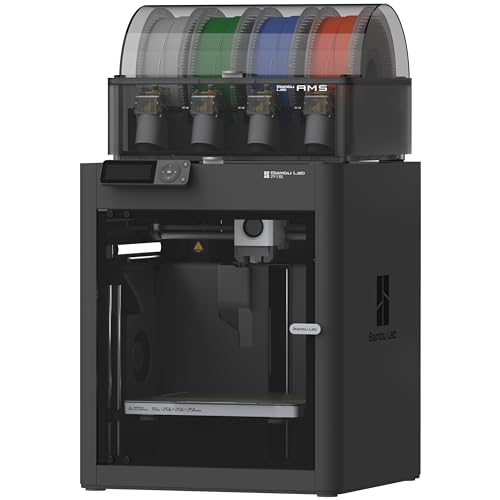
- AMS enables printing with up to 16 colors
- Fast, enclosed printer with auto-leveling
- Setup takes about 15 minutes
Best For: Beginners seeking speed, enclosure, and multicolor projects
Best for STEM Learning
Entina Tina2C Beginner 3D Printer

- Starts printing in as little as eight minutes
- App offers 3,500-plus models and STEM modules
- Wi-Fi, auto-leveling, and quiet compact design
Best For: Families, students, classrooms, and guided home projects
Best for Creative Kids

- Kid-friendly enclosed design with quiet, leveling-free operation
- AI-assisted creation and one-tap app printing
- Includes eight PLA rolls and 12,000+ print-tested models
Best For: Families introducing children to creative 3D printing
Best Connected Starter
Bambu Lab A1 mini with LED Lamp Kit

- Automatic calibration and simple setup for new users
- Connected MakerWorld and Bambu Handy ecosystem
- Includes an LED Lamp Kit for functional décor projects
Best For: Beginners wanting convenient app-connected printing
Best Beginner Pick – Bambu Lab A1
The Bambu Lab A1 is a practical 3d printer for beginners who want an easy, ready-to-use FDM machine with automatic calibration and quiet operation. Its fast printing, simple touchscreen, and quick-swap nozzle reduce the routine setup and maintenance work that can discourage new users.
Best For: Beginners, families, and kids who want straightforward printing with the option to add multi-color capability.
Pros:
- Full-auto calibration handles Z-offset and bed leveling.
- Fast printing with up to 10,000 mm/s² acceleration.
- Quiet operation, a simple touchscreen, and a quick-swap nozzle.
- Supports multi-color printing when paired with AMS lite.
Cons:
- AMS lite is required for multi-color printing and is not included with every configuration.
- The printer weighs 22 pounds and has a relatively large footprint.
The A1 is a strong choice when ease of use matters more than extensive hands-on tuning. Choose the appropriate package if multi-color printing is a priority.
Best for Speed – FLASHFORGE Adventurer 5M
The FLASHFORGE Adventurer 5M is a 3d printer for beginners who want a quick transition from unboxing to printing. One-click auto leveling, a Core XY motion system, and a maximum speed of 600mm/s make it suited to users who value fast results without giving up basic convenience features.
Best For: New users who want high-speed prototyping and support for common materials such as PLA, PETG, and TPU.
Pros:
- Full-auto one-click leveling helps establish a reliable first layer.
- Maximum printing speed of 600mm/s and up to 20,000 mm/s² acceleration.
- Vibration compensation helps reduce ghosting.
- Filament run-out sensing and power-loss recovery can protect longer prints.
Cons:
- The open design is intended for open, well-ventilated environments.
- Some reinforced materials require a 0.6mm nozzle rather than the standard 0.4mm nozzle.
With a 220 x 220 x 220mm print volume and a setup designed to take about 10 minutes, the Adventurer 5M offers a beginner-friendly path to faster printing. Its open frame may be less suitable where enclosure is important.
Best Enclosed Option – Bambu Lab P1S
The Bambu Lab P1S is a 3d printer for beginners who want a ready-to-use machine with an enclosed design and room to grow. It combines automatic bed leveling, a 15-minute setup, and high-speed printing with support for several everyday and more advanced filaments.
Best For: Beginners and growing makers who want an enclosed printer for PLA, PETG, TPU, and other supported materials.
Pros:
- Enclosed body can improve performance with advanced filaments.
- Automatic bed leveling simplifies the printing process.
- Prints at up to 500mm/s with 20,000 mm/s² acceleration.
- Can support up to 16 colors when connected to a Bambu Lab AMS.
Cons:
- The Bambu Lab AMS is required for multi-color or multi-material printing.
- Carbon- and glass-fiber-reinforced polymers are not recommended.
- At 38.9 pounds, it is heavier than the other listed options.
The P1S is a compelling choice for users who prefer an enclosed, fast platform rather than an open-frame beginner printer. Its material guidance should be checked before planning specialized projects.
Best Budget-Friendly Starter – Creality Ender 3 V3 SE
The Creality Ender 3 V3 SE is a beginner-friendly 3d printer for beginners who want quick assembly, automatic leveling, and a direct-drive extruder for common filaments. Its stable motion system and flexible build plate also make routine printing and model removal more approachable.
Best For: New makers printing prototypes, functional parts, and everyday projects with PLA, PETG, or TPU.
Pros:
- CR Touch auto leveling and automatic Z-offset calibration simplify setup.
- Prints at speeds up to 250mm/s.
- Sprite direct-drive extrusion supports PLA, PETG, and TPU.
- Silent mainboard and flexible PC spring steel plate improve everyday usability.
Cons:
- Its maximum speed is lower than the faster 600mm/s-class option in this roundup.
- The open-frame design does not provide an enclosed printing environment.
The Ender 3 V3 SE balances useful automation with a straightforward mechanical design. It is a sensible starting point for users who want reliable basic features and broad support for common flexible and rigid filaments.
Best Starter Kit – TINA2S Mini 3D Printer
The TINA2S is a practical 3d printer for beginners who want to start printing without complicated assembly. It arrives fully assembled and includes PLA filament, a microSD card with model designs and splicing software, auto-leveling, and a flexible magnetic build plate.
Best For: Kids, classrooms, dorms, and first-time users who want a compact, ready-to-use starter kit.
Pros:
- Fully assembled and includes 10 meters of PLA filament plus accessories.
- Auto-leveling, dual Z-axis rails, and a magnetic build plate simplify setup and print removal.
- One-touch filament loading works with 1.75 mm PLA, PLA Pro, and TPU.
- Compact 8.3-by-8.3-by-11.4-inch design with Wi-Fi and broad slicer compatibility.
Cons:
- The 2.4-inch LCD and mini size may feel limiting for larger or more advanced projects.
- Requires the included or a comparable magnetic metal platform plate for the proximity sensor to work properly.
For beginners, the TINA2S emphasizes convenience over expansion. Its included materials and simple controls reduce the initial learning curve, while the compact footprint makes it easy to place at home or in a classroom.
Best for Multicolor Printing – Bambu Lab P1S Combo
The Bambu Lab P1S Combo is a 3d printer for beginners who want an easy starting point with room for ambitious projects. It sets up in about 15 minutes, includes automatic bed leveling, and combines an enclosed printer with an AMS system for multi-color or multi-material printing.
Best For: Beginners who prioritize speed, enclosed printing, and colorful or more advanced filament projects.
Pros:
- Supports multi-color or multi-material printing with up to 16 colors when connected to the AMS.
- High-speed printing reaches up to 500 mm/s with 20,000 mm/s² acceleration.
- Enclosed design supports advanced filaments and helps improve print performance.
- Automatic bed leveling and a setup time of about 15 minutes make it approachable.
Cons:
- At 47.5 pounds, it is substantially larger and heavier than the mini printers in this roundup.
- Carbon- and glass-fiber-reinforced polymers are not recommended.
- AMS connection is required for the advertised multi-color capability.
The P1S Combo offers more capability than a basic beginner machine, particularly for users interested in fast or multi-color prints. Its enclosed 15.31-by-18.03-by-15.31-inch footprint is best suited to a dedicated workspace.
Best for STEM Learning – Entina Tina2C Beginner 3D Printer
The Entina Tina2C is a 3d printer for beginners built around guided learning and quick setup. The Poloprint Cloud app provides AI-powered model search, photo-to-print features, more than 3,500 models, and over 25 creative modules, while auto-leveling and a flexible magnetic plate help simplify everyday printing.
Best For: Families, students, classrooms, and home users who want app-guided STEM activities in a small format.
Pros:
- Fully assembled and designed to start a first print in as little as eight minutes.
- App includes AI tools, more than 3,500 models, and 25-plus creative DIY modules.
- Supports 2.4G Wi-Fi and TF card offline printing, with Windows, macOS, Linux, and Chromebook compatibility.
- Compact, quiet design includes auto-leveling, power-loss recovery, and a flexible magnetic plate.
Cons:
- The 3.9-by-3.9-by-3.9-inch print volume is intended for small projects.
- Its app-centered workflow may be less appealing to users who prefer a more hands-on setup.
The Tina2C is especially approachable for guided experimentation. Its small footprint and learning-focused software make it a strong choice when ease of use, quiet operation, and creative activities matter more than large print capacity.
Best for Creative Kids – AOSEED AI Enclosed 3D Printer
For families seeking a 3d printer for beginners, this enclosed AOSEED model emphasizes simple, kid-friendly operation. One-tap printing, an app with more than 12,000 print-tested models, AI-assisted design tools, and a starter bundle with eight PLA rolls make it easy to begin creating. It prints in a single color at a time, though multicolor designs can be assembled from separate parts.
Best For: Kids and families who want guided, creative toy and STEM projects.
Pros:
- Enclosed, pinch-resistant design with quiet operation and a leveling-free platform.
- AI Doodle, AI MiniMe, voice control, and app-based one-tap printing lower the learning curve.
- Includes eight PLA rolls, tools, a magnetic build plate, and access to 12,000+ models.
- Built-in camera supports smartphone monitoring and time-lapse sharing.
Cons:
- Supports single-color printing only; multicolor projects require separate parts and assembly.
- Its kid-focused features may be more than users need for straightforward adult projects.
With safety-oriented construction, guided software, and plenty of included filament, this is a particularly approachable choice for supervised family use. The enclosed format and creative tools make it more of a home toy-making station than a traditional hobbyist printer.
Best Connected Starter – Bambu Lab A1 mini with LED Lamp Kit
The Bambu Lab A1 mini is a strong 3d printer for beginners who want a compact setup with minimal calibration. Automatic calibration, simple setup, quiet printing, and app-based control help new users get from model selection to finished project with less troubleshooting. The included LED Lamp Kit adds a practical creative use beyond ordinary prints.
Best For: Beginners who want an easy, connected printer for décor, gifts, toys, and lamp projects.
Pros:
- Automatic calibration and straightforward setup simplify the first printing experience.
- MakerWorld provides access to a large library of ready-to-print models.
- Bambu Handy app supports connected print management.
- Included LED Lamp Kit enables functional decorative light projects.
Cons:
- The included lamp projects depend on compatible models and the printer’s supported setup.
- Its compact format is best suited to everyday creative projects rather than very large prints.
The A1 mini focuses on convenience: automatic calibration, a quiet footprint, and an established software ecosystem make it a sensible starting point. The lamp kit also gives beginners an immediate project category to explore after setup.
Best Ready-to-Use Value – Fully Assembled Mini 3D Printer
This fully assembled mini machine is a practical 3d printer for beginners who want to start without construction or complicated setup. One-button auto-leveling, one-touch filament loading, automatic nozzle cleaning, and a supplied SD card make the initial workflow approachable, while the included test filament lets users print immediately.
Best For: First-time users, students, and home printers seeking a complete basic starter kit.
Pros:
- Arrives fully assembled and includes test PLA filament, an SD card, and accessories.
- One-button auto-leveling and automatic nozzle cleaning simplify routine setup.
- Supports printing speeds up to 250 mm/s with stated 0.01 mm precision.
- Includes a PEI heated bed for easier model removal.
Cons:
- The starter bundle includes one roll of filament rather than a larger multi-roll supply.
- Using a 1 kg spool requires printing the included holder file first.
- The supplied notes do not mention an enclosed design or app-based monitoring.
Its strongest advantage is a low-friction start: unpack it, load the supplied filament, and use the automatic controls to begin. The warranty and support coverage add reassurance for newcomers, while the included holder file provides a path to using larger spools later.
How We Picked the Best 3d Printer for Beginners
We focused on the features that matter most when learning 3D printing: dependable first-layer performance, straightforward setup, intuitive software, accessible replacement parts, and useful customer support. Automatic bed leveling and a well-designed filament path can reduce common early frustrations, while an enclosed frame may improve safety and temperature consistency.
We also considered print speed, build volume, connectivity, noise, included accessories, and whether each machine offers room to develop new skills. A beginner printer should be easy to use immediately without being so limited that it becomes obsolete after a few projects.
Quick Comparison
| Best For | What to Prioritize | Recommended Type |
|---|---|---|
| Young children | Enclosure, simple controls, safety | Fully assembled mini printer |
| First adult printer | Auto leveling, reliable software, easy maintenance | Ready-to-use FDM printer |
| Large or functional parts | Build volume, materials, direct drive | Full-size open or enclosed printer |
| Fast prototyping | High motion speed and dependable calibration | Modern high-speed FDM printer |
| Multi-color projects | Automatic material handling and software support | Printer-and-AMS combo |
Key Buying Factors for a 3d Printer for Beginners
Setup and Calibration
Look for automatic bed leveling, guided setup, and a printer that arrives mostly assembled. These features save time and make it easier to understand the basics before troubleshooting mechanical adjustments.
Build Volume and Print Materials
Mini printers are space-efficient and economical, but their smaller beds limit the size of models. A standard desktop printer is more versatile for organizers, toys, replacement parts, and cosplay components. Check the recommended filament types before buying; PLA is the easiest starting material, while PETG and ABS require more control and, in some cases, an enclosure.
Safety and Supervision
For children, an enclosed design, protected moving parts, simple controls, and adult supervision are important. Even beginner-friendly machines have hot nozzles and heated surfaces, so placement and supervision matter as much as the printer’s features.
Software and Connectivity
Wi-Fi, mobile apps, cameras, and cloud libraries can simplify file transfer and monitoring. However, a polished slicer and clear instructions are often more valuable than a long feature list. Confirm that the printer works with common slicers and supports standard file formats.
Who Should Buy Which 3d Printer for Beginners?
Choose a fully assembled mini model if you want the simplest introduction, have limited desk space, or are buying for a child. These printers are convenient for small toys, decorations, and educational projects, though their smaller build areas and lower throughput may eventually feel restrictive.
A standard ready-to-use model is the better all-around choice for adults who want to learn while making a broad range of practical objects. Prioritize automatic leveling and dependable software over headline speed.
Choose a faster full-size printer if you expect to print frequently or make larger parts. For users interested in multiple colors, a printer bundle with an automatic material system can be worthwhile, but it adds cost, filament management, and some extra maintenance.
Finally, budget for filament, spare nozzles, a scraper or removal tool, and a stable, ventilated workspace. The best 3d Printer for Beginners is the one that matches your projects, available space, and willingness to learn—rather than simply the model with the most impressive specifications.