Choosing among the best 3D printers for miniatures depends on more than headline resolution. Resin printers usually capture tiny facial features, armor details, and textures most sharply, while FDM models offer cleaner handling, larger builds, and easier everyday printing.
This roundup compares ten standout options across resin and filament technologies, from beginner-friendly machines to fast, high-resolution printers for serious hobbyists. Consider your preferred materials, workspace, cleanup tolerance, and the scale of miniatures you plan to produce.
Best 10 3d Printers for Miniatures Picks for 2026
Best Detail Value

- 22-micron XY resolution with an 8K monochrome LCD
- Compact build volume for tabletop models
- Supports Lychee, Chitubox, Tango, and open-source software
Best For: Beginners and hobbyists focused on detailed miniatures
Best High-Speed FDM Option

- Up to 500 mm/s printing speed
- Enclosed design with automatic bed leveling
- Optional AMS supports up to 16 colors
Best For: Fast, convenient FDM printing and general model making
Best Smart Resin Printer

- 9K LCD with 18-micron XY resolution
- AI camera and mechanical failure detection
- Wi-Fi transfer and multi-printer cluster support
Best For: Detailed resin miniatures with added automation
Best Stability and Automation

- 14K mono LCD for highly detailed resin prints
- Ball screws and precision rails support stability
- Intelligent leveling and AI-assisted print checks
Best For: Stable, automated resin printing for detailed models
Beginner-Friendly Resin Pick

- 6.6-inch 4K monochrome screen
- Automatic leveling for simpler setup
- Built-in checks and overheat protection
Best For: Beginners printing detailed miniatures
Fast FDM Option

- 10,000 mm/s² acceleration
- Automatic calibration and flow compensation
- Optional multi-color printing with AMS lite
Best For: Beginners wanting fast, quiet FDM printing
High-Detail Resin Choice
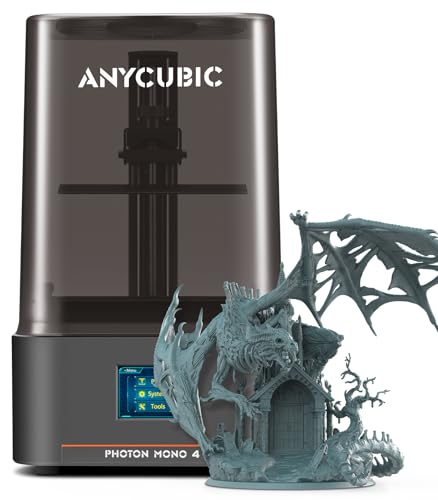
- 7-inch 10K HD screen
- 17 × 17 μm pixel precision
- Power recovery and quick setup
Best For: Users prioritizing fine miniature detail
Best with Extra Features

- Automatic bed leveling simplifies setup
- Up to 600mm/s travel speed
- Supports optional 0.25mm nozzle
Best For: Fast, straightforward FDM miniature printing
Best Detail-Focused Resin Pick

- 10K screen with 17μm XY pixels
- Up to 120mm/h print speed
- Intelligent checks monitor print issues
Best For: High-detail resin miniatures and collectibles
Best Multicolor Smart Pick

- Automatic leveling and calibration
- Optional CFS Lite enables multicolor printing
- AI camera monitors common print failures
Best For: Automated FDM and multicolor miniature projects
Best Detail Value – Phrozen Sonic Mini 8K
For shoppers comparing 3d printers for miniatures, the Phrozen Sonic Mini 8K focuses on fine detail in a compact resin-printer format. Its 22-micron XY resolution, 8K monochrome LCD, and support for popular slicers make it a practical choice for detailed models, miniatures, and action figures.
Best For: Beginners and hobbyists prioritizing miniature detail in a compact resin printer.
Pros:
- 22-micron XY resolution and an 8K monochrome LCD support highly detailed prints.
- Compact 16.5 x 7.2 x 17 cm printing volume suits tabletop models and miniatures.
- Works with open-source software and slicers such as Lychee, Chitubox, and Tango.
Cons:
- Its build volume is more limited than larger-format printers.
- At 22 pounds, it is not especially lightweight for a compact printer.
The Sonic Mini 8K is a strong detail-first option when miniature quality and slicer flexibility matter more than maximum build size.
Best High-Speed FDM Option – Bambu Lab P1S
Among 3d printers for miniatures, the Bambu Lab P1S stands out as a ready-to-use enclosed FDM machine with automatic bed leveling and high stated speeds. It is designed for convenient setup and supports common materials including PLA, PETG, TPU, PVA, PET, ABS, and ASA.
Best For: Makers who want fast, convenient FDM printing for miniature-related projects and general models.
Pros:
- Print speeds up to 500 mm/s and acceleration up to 20,000 mm/s² can reduce waiting time.
- Enclosed design improves print performance with advanced filaments.
- Automatic bed leveling and a stated 15-minute setup simplify operation.
- Optional Bambu Lab AMS enables multi-color or multi-material printing of up to 16 colors.
Cons:
- The multi-color capability requires the separate Bambu Lab AMS.
- Carbon- and glass-fiber-reinforced polymers are not recommended.
- Its 38.9-pound weight and larger footprint require a sturdy workspace.
The P1S is better suited to users who value speed, enclosure, and ease of use in an FDM workflow rather than resin-specific miniature detail.
Best Smart Resin Printer – ELEGOO Mars 5 Ultra
The ELEGOO Mars 5 Ultra is a smart resin option for shoppers seeking 3d printers for miniatures with detailed output and built-in monitoring. Its 9K monochrome LCD, 18-micron XY resolution, AI camera, mechanical sensor, and Wi-Fi features add convenience to the printing process.
Best For: Resin-printing hobbyists who want fine detail, automated checks, and remote file transfer.
Pros:
- 9K LCD and 18-micron XY resolution support detailed, lifelike models.
- AI camera can detect empty build plates and model warping.
- Smart mechanical sensing can alert users to low resin, foreign objects, or high light-board temperature.
- Wi-Fi transfer, cluster printing, remote control, and OTA updates add workflow flexibility.
Cons:
- It is a resin printer, so buyers should be prepared for a resin-based workflow.
- The listed dimensions are relatively large for a compact-format miniature printer.
With its combination of high resolution and automated safeguards, the Mars 5 Ultra is an appealing choice for users who want more monitoring and connectivity than a basic resin printer provides.
Best Stability and Automation – Anycubic Photon P1
The Anycubic Photon P1 is built for shoppers comparing 3d printers for miniatures who want high-resolution resin printing with an emphasis on stability and setup assistance. Its 14K mono LCD, ball-screw structure, intelligent leveling, and AI-assisted checks are aimed at consistent, detailed results.
Best For: Users seeking a stable, highly detailed resin printer with guided leveling and print inspections.
Pros:
- 14K mono LCD and LighTurbo 4.0 support sharp details and over 92% illumination uniformity.
- Industrial-grade ball screws and precision guide rails help reduce translational vibration.
- Intelligent Leveling 3.0 provides pre-print self-checks and four-corner leveling guidance.
- AI-assisted inspection checks the build plate, bottom-layer separation, resin level, and residue.
Cons:
- At 37.8 pounds, it is relatively heavy for a desktop resin printer.
- Its listed dimensions call for substantial workspace.
The Photon P1 is a compelling detail-oriented option when mechanical stability, leveling assistance, and automated checks are higher priorities than a lightweight setup.
Beginner-Friendly Resin Pick – ELEGOO Mars 5
The ELEGOO Mars 5 is a practical choice for beginners seeking a resin printer for miniatures. Its 6.6-inch 4K monochrome screen is designed to capture fine model detail, while automatic leveling and built-in checks simplify setup and routine printing.
Best For: Beginners who want detailed miniature prints with guided setup and safety features.
Pros:
- 6.6-inch 4K monochrome LCD with 35 × 35 μm resolution for detailed prints.
- Automatic leveling reduces the need for repeated manual adjustments.
- Mechanical sensing, one-click self-checks, and overheat protection add operational safeguards.
Cons:
- Resin printing requires the additional handling and workflow associated with liquid resin.
- Its 4K resolution is lower than the 10K resolution offered by some competing resin models.
Choose the Mars 5 if ease-of-use features matter as much as miniature detail. Automatic leveling and self-checking make it a particularly approachable starting point for new resin users.
Fast FDM Option – Bambu Lab A1
The Bambu Lab A1 is a ready-to-use FDM printer for buyers who prefer straightforward printing and broad material flexibility. For 3d printers for miniatures, its automatic calibration, flow-rate compensation, and high acceleration can help produce consistent results, though multi-color printing requires AMS lite.
Best For: Beginners, families, and makers who want a fast, quiet FDM printer with optional multi-color capability.
Pros:
- 10,000 mm/s² acceleration supports fast printing while maintaining precision.
- Full-auto calibration handles Z-offset, bed leveling, and related adjustments.
- Quiet operation, a simplified touchscreen, and a 1-clip quick-swap nozzle support easy use.
Cons:
- Multi-color printing requires AMS lite, sold separately unless purchasing the A1 Combo.
- It is an FDM printer, so it may not provide the same miniature detail as a high-resolution resin printer.
The A1 makes the most sense when convenience, speed, and quieter operation are priorities. Consider it for larger or less intricate miniatures, terrain, prototypes, and general-purpose projects.
High-Detail Resin Choice – Anycubic Photon Mono 4
The Anycubic Photon Mono 4 is built for miniature enthusiasts who want highly resolved resin prints. Its 7-inch 10K screen and 17 × 17 μm pixel precision target micro-detail, while the stabilized light source and upgraded build plate are designed to support smooth, reliable results.
Best For: Detail-focused users who want a high-resolution resin printer with quick setup and recovery features.
Pros:
- 7-inch 10K screen delivers 9024 × 5120 resolution and 17 × 17 μm pixel precision.
- LighTurbo matrix lighting supports smooth surfaces and 1.5-second exposures.
- Factory calibration, a four-point leveling check, power-failure recovery, and an upgraded build plate simplify printing.
Cons:
- As a resin printer, it requires a liquid-resin workflow rather than simple filament loading.
- Its feature set is focused on high-detail resin printing rather than FDM-style multi-color output.
For miniature sculpting and other small models where surface detail is the priority, the Photon Mono 4 is the strongest resolution-focused option in this group. Its quick-start design also helps reduce initial setup time.
Best with Extra Features – FlashForge Adventurer 5M
For shoppers comparing 3d printers for miniatures, the FlashForge Adventurer 5M is a practical FDM option when speed, simple setup, and a medium-size build area matter. Automatic bed leveling and a direct-drive extruder help streamline everyday printing.
Best For: Fast, low-fuss FDM printing of miniatures, prototypes, and larger creative projects.
Pros:
- Fully automatic bed leveling helps simplify first-layer setup.
- CoreXY motion system supports travel speeds up to 600mm/s.
- Direct extruder reaches 280°C and supports optional 0.25mm to 0.8mm nozzles.
- Quick-change nozzle design, dual-sided PEI platform, and remote app monitoring add convenience.
Cons:
- Its standard 0.4mm nozzle may not provide the finest possible miniature detail without an optional smaller nozzle.
- At 22 pounds, it is less portable than compact desktop printers.
The Adventurer 5M is a strong choice if you want productive FDM printing with minimal manual calibration. Consider a smaller nozzle for more detailed miniature work.
Best Detail-Focused Resin Pick – Anycubic Photon Mono 4 Ultra
Among 3d printers for miniatures, the Anycubic Photon Mono 4 Ultra stands out for resin-focused detail. Its 7-inch 10K monochrome screen, 17μm XY pixel size, and controlled COB light source are designed for finely resolved models.
Best For: Detailed resin miniatures, collectibles, and models where surface definition is a priority.
Pros:
- 10K screen provides 9024×5120 resolution and 17×17μm XY pixels.
- COB lighting with Fresnel lenses and light uniformity of at least 90% supports consistent exposure.
- ACF film and an intelligent release algorithm support speeds up to 120mm/h.
- Five intelligent inspections help monitor resin, failed prints, and printer status.
Cons:
- As a resin printer, it is more specialized for detailed models than general-purpose FDM printing.
- Its 7-inch screen and listed dimensions may limit the scale of individual prints compared with larger-format machines.
The Photon Mono 4 Ultra is the more detail-oriented choice in this group. Its high-resolution screen and resin-printing features make it especially appealing for miniature makers focused on fine visual detail.
Best Multicolor Smart Pick – Creality SPARKX i7
For buyers seeking versatile 3d printers for miniatures, the Creality SPARKX i7 combines automatic calibration, AI-assisted monitoring, and optional multicolor printing. Its 260×260×255mm build volume also leaves room for larger models and accessories.
Best For: Users who want automated FDM printing, multicolor projects, and smart monitoring in one desktop machine.
Pros:
- Automatically handles bed leveling, nozzle Z-offset, and input shaping.
- Built-in AI camera can detect issues such as spaghetti prints and filament entanglement.
- Supports multicolor printing with the optional CFS Lite and claims 50% less purging waste.
- Pressure Advance and Input Shaping help reduce blobs, oozing, and ringing.
Cons:
- Multicolor printing requires the separately indicated CFS Lite system.
- The 20.1-pound printer has a relatively large desktop footprint.
- AI portrait-to-3D features and monitoring depend on the printer’s smart functions and workflow.
The SPARKX i7 is a compelling option for creators who value automation and color experimentation. It offers useful miniature-oriented features while retaining enough build volume for larger projects.
How We Picked These 3d Printers for Miniatures
We selected models based on the characteristics that matter most for tabletop figures, terrain, display pieces, and gaming accessories. These include XY or layer resolution, print consistency, build volume, leveling and calibration features, speed, material compatibility, ease of use, and overall value. The list includes MSLA resin printers for fine detail as well as FDM printers for larger terrain, organizers, prototypes, and lower-maintenance printing.
Specifications such as resolution and maximum speed are useful starting points, but real-world results also depend on exposure settings, resin or filament quality, model orientation, supports, and post-processing. A printer with helpful sensors or automatic calibration can be a better choice for beginners than a theoretically higher-performing machine that requires constant adjustment.
Quick Comparison
| Best For | Printer Type | What to Look For |
|---|---|---|
| Maximum miniature detail | High-resolution MSLA resin | Fine XY resolution and reliable exposure control |
| Beginner resin printing | MSLA resin | Auto-leveling, guided setup, and sensor features |
| Terrain and larger models | FDM filament | Build volume, nozzle temperature, and dependable calibration |
| Fast general-purpose printing | High-speed FDM | Automatic leveling, direct drive, and stable motion |
| Multicolor projects | Multicolor FDM | Compatible color system, material support, and waste management |
Key Buying Factors for 3d Printers for Miniatures
Resin Versus FDM
Resin is generally the better technology for small figures and intricate details. It can reproduce sharp edges, facial features, weapons, and textured surfaces with minimal visible layer lines. However, resin requires gloves, washing, curing, ventilation, and careful handling of uncured material. FDM filament printers are simpler to operate and better suited to terrain, buildings, bases, storage tools, and larger pieces, though fine details may be less crisp.
Resolution and Build Volume
Higher XY resolution can improve small features, but it does not guarantee a perfect miniature. Look for a balanced combination of resolution, uniform screen exposure, dependable mechanics, and suitable build volume. A larger platform is useful when printing multiple figures or bigger terrain pieces, while a compact printer may fit more easily in a hobby workspace.
Ease of Setup and Maintenance
Automatic leveling, mechanical sensors, flexible build plates, reliable slicing software, and remote monitoring can reduce failed prints. Resin users should also budget for a wash-and-cure setup and replacement vats or screens. FDM users should check nozzle access, bed maintenance, filament storage, and whether the printer supports the materials they intend to use.
Who Should Buy Which 3d Printers for Miniatures?
Choose a high-resolution resin model if your priority is premium detail on tabletop figures, busts, or display miniatures. A beginner-oriented MSLA printer is preferable if you want guided setup and fewer calibration steps. Choose an FDM model such as the Bambu Lab A1, Bambu Lab P1S, or FLASHFORGE Adventurer 5M for clean, convenient printing of terrain, scenery, bases, and practical accessories. If speed and a larger general-purpose workflow matter most, a fast enclosed or semi-enclosed FDM printer may be the strongest fit. For color experimentation, consider a multicolor system, but remember that color changes can increase print time and material waste. Finally, match the printer to your workspace: resin demands ventilation and dedicated cleanup, while FDM is usually the more approachable choice for shared living areas and family use.