The best 3D printers for hobbyists make it easier to turn digital designs into useful parts, creative projects, and detailed models at home. Today’s options range from simple, ready-to-use machines for beginners to fast CoreXY printers with advanced automation and multi-color capabilities.
We selected 10 standout models across different budgets, build styles, and experience levels so you can find a printer that matches your projects, workspace, and willingness to fine-tune settings.
Best 10 3d Printers for Hobbyists Picks for 2026
Premium Multicolor Pick

- Up to 600 mm/s printing
- AMS 2 Pro multicolor and drying
- Automatic calibration and failure detection
Best For: Hobbyists seeking fast, automated multicolor printing
Budget-Friendly Starter
Fast Printing with Filament Included

- Up to 250 mm/s printing
- Automatic leveling and Z-offset sensing
- Four PLA filament colors included
Best For: New hobbyists starting with PLA printing
Beginner-Friendly Pick
Quiet, Automated Everyday Printing

- Automatic calibration and leveling
- Quiet operation with touchscreen controls
- Optional AMS lite multicolor support
Best For: Beginners wanting simple, quiet FDM printing
Advanced Multimaterial Pick

- Four toolheads with five-second changes
- Supports rigid, flexible, and engineering materials
- 500 mm/s CoreXY printing with automation
Best For: Makers tackling complex multicolor and multimaterial projects
Fast Multi-Material Pick

- Up to 500mm/s printing speed
- Enclosed design with auto bed leveling
- Optional AMS supports up to 16 colors
Best For: Hobbyists seeking fast, easy FDM printing
Feature-Rich Speed Choice

- Up to 600mm/s CoreXY printing
- One-click auto calibration
- Tool-free quick-swap nozzle system
Best For: Hobbyists wanting automation and connected controls
Beginner-Friendly Value

- Up to 250mm/s printing speed
- Auto leveling and Z-offset calibration
- Direct drive supports PLA, PETG, and TPU
Best For: New hobbyists learning everyday 3D printing
Best High-Speed Pick
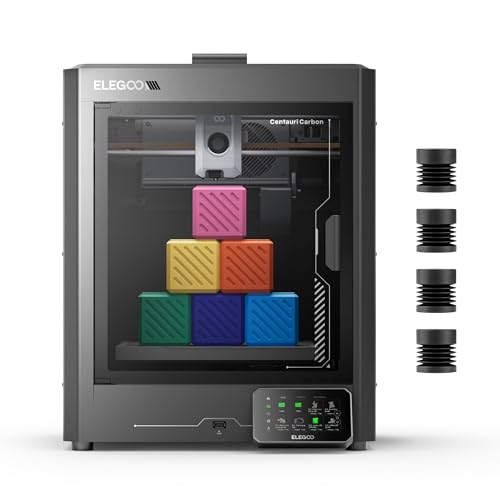
- 500 mm/s CoreXY printing
- 320°C nozzle and enclosed chamber
- 256 mm cubed build volume
Best For: Fast, advanced-material hobby printing
Best Heavy-Duty Pick

- Starts in as little as 8 minutes
- App, Wi-Fi, and model library
- Compact 3.9-inch build volume
Best For: Beginners, families, and STEM projects
Best Rapid-Prototyping Pick

- Up to 600 mm/s rated speed
- Fully automatic bed leveling
- Quick-change detachable nozzle
Best For: Fast prototypes and repeated hobby prints
Premium Multicolor Pick – Fast, Feature-Rich Printing
For hobbyists who want speed, automation, and multicolor capability in one setup, the Bambu Lab P2S Combo is a highly equipped choice. It combines fast FDM printing with the AMS 2 Pro for streamlined multicolor and multimaterial projects.
Best For: Hobbyists who want professional-style automation, rapid printing, and integrated multicolor printing.
Pros:
- Prints at speeds up to 600 mm/s with active flow-rate compensation for consistent detail.
- Includes automatic calibration, AI failure detection, and quick-swap nozzles.
- AMS 2 Pro supports multicolor printing and filament drying up to 65 °C.
- Adaptive airflow can cool prints or maintain a chamber temperature up to 50 °C.
Cons:
- The complete setup is relatively large and heavy at 46.3 pounds.
- Multicolor printing requires the Combo version with the AMS 2 Pro.
The P2S Combo is a strong fit for hobbyists who value convenience and advanced features over a minimal setup. Its automated workflow and material-handling capabilities make it particularly appealing for ambitious, frequently repeated projects.
Budget-Friendly Starter – Fast Printing with Filament Included
Creality Ender 3 V3 SE 3D Printer Bundle with PLA Filament 4 Packs(Black+White+Red+Blue)
Check Price On AmazonThe Creality Ender 3 V3 SE bundle is a practical entry point for hobbyists who want a capable printer plus four PLA filament colors. Its automatic leveling and direct-drive extruder simplify setup while supporting common materials such as PLA, TPU, and PETG.
Best For: New hobbyists who want an accessible printer bundle with multiple PLA colors included.
Pros:
- Supports printing speeds up to 250 mm/s with 2,500 mm/s² acceleration.
- CR Touch auto-leveling and a strain sensor automate key setup adjustments.
- Full-metal dual-gear direct extruder supports PLA, TPU, and PETG.
- Bundle includes PLA filament in black, white, red, and blue.
Cons:
- The included filament is PLA, so other materials require separate purchases.
- It does not offer the integrated multicolor printing system included with some higher-end options.
For hobbyists building their first 3D-printing setup, this Ender 3 V3 SE bundle offers useful automation and immediate access to several PLA colors. It is a sensible choice when value and straightforward materials matter most.
Beginner-Friendly Pick – Quiet, Automated Everyday Printing
The Bambu Lab A1 is designed for hobbyists who want a ready-to-use printer with minimal manual calibration. It delivers fast, quiet FDM printing and can support multicolor projects when paired with the AMS lite or purchased as an A1 Combo.
Best For: Beginners, families, and hobbyists who prioritize simple setup, quiet operation, and reliable everyday printing.
Pros:
- Automatic calibration handles Z-offset, bed leveling, and related setup tasks.
- Active flow-rate compensation helps produce smooth, consistent prints.
- Quiet motor noise canceling and a simplified touchscreen improve usability.
- Supports multicolor printing with the optional AMS lite.
Cons:
- Multicolor printing requires the AMS lite, which is not included with the standalone printer.
- It has a smaller footprint and lower listed weight than the larger P2S Combo, which may limit some larger projects.
The A1 is an appealing choice among 3D printers for hobbyists who want to start printing quickly without learning extensive manual calibration. Its quiet operation and optional multicolor upgrade add flexibility as interests develop.
Advanced Multimaterial Pick – Four Toolheads, Minimal Waste
The Snapmaker U1 is aimed at hobbyists who want true multimaterial versatility rather than conventional filament swapping. Its four independent toolheads, rapid tool changes, and CoreXY motion system support complex functional parts, prototypes, and multicolor models.
Best For: Experienced hobbyists, makers, and small workshops working with multiple materials or demanding multicolor designs.
Pros:
- Four toolheads can change in about five seconds without repeated purging.
- Supports mixed-material projects, including rigid, flexible, engineering, and water-soluble support materials.
- Automatic calibration, AI print monitoring, remote control, and a built-in model library simplify operation.
- CoreXY printing reaches up to 500 mm/s across a 270 × 270 × 270 mm build volume.
Cons:
- At 59 pounds, it is a substantial printer for a hobby workspace.
- Its advanced material and toolhead capabilities may be more than casual users need.
- Some listed features depend on using the Snapmaker Orca software and related ecosystem.
The U1 stands out for hobbyists who regularly combine colors or materials and want to reduce waste from filament changes. Its broad compatibility and automation make it versatile, while its size and feature set are best suited to a dedicated workspace.
Fast Multi-Material Pick – Bambu Lab P1S
The Bambu Lab P1S is a ready-to-use option for hobbyists who want fast, low-fuss FDM printing. Its enclosed design, automatic bed leveling, and 15-minute setup make it a practical choice for projects using materials such as PLA, PETG, TPU, and ASA.
Best For: Hobbyists who prioritize speed, straightforward setup, and enclosed printing.
Pros:
- Prints at up to 500mm/s with 20,000 mm/s² acceleration.
- Automatic bed leveling helps simplify first-layer setup.
- Enclosed body supports advanced filaments and improves print performance.
- Optional Bambu Lab AMS enables multi-color and multi-material printing, with support for up to 16 colors.
Cons:
- The AMS is required for multi-color or multi-material printing.
- Carbon- and glass-fiber-reinforced polymers are not recommended.
For hobbyists who want to spend more time designing than calibrating, the P1S combines quick setup and high speed in an enclosed format. Its material limitations are worth considering if specialized reinforced filaments are part of your plans.
Feature-Rich Speed Choice – FLASHFORGE AD5M
The FLASHFORGE AD5M is a versatile choice among 3d printers for hobbyists, pairing a CoreXY all-metal structure with automatic calibration and a 220 x 220 x 220mm print volume. It is designed to reduce routine maintenance while supporting high-speed work and remote print management.
Best For: Beginners and experienced hobbyists who want automation, quick nozzle changes, and network controls.
Pros:
- One-click automatic leveling measures nozzle-to-build-plate distance for easier setup.
- CoreXY all-metal motion structure supports printing speeds up to 600mm/s.
- Quick-release nozzles can be changed without tools in as little as three seconds.
- Power-loss recovery, remote monitoring, and batch file transmission add convenience.
Cons:
- The standard print size is limited to 220 x 220 x 220mm.
- Remote and network features depend on the Orca-Flashforge software and Flash Maker app.
The AD5M stands out for hobbyists who value convenience features beyond basic printing. Its automatic calibration and maintenance-friendly nozzle system can make frequent experimentation easier, while the compact build volume may limit larger projects.
Beginner-Friendly Value – Creality Ender 3 V3 SE
The Creality Ender 3 V3 SE is a beginner-friendly entry point for 3d printers for hobbyists. Its simple setup, CR Touch auto leveling, automatic Z-offset calibration, and direct-drive extruder are suited to everyday projects with PLA, PETG, and TPU.
Best For: New hobbyists who want automatic leveling, dependable filament feeding, and easy model removal.
Pros:
- Prints at up to 250mm/s with 2500mm/s² acceleration.
- Auto leveling and automatic Z-offset calibration reduce manual adjustment.
- Sprite direct-drive extrusion supports PLA, PETG, and TPU.
- Flexible PC spring steel plate helps make print removal easier, while the 32-bit silent board reduces operating noise.
Cons:
- Its maximum speed is lower than the faster printers in this roundup.
- The supplied notes focus on everyday materials rather than advanced filament support.
The Ender 3 V3 SE emphasizes approachable setup and consistent daily use rather than the highest specification sheet. It is a sensible fit for newcomers who want useful automation and a straightforward path into hobby printing.
Best High-Speed Pick – ELEGOO Centauri Carbon
For hobbyists who want fast, capable performance without a complicated setup, the ELEGOO Centauri Carbon is a strong option among 3d printers for hobbyists. It arrives assembled and pre-calibrated, while its CoreXY design, 256 x 256 x 256 mm build volume, and 500 mm/s rated speed support larger, quicker projects.
Best For: Hobbyists who want high-speed printing and support for advanced materials such as carbon-fiber-reinforced filament.
Pros:
- Ready-to-print setup with auto bed leveling and touchscreen controls.
- Enclosed design, 320°C hardened-steel nozzle, and enhanced cooling support advanced filaments.
- Built-in camera, dual LED lighting, and remote monitoring add convenience.
- Rigid die-cast frame and vibration compensation promote consistent results.
Cons:
- At 38.5 pounds, it is less convenient to move than a compact printer.
- The larger, performance-focused design may be more than beginners need for simple projects.
Choose the Centauri Carbon if speed, build volume, monitoring, and material versatility matter more than portability. Its out-of-the-box setup also makes its advanced feature set easier to approach.
Best Heavy-Duty Pick – Entina Tina2C
The Entina Tina2C is a compact starting point for families, students, and first-time users comparing 3d printers for hobbyists. It is fully assembled, supports guided setup through the Poloprint Cloud app, and can reportedly begin a first print in as little as eight minutes.
Best For: Beginners, STEM learning, and small home projects where simple controls and a compact footprint are priorities.
Pros:
- Fully assembled with auto leveling and beginner-oriented app guidance.
- Access to a 3,500-plus model library, AI features, and more than 25 creative modules.
- Supports 2.4G Wi-Fi printing as well as TF card offline printing.
- Quiet, compact design with a flexible magnetic build plate and power-loss recovery.
Cons:
- The 3.9 x 3.9 x 3.9-inch print volume limits larger models.
- Its mini format is better suited to small builds than ambitious hobby projects.
The Tina2C emphasizes accessibility over scale. Its app-based learning tools, small footprint, and minimal setup make it especially approachable for home and classroom use.
Best Rapid-Prototyping Pick – FLASHFORGE Adventurer 5M
The FLASHFORGE Adventurer 5M is built for hobbyists who value quick turnaround and straightforward operation. As one of the more production-oriented 3d printers for hobbyists, it combines CoreXY motion, fully automatic leveling, a 220 x 220 x 220 mm build area, and rated travel speeds up to 600 mm/s.
Best For: Hobbyists making prototypes or repeated parts who want speed, automatic leveling, and convenient nozzle changes.
Pros:
- Fully automatic leveling helps simplify first-layer setup.
- CoreXY structure, 20,000 mm/s² acceleration, and high-flow nozzle support rapid printing.
- Three-second detachable nozzle changes and a 35-second warm-up to 200°C improve workflow.
- Remote monitoring, status alerts, and adjustments are available through Flash Studio.
Cons:
- The 220 mm cubed build volume is smaller than the ELEGOO model in this roundup.
- The 280°C extruder provides less temperature headroom than printers with 320°C nozzles.
The Adventurer 5M is a practical choice when efficient production matters. Its automatic setup, quick-change nozzle, and remote controls help reduce interruptions during active hobby workflows.
How We Picked the Best 3d Printers for Hobbyists
We compared these printers by focusing on the features that matter most in a home workshop: setup difficulty, automatic calibration, print speed, build consistency, material support, software and connectivity, noise-conscious design, and overall versatility. We also considered whether each model is better suited to first-time users, experienced makers, families, or hobbyists who want to experiment with multi-color printing.
Specifications can vary by bundle and region, so check the manufacturer’s current details before buying. In particular, confirm the included accessories, enclosure style, supported materials, and whether a multi-material system is part of the package.
Quick Comparison
| Best For | Look For | Models to Consider |
|---|---|---|
| First-time users | Simple setup, auto leveling, guided software | Bambu Lab A1, Creality Ender 3 V3 SE, Entina Tina2C |
| Fast everyday printing | CoreXY motion, automatic calibration, direct-drive extrusion | FLASHFORGE AD5M, FLASHFORGE Adventurer 5M, ELEGOO Centauri Carbon |
| Multi-color projects | Tool-changing or automated material management | Bambu Lab P2S Combo, Snapmaker U1 |
| Enclosed printing | Enclosure, stable temperatures, broader material flexibility | Bambu Lab P1S |
Key Buying Factors for 3d Printers for Hobbyists
Ease of Setup and Calibration
Automatic bed leveling, calibration routines, and preassembled components can save hours of troubleshooting. Beginners should prioritize a printer that reaches its first successful print quickly, while experienced users may accept more manual adjustment for greater control.
Build Volume and Printer Design
Match the build area to the objects you expect to make. Compact printers fit small desks and handle miniatures, organizers, and basic repairs; larger platforms are better for helmets, functional prototypes, or batch printing. An enclosed design can also help with temperature stability and contain drafts.
Speed, Quality, and Materials
High advertised speed is useful only when the printer maintains good motion control and extrusion consistency. Consider nozzle temperature, heated-bed performance, direct-drive extrusion, and the materials you plan to use. PLA is an easy starting point, while PETG, TPU, ABS, and other materials may require additional heat or ventilation.
Software, Connectivity, and Maintenance
Reliable slicer software, Wi-Fi or app control, a built-in camera, and automatic notifications improve day-to-day convenience. Also check replacement nozzle availability, spare-part pricing, cleaning requirements, and the quality of community support.
Who Should Buy Which 3d Printers for Hobbyists?
Choose the Bambu Lab A1 or Entina Tina2C if you want the least intimidating path into 3D printing. The Creality Ender 3 V3 SE is a sensible value choice for buyers who want beginner features while retaining more hands-on control.
For speed-focused hobbyists, the FLASHFORGE AD5M, FLASHFORGE Adventurer 5M, and ELEGOO Centauri Carbon offer modern automated workflows. Pick the Bambu Lab P1S if an enclosed printer better fits your materials and workspace. If multi-color printing is central to your plans, compare the Bambu Lab P2S Combo and Snapmaker U1 by tool-changing approach, material-management cost, and the colors or materials you expect to use most often.