Choosing the right 3D printer for cosplay means balancing build volume, surface detail, material compatibility, speed, and how much post-processing you are willing to handle.
This roundup compares 10 standout options for printing helmets, armor panels, props, accessories, and costume details, including fast enclosed FDM printers, multicolor machines, resin models, and a continuous-belt design.
Best 10 3d Printers for Cosplay Picks for 2026
Fast, Easy FDM Pick

- 600 mm/s maximum speed
- One-click automatic leveling
- 220 mm³ build volume
Best For: Fast PLA, PETG, and TPU cosplay parts
Multicolor Enclosed Choice
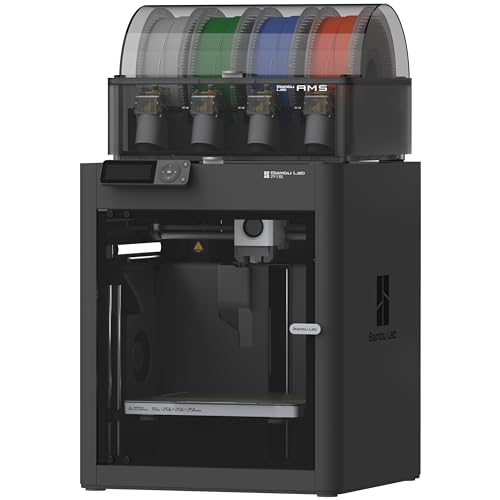
- AMS multicolor printing
- Enclosed design
- 500 mm/s maximum speed
Best For: Colorful cosplay parts and varied filament projects
Large-Format Resin Specialist

- 298 × 164 × 300 mm build volume
- 13.6-inch 7K resin printing
- Automatic resin fill and temperature control
Best For: Large, detailed masks and resin cosplay props
Streamlined Four-Color FDM
ELEGOO Centauri Carbon 2 Combo
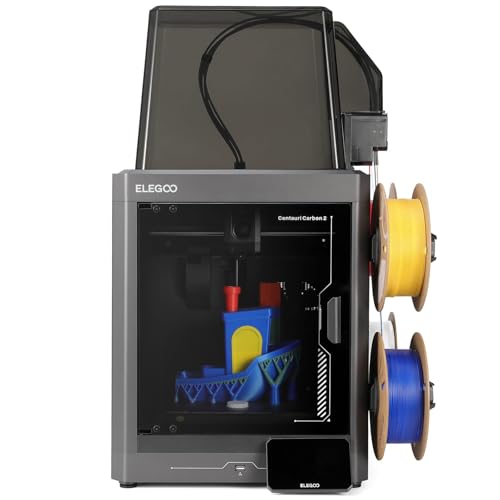
- Four-color CANVAS printing
- 500 mm/s maximum speed
- Automated calibration and monitoring
Best For: Fast, colorful cosplay accessories and display parts
High-Detail Resin Pick

- 12K mono LCD with 19 × 24 μm XY resolution
- 250 mm build height for larger resin parts
- Supports CHITUBOX and Lychee Slicer workflows
Best For: Detailed cosplay masks, props, and intricate costume parts
Long-Part Production Pick
IdeaFormer IR3 V2 Conveyor Belt

- Infinite-Z conveyor belt handles long models
- Supports multiple cosplay-friendly filaments
- Auto-leveling and Klipper system streamline printing
Best For: Long cosplay parts, repeated armor components, and production runs
Beginner Filament Pick

- Auto-leveling and automatic Z-offset calibration
- Direct-drive extruder supports PLA, PETG, and TPU
- 250 mm/s maximum listed print speed
Best For: Beginners printing cosplay accessories, prototypes, and filament parts
Best Enclosed Choice

- Enclosed chamber with dual filtration
- 600mm/s CoreXY printing with automatic leveling
- 280°C nozzle supports ABS, ASA, and PETG-CF
Best For: Material versatility and quieter home-studio printing
Best Easy-Maintenance Pick

- One-click automatic calibration
- Three-second tool-free nozzle changes
- 220 × 220 × 220mm build volume with PEI plate
Best For: Beginners and hobbyists making standard-size cosplay parts
Fast, Easy FDM Pick – FLASHFORGE Adventurer 5M
For makers seeking practical 3d printers for cosplay, the FLASHFORGE Adventurer 5M emphasizes speed, straightforward setup, and dependable first layers. Its 220 x 220 x 220 mm build area suits many costume accessories, armor components, and smaller props.
Best For: Cosplayers who want fast, low-fuss PLA, PETG, or TPU printing.
Pros:
- One-click full-auto leveling helps produce consistent first layers.
- Prints at speeds up to 600 mm/s with vibration compensation to reduce ghosting.
- Direct extruder and quick-detachable 280°C nozzle support PLA, PETG, and TPU.
- Filament run-out sensing and power-loss recovery help protect longer prints.
Cons:
- The open design is best used in open, well-ventilated environments.
- The 220 mm build dimensions may require splitting larger cosplay props.
The Adventurer 5M is a strong all-around choice when speed and easy calibration matter more than enclosed printing or a very large build volume.
Multicolor Enclosed Choice – Bambu Lab P1S Combo
The Bambu Lab P1S Combo is one of the more versatile 3d printers for cosplay if you want enclosed printing and multicolor capability. Its included AMS supports designs with up to 16 colors, while the automated setup keeps the workflow accessible.
Best For: Cosplayers making colorful accessories, accents, and parts with varied filament needs.
Pros:
- AMS-enabled workflow supports multicolor and multimaterial printing, with up to 16 colors.
- Enclosed construction improves printing performance with advanced filaments.
- Automatic bed leveling and a setup time of about 15 minutes simplify operation.
- Supports PLA, PETG, TPU, PVA, PET ABS, and ASA; it is also capable of PA and PC.
Cons:
- Carbon- and glass-fiber-reinforced polymers are not recommended.
- The 47.5-pound combination is relatively substantial for a home workspace.
Choose the P1S Combo when color changes, enclosure benefits, and material flexibility are central to your cosplay projects.
Large-Format Resin Specialist – Anycubic Photon Mono M7 Max
For detailed masks, terrain, and intricate costume components, the Anycubic Photon Mono M7 Max stands out among 3d printers for cosplay with its 298 x 164 x 300 mm resin build volume. Its high-resolution light system is designed to reduce visible layer lines and aliasing.
Best For: Large, highly detailed resin masks, props, game terrain, and models.
Pros:
- Large build volume can accommodate full-size masks and sizeable props with less cutting and assembly.
- 13.6-inch 7K printing and over-90% light uniformity target fine surface detail.
- Dynamic resin temperature control and auto-fill features support longer print sessions.
- Flip-open cover and integrated release-film design improve routine handling and maintenance.
Cons:
- At 52.8 pounds and roughly 31 inches tall, it requires considerable workspace.
- Its 60 mm/h maximum speed is lower than the listed speeds of the FDM options.
- Resin printing adds material-management considerations compared with filament printing.
The M7 Max is the specialized pick for large, detail-focused resin work, particularly when minimizing seams in masks or intricate props is important.
Streamlined Four-Color FDM – ELEGOO Centauri Carbon 2 Combo
The ELEGOO Centauri Carbon 2 Combo combines CoreXY speed with four-color printing, making it a practical option among 3d printers for cosplay when you want colorful details without a complicated workflow. Its automated calibration and monitoring are designed for straightforward operation.
Best For: Cosplayers who want fast, automated multicolor printing for accessories and display pieces.
Pros:
- CANVAS supports four-color printing with instant switching and smart filament detection.
- Auto refill and tangle detection help maintain smoother multicolor sessions.
- Fully automated calibration and monitoring support a load-and-print workflow.
- CoreXY mechanics, a rigid aluminum frame, and vibration compensation target fast, stable results up to 500 mm/s.
Cons:
- The 18.9 x 19.7 x 29.3-inch footprint requires dedicated space.
- The supplied notes do not specify the exact build volume.
The Centauri Carbon 2 Combo is a compelling fit for users prioritizing automated four-color output, speed, and material versatility in a modern FDM setup.
High-Detail Resin Pick – ELEGOO Saturn 3 12K
For makers prioritizing fine surface detail, the ELEGOO Saturn 3 is a strong resin option among 3d printers for cosplay. Its 12K monochrome LCD, 19 × 24 μm XY resolution, and relatively tall build volume suit detailed masks, props, and costume components, though resin printing requires a more involved workflow than filament printing.
Best For: Detailed cosplay masks, props, and intricate costume parts where surface clarity matters.
Pros:
- 12K resolution and 19 × 24 μm XY resolution support highly detailed prints.
- 218.88 × 122.88 × 250 mm build volume accommodates larger individual parts.
- Laser-carved build plate and Fresnel-collimated light source are designed to support adhesion and consistent curing.
- Supports Voxeldance Tango modes and open-source GOO files compatible with CHITUBOX and Lychee Slicer.
Cons:
- Resin printing generally involves more handling and post-processing than filament printing.
- The build area may still require splitting especially large cosplay pieces.
- At 33 pounds, it is not especially lightweight to move.
The Saturn 3 is best suited to cosplay builders who value intricate detail over the simplicity of filament printing. Its generous height and high-resolution screen make it a capable choice for display-quality components and fine textures.
Long-Part Production Pick – IdeaFormer IR3 V2 Conveyor Belt
The IdeaFormer IR3 V2 takes a different approach to 3d printers for cosplay, using a conveyor belt for continuous Z-axis printing. That design is useful for long armor sections, repeated parts, and production runs, while its filament compatibility gives cosplay makers flexibility across common materials.
Best For: Long cosplay parts, repeated armor components, prototyping, and small-batch production.
Pros:
- Infinite-Z conveyor-belt design supports long models and continuous printing.
- 250 × 250 mm format provides a practical footprint for cosplay components.
- Supports PLA, PETG, ABS, TPU, ASA, PP, and other filaments listed by the manufacturer.
- Klipper firmware, auto-leveling, and speeds up to 400 mm/s target efficient printing.
Cons:
- The 44-pound machine has a substantial footprint and weight.
- Conveyor-belt printing is a specialized format that may require a learning curve.
- The notes emphasize production and long-part capability rather than fine resin-level detail.
Choose the IR3 V2 when your cosplay projects benefit from length, repeatability, or hands-off batch printing. Its belt layout is particularly compelling for armor work and other parts that are awkward to fit on a conventional flat bed.
Beginner Filament Pick – Creality Ender 3 V3 SE
The Creality Ender 3 V3 SE is a straightforward filament choice among 3d printers for cosplay, especially for newcomers building props, costume accessories, or prototypes. Its auto-leveling, automatic Z-offset calibration, and direct-drive extruder reduce setup friction while supporting PLA, PETG, and TPU.
Best For: Beginners printing cosplay accessories, prototypes, and everyday filament parts.
Pros:
- CR Touch auto-leveling and automatic Z-offset calibration simplify first-layer setup.
- Sprite direct-drive extrusion supports PLA, PETG, and TPU.
- Print speeds up to 250 mm/s can shorten compatible projects.
- Flexible PC spring steel plate helps with print removal, while the 32-bit silent board reduces noise.
Cons:
- Its listed features and materials are more focused on everyday filament printing than specialty cosplay materials.
- The product notes do not specify an infinite-Z or unusually large-format design.
- Large armor pieces may need to be divided into multiple sections.
The Ender 3 V3 SE makes sense for cosplay beginners who want an accessible way to start with filament. It offers useful automation and material flexibility, while its conventional format is best matched with segmented parts and smaller accessories.
Best Multicolor Speed – FLASHFORGE AD5X
For makers seeking 3d printers for cosplay, the FLASHFORGE AD5X stands out when colorful costume details, fast production, and streamlined setup matter. Its four-color Intelligent Filament System, automatic calibration, and CoreXY motion system support efficient, detailed projects.
Best For: Multicolor cosplay accents, props, and makers who want high-speed printing with flexible material support.
Pros:
- Supports four-color printing through the Intelligent Filament System.
- Prints at speeds up to 600mm/s with up to 20,000mm/s² acceleration.
- Full-auto leveling and vibration compensation help maintain consistent print quality.
- Compatible with materials including PLA, TPU, PETG, PLA-CF, and PETG-CF.
Cons:
- The 220-pound? No—the supplied weight is 22 pounds, but its compact footprint still requires dedicated workspace.
- Multicolor printing adds system complexity compared with a standard single-filament setup.
The AD5X is a strong choice for cosplay builders who value speed and color versatility. Its compact, modular design also helps conserve workspace while keeping several filament spools ready.
Best Enclosed Choice – FLASHFORGE Adventurer 5M Pro
The FLASHFORGE Adventurer 5M Pro is a practical option among 3d printers for cosplay if you want an enclosed machine for dependable, quieter printing. Its high-temperature extruder, heated bed, filtration, and automatic leveling support both common and more demanding materials.
Best For: Cosplay makers printing larger costume components or experimenting with ABS, ASA, and PETG-CF in a home or shared workspace.
Pros:
- Enclosed chamber with dual filtration supports a cleaner printing environment.
- Prints at up to 600mm/s using an all-metal CoreXY structure.
- 280°C nozzle and 110°C heated bed support PLA, PETG, ABS, ASA, and PETG-CF.
- Includes one-click leveling, quick-swap nozzles, a camera, and power-loss recovery.
Cons:
- The enclosed design and 22-pound weight may require more dedicated placement space.
- Its advanced material and monitoring features may be more than beginners need for basic PLA projects.
Choose the Adventurer 5M Pro when material range and a controlled printing environment are priorities. The enclosed, quiet design is especially useful for home studios, while remote monitoring adds convenience during long cosplay prints.
Best Easy-Maintenance Pick – FLASHFORGE AD5M
For builders comparing 3d printers for cosplay, the FLASHFORGE AD5M offers a straightforward feature set focused on reliable setup and maintenance. Automatic calibration, a flexible PEI plate, and a tool-free quick-release nozzle make it approachable for both new and experienced makers.
Best For: Beginners and hobbyists producing cosplay parts in a 220 × 220 × 220mm print area who want simple operation and easy upkeep.
Pros:
- One-click automatic leveling simplifies first-layer preparation.
- Quick-release nozzles can be changed in about three seconds and come in multiple diameters.
- CoreXY construction supports high-speed, low-noise printing up to 600mm/s.
- Flexible double-sided PEI plate makes model removal easier and includes a PETG-oriented side.
Cons:
- The 220 × 220 × 220mm build volume may limit oversized cosplay components.
- It is presented as a standard printer rather than an enclosed model, so enclosure-based material control is not listed.
The AD5M is a sensible starting point for cosplay makers who value ease of use over specialized multicolor or enclosed printing. Its quick nozzle changes and simple bed removal can reduce routine maintenance between projects.
How We Picked the Best 3d Printers for Cosplay
We evaluated these printers by the needs that matter most for costume making: usable build volume, dimensional consistency, print speed, material support, automation, enclosure design, and likely finishing workload. We also considered whether each model suits large wearable pieces, small high-detail components, multicolor accents, or repeated production.
FDM printers generally offer the most practical route for helmets, armor, props, and other large parts because filament is comparatively affordable and parts can be scaled without resin-washing equipment. Resin printers can produce finer detail for badges, jewelry, miniature accessories, and intricate face pieces, but they require ventilation, washing, curing, and careful handling.
Quick Comparison
- Best overall flexibility: Bambu Lab P1S Combo for fast enclosed printing and multicolor capability.
- Best for high-speed FDM printing: FLASHFORGE Adventurer 5M or AD5M models.
- Best for multicolor cosplay parts: Bambu Lab P1S Combo or ELEGOO Centauri Carbon 2 Combo.
- Best for fine detail: ANYCUBIC Photon Mono M7 MAX or ELEGOO Saturn 3 MSLA 12K.
- Best beginner value: Creality Ender 3 V3 SE.
- Best for continuous long parts: the IdeaFormer-3D IR3 V2 conveyor-belt printer.
Key Buying Factors for 3d Printers for Cosplay
Build Volume and Part Orientation
Measure your largest planned pieces before buying. A bigger build area reduces splitting and gluing, while a belt printer can be useful for long repeated sections. Even with a large machine, helmets and armor often need strategic orientation or separate panels.
Material and Temperature Capability
PLA is easy to print and suitable for many props. PETG offers more toughness, while ABS and ASA can be useful for heat-resistant parts but benefit from an enclosure and controlled ventilation. Check nozzle temperature, bed temperature, and whether the printer’s hot end and build surface support your preferred filament.
Detail, Speed, and Finishing
High-resolution resin printing is attractive for small intricate components, but FDM parts are usually easier to scale and finish for wearable pieces. Fast advertised speeds are useful only when motion control, cooling, and calibration maintain quality. Auto-leveling and automatic calibration can reduce setup time, especially for beginners.
Safety and Workflow
Resin requires gloves, eye protection, ventilation, washing, and UV curing. Enclosed filament printers can help manage drafts, odors, and temperature-sensitive materials. Also budget for spare nozzles, filament or resin, supports, sanding supplies, adhesives, and replacement build surfaces.
Who Should Buy Which 3d Printers for Cosplay?
Beginners should start with an automated FDM model such as the Creality Ender 3 V3 SE or a FlashForge Adventurer model. Cosplayers making large armor and props should prioritize build volume, dependable auto-calibration, and filament flexibility. Creators producing colorful costume accents will benefit from a multicolor combo system, while detail-focused makers should choose a 12K or large-format resin printer and plan for the required cleanup equipment.
If you are unsure, choose an enclosed FDM printer first: it handles the widest range of cosplay projects with a simpler, more economical workflow.