The best 3D printers make it easier to turn digital designs into useful parts, creative models, and custom projects. This year’s leading options range from compact beginner machines to fast CoreXY printers with multicolor capabilities.
We selected these 10 models for their balance of print quality, ease of use, speed, build features, and upgrade potential. Use the guide below to narrow the list to the printer that fits your space, experience, and budget.
Best 10 3d Printers Picks for 2026
Best High-Speed Multicolor Pick

- Up to 600 mm/s printing with flowrate compensation
- AMS 2 Pro enables multi-color printing and filament drying
- Automatic calibration and AI failure detection
Best For: Fast, automated multi-color FDM printing
Best Beginner Mini Printer

- Fully assembled and ready to print in as little as 8 minutes
- App, WiFi, TF card, and 3,500+ model library support
- Auto leveling and compact low-noise design
Best For: First-time users, families, and STEM learning
Best Enclosed High-Speed Printer

- Prints up to 500 mm/s with high acceleration
- Enclosed body supports advanced filaments
- AMS-compatible for optional multi-color printing
Best For: Fast enclosed FDM printing with upgrade potential
Best Toolchanging Multimaterial Printer

- Four toolheads switch in about five seconds
- Supports rigid, flexible, engineering, and soluble materials
- 500 mm/s CoreXY printing with a 270 mm cubed build volume
Best For: Complex multi-material prototypes and productive workshops
Best Beginner Pick

- Automatic calibration simplifies setup
- Fast, quiet FDM printing
- Multicolor support with AMS lite
Best For: Beginners, families, and everyday makers
Best for Everyday Use

- Prints up to 600 mm/s
- Supports four-color printing
- Flexible nozzle and remote-control features
Best For: Rapid prototyping, batch production, and multicolor makers
Best Compact Creative Bundle

- Includes an LED Lamp Kit
- Automatic calibration for beginners
- Quiet printing with app and model-library access
Best For: Home creativity, DIY décor, and first-time users
Best High-Speed Pick

- Automatic bed leveling
- Up to 600mm/s travel speed
- Remote monitoring via Flash Studio
Best For: Rapid prototyping and convenient everyday printing
Best Multicolor Bundle
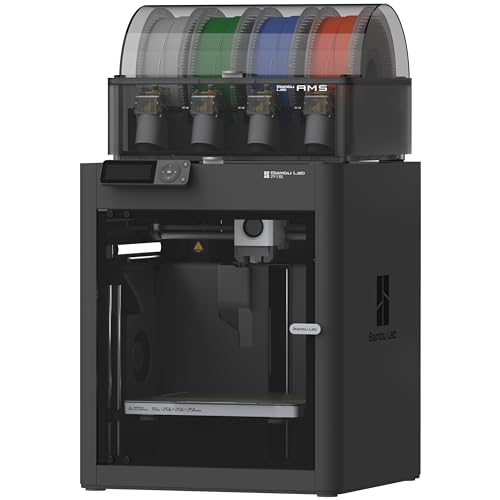
- AMS supports up to 16 colors
- Enclosed design
- Automatic bed leveling and 15-minute setup
Best For: Multicolor printing and enclosed advanced-filament workflows
Best High-Speed Multicolor Pick – Bambu Lab P2S Combo
For shoppers comparing 3d printers, the Bambu Lab P2S Combo stands out as a fast, feature-rich FDM system with the AMS 2 Pro included. It combines speeds up to 600 mm/s, automatic calibration, AI failure detection, and a workflow designed to get beginners printing quickly.
Best For: Makers who want high-speed precision and convenient multi-color or multi-material printing.
Pros:
- Prints up to 600 mm/s with active flowrate compensation for smooth, accurate layers.
- AMS 2 Pro supports multi-color and multi-material printing and includes filament drying up to 65 °C.
- Automatic calibration, quick-swap nozzles, and AI failure detection simplify setup and operation.
- Adaptive airflow supports both general-purpose and engineering-grade materials.
Cons:
- The printer is relatively large and heavy at 46.3 pounds.
- Multi-color printing requires the Combo version with the AMS 2 Pro.
The P2S Combo is a strong choice when speed, automation, and integrated multi-color capability matter more than a compact footprint. Its connected MakerWorld and Bambu software ecosystem also gives users an expansive starting point for projects.
Best Beginner Mini Printer – Entina Tina2C
Among compact 3d printers, the Entina Tina2C is designed for a quick, approachable start. It arrives fully assembled, offers guided setup through the Poloprint Cloud app, and combines auto leveling with WiFi and offline printing options.
Best For: Beginners, families, classrooms, and small home projects that need a compact printer.
Pros:
- Fully assembled design can be ready to print in as little as 8 minutes.
- Poloprint Cloud provides AI-powered search, photo-to-print features, and more than 25 creative modules.
- Auto leveling, power-loss recovery, and a flexible magnetic build plate help simplify printing.
- Compact, low-noise design works well in home, classroom, and office environments.
Cons:
- The 3.9 × 3.9 × 3.9-inch print volume limits projects to smaller models.
- WiFi printing is limited to 2.4G networks.
The Tina2C prioritizes accessibility over large-scale production. Its small build area is a limitation, but the guided app experience, STEM content, and simple maintenance make it a practical entry point for new users.
Best Enclosed High-Speed Printer – Bambu Lab P1S
The Bambu Lab P1S is a ready-to-use enclosed FDM option for shoppers seeking capable, fast 3d printers. It reaches up to 500 mm/s, includes automatic bed leveling, and is designed to improve performance with advanced filaments while keeping setup straightforward.
Best For: Users who want a fast enclosed printer with room to expand into multi-color printing.
Pros:
- High-speed printing reaches up to 500 mm/s with 20,000 mm/s² acceleration.
- Enclosed design supports printing with advanced filament types such as ABS and ASA.
- Automatic bed leveling helps improve first-layer consistency.
- Compatible with Bambu Lab AMS for multi-color or multi-material printing.
Cons:
- AMS is required for multi-color printing and is not included in the listed printer package.
- Carbon- and glass-fiber-reinforced polymers are not recommended.
- Its 38.9-pound weight and enclosed footprint require dedicated space.
The P1S offers a useful balance of speed, enclosure benefits, and ease of setup. It is especially appealing for users who want a capable single-color machine now while retaining the option to add an AMS later.
Best Toolchanging Multimaterial Printer – Snapmaker U1
For advanced 3d printers shoppers, the Snapmaker U1 takes a toolchanging approach to multi-color and multi-material work. Its four independent toolheads can switch in about five seconds, reducing purging and supporting combinations such as rigid, flexible, engineering, and water-soluble support materials.
Best For: Makers, workshops, and professionals producing complex multi-material parts with less filament waste.
Pros:
- Four preloaded toolheads enable true multi-color and multi-material printing without repeated filament swaps.
- Five-second tool changes can reduce waste and improve multi-material productivity.
- Supports a broad range of materials, including PLA, TPU, PETG, ABS, ASA, PA, and PC.
- Automatic calibration, AI print monitoring, remote app control, and a 270 × 270 × 270 mm build volume add capability.
Cons:
- At 59 pounds, it is substantially heavier than compact beginner printers.
- The 22.6-inch length requires considerable workspace.
- Its advanced toolchanging system may be more capability than casual users need.
The U1 is aimed at productivity and material flexibility rather than the smallest footprint or simplest setup. Its independent toolheads are particularly useful for functional prototypes, soluble supports, and detailed multi-color models.
Best Beginner Pick – Bambu Lab A1
The Bambu Lab A1 is one of the most approachable 3d printers for beginners and kids, combining automatic calibration, quiet operation, and high-speed FDM printing. Its active flow rate compensation and quick-swap nozzle are designed to simplify setup and maintenance.
Best For: Beginners, families, and makers who want reliable everyday printing with optional multicolor capability.
Pros:
- Automatic calibration handles Z-offset and bed leveling.
- High-speed printing with up to 10,000 mm/s² acceleration.
- Quiet operation and a simplified touchscreen interface.
- Supports multicolor printing with the separately required AMS lite.
Cons:
- AMS lite is required for multicolor printing and is not included with the standard printer.
- The supplied notes do not specify the build volume or supported materials.
The A1 stands out for its low-friction setup and convenience-focused features. Choose the A1 Combo or add an AMS lite separately if multicolor projects are important.
Best for Everyday Use – FlashForge AD5X
The FLASHFORGE AD5X is a performance-focused option among 3d printers, pairing a CoreXY design with speeds up to 600 mm/s and support for up to four colors. Its auto leveling, direct-drive extruder, and remote monitoring features suit users who value efficient production.
Best For: Multicolor projects, rapid prototyping, batch production, and makers who want flexible nozzle options.
Pros:
- Supports up to four colors simultaneously.
- CoreXY system reaches up to 600 mm/s with 20,000 mm/s² acceleration.
- 1-click auto leveling and automatic filament feeding simplify operation.
- Supports 0.25 mm, 0.4 mm, 0.6 mm, and 0.8 mm nozzles.
Cons:
- The supplied notes do not identify an included enclosure or specify supported materials.
- Some nozzle sizes are optional upgrades rather than the pre-installed configuration.
The AD5X is a strong fit when speed and multicolor output matter more than a minimalist beginner setup. Its combination of remote control, recovery after power loss, and nozzle flexibility adds practical versatility.
Best Compact Creative Bundle – Bambu Lab A1 mini
The Bambu Lab A1 mini is a compact, ready-to-use choice among 3d printers, with automatic calibration, quiet printing, and access to Bambu Lab’s connected ecosystem. This bundle also includes an LED Lamp Kit for turning compatible printed models into decorative or functional lights.
Best For: First-time users, home workspaces, DIY décor, personalized gifts, and creative light projects.
Pros:
- Includes an LED Lamp Kit for compatible lamp projects.
- Automatic calibration and simple setup support beginners.
- Quiet, high-speed printing fits home or studio use.
- Works with MakerWorld and the Bambu Handy app.
Cons:
- The supplied notes do not specify the build volume or multicolor capability.
- LED lamp projects depend on compatible models and the included kit.
The A1 mini bundle adds a clear creative angle to an easy-to-use beginner printer. It is especially appealing for users who want to make décor, gifts, and lamp projects without a complicated setup.
Best High-Speed Pick – FlashForge Adventurer 5M
The FlashForge Adventurer 5M is a practical choice for shoppers seeking fast, low-maintenance 3d printers. Automatic bed leveling, a CoreXY structure, and a 600mm/s travel speed support efficient printing, while the direct-drive extruder and detachable nozzle add flexibility for different projects.
Best For: Rapid prototyping, creative projects, and users who want automatic leveling with remote monitoring.
Pros:
- Automatic bed leveling simplifies first-layer setup.
- CoreXY design supports high-speed printing with vibration compensation.
- Quick-swap nozzle and dual-sided PEI platform improve convenience.
- Flash Studio enables remote progress monitoring and status alerts.
Cons:
- The 220 x 220 x 220mm build volume may limit larger models.
- Optional nozzle sizes and accessories may require additional purchases.
Choose the Adventurer 5M if speed and ease of operation matter most. Its automatic setup and app controls make it approachable, while the 280°C direct extruder supports a range of everyday printing needs.
Best Multicolor Bundle – Bambu Lab P1S Combo
The Bambu Lab P1S Combo stands out among 3d printers for buyers who want enclosed printing and included multi-color capability. Its P1S printer and AMS combination supports up to 16 colors, while automatic bed leveling and a 15-minute setup keep the workflow accessible.
Best For: Multicolor projects, enclosed printing with advanced filaments, and users who want a ready-to-use bundle.
Pros:
- AMS enables multi-color and multi-material printing, with up to 16 colors.
- Enclosed design improves print performance with advanced filaments.
- Automatic bed leveling simplifies setup and first-layer preparation.
- 500mm/s printing speed and 20,000mm²/s acceleration support faster production.
Cons:
- The printer is not recommended for carbon- or glass-fiber-reinforced polymer.
- Its 47.5-pound weight makes it less convenient to relocate.
The P1S Combo is a strong fit when color changes and an enclosed design are higher priorities than a compact footprint. Its broad supported-filament list and quick setup make it a versatile bundle for creative users.
Best Expandable Option – Creality K2 SE
The Creality K2 SE is an appealing option among 3d printers for buyers who want fast printing now and a path to multicolor printing later. Its rigid metal frame, automatic leveling, direct-drive extruder, and compatibility with the separately sold Creality CFS provide a capable foundation for functional and creative models.
Best For: Users who want a stable high-speed printer with optional CFS multicolor expansion.
Pros:
- 500mm/s printing and 20,000mm²/s acceleration support efficient workflows.
- Die-cast aluminum construction and crossbeams promote stability at speed.
- Automatic leveling and five-minute assembly simplify initial setup.
- Quick-swap nozzle, hardened steel gears, and filament run-out sensing improve usability.
Cons:
- The Creality CFS multicolor system is sold separately.
- The supplied notes do not specify a complete supported-filament list.
Select the K2 SE if mechanical stability and future expansion are central to your buying decision. It offers a straightforward starting setup while leaving room to add CFS functionality as your projects become more demanding.
How We Picked These 3d Printers
We focused on practical features that affect the ownership experience, not just headline specifications. The selection includes beginner-friendly printers, enclosed and open-frame designs, high-speed CoreXY machines, and models that support multicolor printing through an accessory or integrated tool-changing system.
We also considered setup time, automatic bed leveling, material compatibility, print volume, software and app support, maintenance requirements, and whether the printer offers a sensible path for future projects. Because the right choice depends heavily on experience and intended use, the list deliberately includes compact entry-level models alongside more capable workhorses.
Quick Comparison
Compact models such as the Bambu Lab A1 mini and Entina Tina2C suit small spaces, first-time users, and simple PLA projects. The Bambu Lab A1 provides a larger build area while retaining a beginner-friendly workflow. For faster everyday printing, the FLASHFORGE Adventurer 5M, FLASHFORGE AD5X, Creality K2 SE, and Bambu Lab P1S are stronger fits.
Choose the Bambu Lab P2S Combo or P1S Combo when multicolor printing and a more automated workflow are priorities. The Snapmaker U1 is especially interesting for users who want tool-changing flexibility, while enclosed models are better suited to temperature-sensitive materials and improved protection around the printer.
Key Buying Factors for 3d Printers
Build Volume and Printer Size
Check the maximum model dimensions before buying. A larger build area is useful for cosplay parts, organizers, and functional components, but it also requires more desk space. Mini printers are easier to place and operate but limit the size of each print.
Ease of Setup and Reliability
Automatic bed leveling, a preassembled frame, filament sensors, remote monitoring, and a well-designed slicer can make a bigger difference than maximum speed. Beginners should prioritize a predictable first layer and simple maintenance.
Speed, Materials, and Enclosure
High-speed printing is useful only when motion control, cooling, and extrusion remain consistent. Open printers are excellent for PLA and many PETG projects. An enclosed printer is preferable for ABS, ASA, and other materials that benefit from stable temperatures and reduced drafts.
Multicolor and Tool-Changing Features
Multicolor systems add creative possibilities but may increase waste, setup complexity, and cost. Consider whether you need automatic filament switching, multiple toolheads, or simply reliable single-color printing before paying for the added capability.
Who Should Buy Which 3d Printers?
First-time users and families: Start with the Entina Tina2C, Bambu Lab A1 mini, or Bambu Lab A1 for straightforward setup and accessible operation.
Everyday makers: The Bambu Lab P1S, FLASHFORGE Adventurer 5M, and similar fast, ready-to-use machines offer a strong balance of speed, convenience, and useful build volume.
Multicolor hobbyists: Consider the Bambu Lab P1S Combo, Bambu Lab P2S Combo, or FLASHFORGE AD5X if automated color changes are central to your projects.
Advanced users: The Snapmaker U1 and Creality K2 SE are better suited to buyers who value higher performance, expanded material options, or a machine they can grow into. Before ordering, confirm current bundle contents, supported materials, software compatibility, and replacement-part availability.