Choosing the best power amplifier for audiophiles means matching clean output, speaker demands, system connections, and listening preferences—not simply chasing the highest wattage.
This roundup compares 10 options across Class A, Class AB, Class D, hybrid tube, and integrated amplifier designs, with choices for stereo systems, home theater, desktop listening, and high-efficiency speakers.
Best 10 Power Amplifier for Audiophiles Picks for 2026
High-Output Reference Choice

- Up to 500W at 8 ohms in bridged mode
- 115dB SNR and 0.003% THD+N
- XLR/RCA inputs with damping factor over 400
Best For: Large floorstanding speakers and high-end two-channel systems
Versatile Hybrid All-in-One
- Hybrid tube preamp and Class A/B amplification
- 100W per channel at 4 ohms
- Bluetooth, USB DAC, phono, and digital inputs
Best For: Flexible stereo systems with tube warmth and built-in sources
Multichannel Theater Powerhouse
Marantz MM8077 7-Channel Amplifier

- Seven channels at 150W per channel into 8 ohms
- High-current toroidal transformer for dynamic peaks
- Balanced XLR and RCA inputs on every channel
Best For: Seven-channel home theater and multichannel audiophile systems
Hand-Wired Tube Specialist

- 10W-per-channel single-ended Class A design
- Hand-wired point-to-point construction
- Best with speakers rated 88dB sensitivity or higher
Best For: Efficient speakers and warm, intimate tube listening
Best Balanced Starter
- 70W-per-channel stereo output
- Built-in DAC, phono stage, and Bluetooth
- Selectable analog mode
Best For: Flexible home stereo systems with vinyl and digital sources
Best Compact High-Power Amp

- 250W x2 stereo output
- Balanced XLR and RCA inputs
- Stereo and mono operating modes
Best For: Balanced preamp systems and demanding speakers
Best High-End Hybrid Design

- 30W Class A and 200W Class AB operation
- XLR and RCA connectivity
- 125dB SNR with 480 damping factor
Best For: Demanding speakers in a serious two-channel HiFi system
High-Power Balanced Choice

- 250W per channel into 4Ω in stereo mode
- RCA, XLR, and XLR mono-bridge inputs
- CNC aluminum chassis with GaN power design
Best For: Demanding speakers and larger balanced audio systems
Versatile Tube All-in-One
- Integrated DAC, amplifier, preamp, and headphone amp
- Bluetooth, USB, optical, coaxial, and RCA inputs
- 105W x2 at 4Ω with replaceable tubes
Best For: Compact desktop systems and flexible mixed-source listening
Warm Class A Specialist
Nobsound NS-02G PRO Stereo Amplifier

- Single-ended Class A design with warm tonality
- 30W x2 at 8Ω and 42W x2 at 4Ω
- Dual RCA inputs for two analog sources
Best For: Analog-focused systems and long-session Class A listening
High-Output Reference Choice – Eversolo AMP-F8
For audiophiles building a serious two-channel system, the Eversolo AMP-F8 is a powerful option with substantial headroom. Its Class-AB design, 800W toroidal linear power supply, low THD+N, and high damping factor suit demanding speakers and larger listening spaces.
Best For: Audiophiles driving large floorstanding speakers or upgrading a high-end two-channel system.
Pros:
- Up to 500W at 8 ohms in bridged mode for large, demanding speakers.
- 115dB SNR and THD+N as low as 0.003% support a clean, detailed presentation.
- Balanced XLR and unbalanced RCA inputs accommodate varied preamps, DACs, and sources.
- Damping factor over 400 helps maintain controlled, well-defined bass.
Cons:
- Its high power output may be unnecessary for compact rooms or efficient speakers.
- This is a power amplifier, so it requires a separate preamp or compatible source component.
The AMP-F8 is a compelling power amplifier for audiophiles who prioritize control, scale, and reserve power. Its connectivity and measured specifications make it a flexible foundation for a demanding stereo setup.
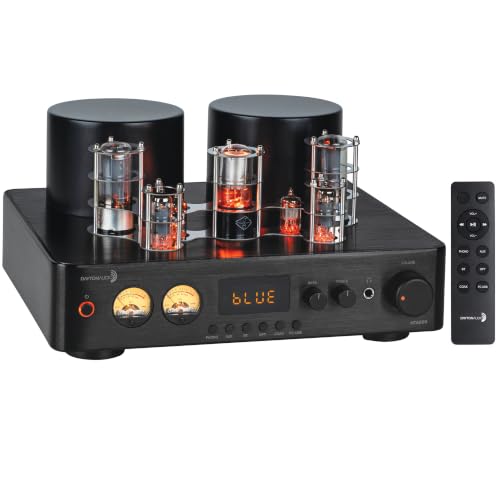
Versatile Hybrid All-in-One – Dayton Audio HTA200
The Dayton Audio HTA200 is an integrated choice for listeners who want tube character without assembling separate source components. Its hybrid tube/Class A/B design delivers 100 watts per channel at 4 ohms, while Bluetooth, USB, phono, and digital inputs simplify system building.
Best For: Audiophiles who want warm hybrid-tube sound, broad connectivity, and straightforward stereo system setup.
Pros:
- Combines vacuum-tube preamp warmth with a Class A/B amplifier stage.
- Provides 100 watts per channel RMS at 4 ohms for larger systems.
- Includes Bluetooth 5.0, USB DAC, phono, optical, coaxial, and AUX inputs.
- Supports a powered subwoofer through the dedicated full-range preamp output.
Cons:
- As an integrated amplifier, it is less suitable if you already own a separate preamp and power amp.
- The tube-influenced presentation may not suit listeners seeking strictly neutral solid-state sound.
For buyers seeking a flexible power amplifier for audiophiles with built-in source features, the HTA200 is a practical alternative to a component stack. Its phono input, DAC, wireless streaming, and subwoofer output cover a wide range of home listening needs.
Multichannel Theater Powerhouse – Marantz MM8077 7-Channel Amplifier
The Marantz MM8077 is designed for listeners who need consistent power across a home theater or multichannel audiophile system. It supplies 150 watts per channel into 8 ohms across seven channels, with balanced and unbalanced inputs for flexible installation.
Best For: Home theater enthusiasts and audiophiles powering seven passive channels with matched amplification.
Pros:
- Seven identical channels deliver 150 watts per channel into 8 ohms.
- High-current toroidal transformer provides headroom for dynamic peaks and demanding loads.
- Both XLR balanced and RCA unbalanced inputs support varied system configurations.
- Copper-plated chassis, gold-plated terminals, and remote power control support durable installation.
Cons:
- Its seven-channel design is excessive for a simple two-channel system.
- At 40 pounds, it requires a sturdy shelf or suitable equipment rack.
Among power amplifier options for audiophiles, the MM8077 stands out when uniform multichannel output matters more than compact size. It is a strong match for a carefully configured home theater using demanding passive speakers.
Hand-Wired Tube Specialist – Oldchen EL34 Class A Tube Amp
The Oldchen EL34 is a low-powered, single-ended Class A integrated tube amplifier aimed at listeners who value warmth and handcrafted construction. Its 10 watts per channel are best paired with bookshelf or floorstanding speakers rated at 88dB sensitivity or higher.
Best For: Audiophiles using efficient speakers for jazz, classical, acoustic music, and intimate two-channel listening.
Pros:
- EL34 single-ended Class A design offers a warm, rich, and detailed sound profile.
- Hand-wired point-to-point circuitry uses Teflon silver-plated wiring.
- Includes custom transformers, ALPS potentiometer, Black Gold capacitors, and a 5H CLC filter.
- Gold-plated terminals accept 4-ohm and 8-ohm speaker connections.
Cons:
- 10 watts per channel limits its suitability for inefficient speakers or large listening spaces.
- Tube amplification requires consideration of tube maintenance and replacement over time.
- Its integrated design is not intended for buyers seeking a standalone power amplifier.
This Oldchen model is a specialized power amplifier for audiophiles who prefer single-ended tube character over maximum output. With efficient speakers, its hand-wired construction and warm voicing make it a focused choice for intimate, detail-oriented listening.
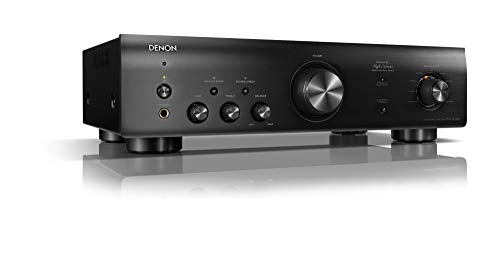
Best Balanced Starter – Denon PMA-600NE
The Denon PMA-600NE is a practical choice if you want a power amplifier for audiophiles that combines traditional stereo inputs with convenient digital and Bluetooth playback. Its 70-watt-per-channel output, built-in DAC, phono stage, and selectable analog mode make it well suited to a flexible home audio system.
Best For: Vinyl listeners and music fans who want an approachable integrated amplifier with both analog and digital connectivity.
Pros:
- 70 watts per channel at 4 ohms for driving a broad range of speakers.
- Built-in DAC, phono input, two optical inputs, coaxial input, and Bluetooth.
- Analog mode can disengage digital circuits for an undivided analog listening experience.
- Vibration-resistant design and a three-year manufacturer warranty.
Cons:
- Provides two-channel stereo rather than multichannel surround sound.
- Bluetooth and digital circuitry may be unnecessary for an all-analog system.
The PMA-600NE stands out as a versatile, space-conscious integrated amplifier rather than a specialist high-power power amp. It is a sensible fit for listeners building a straightforward stereo setup around a turntable, digital sources, or a smartphone.
Best Compact High-Power Amp – SMSL PA400
The SMSL PA400 is aimed at audiophiles who need substantial amplification in a compact desktop-style chassis. With 250 watts per channel in stereo, balanced XLR connectivity, mono-mode flexibility, and gallium nitride switching technology, it is designed to pair with a capable preamplifier and demanding speakers.
Best For: Enthusiasts building a balanced preamp-and-power-amp system or needing high output for difficult-to-drive speakers.
Pros:
- Up to 250 watts per channel in stereo and support for mono configurations.
- Balanced XLR and RCA inputs support flexible system integration.
- Gallium nitride technology is designed to improve high-frequency switching and detail.
- Overheating and overcurrent protection support extended high-load operation.
Cons:
- Its power-amp-focused design is less suitable for buyers wanting built-in source inputs or a complete integrated amplifier.
- Best results may require a separate preamplifier.
The PA400 is a focused solution for listeners who prioritize power, balanced connections, and system flexibility over all-in-one convenience. Its stereo-to-mono options also make it a useful platform for future system expansion.
Best High-End Hybrid Design – Class A/AB Hybrid Stereo Amp
This Class A/AB hybrid stereo amplifier targets audiophiles who want warm low-volume performance with substantial headroom for dynamic peaks. It combines 30 watts of Class A operation at 8 ohms with up to 200 watts per channel in Class AB, along with balanced inputs, multiple RCA inputs, and a heavy aluminum chassis.
Best For: High-end home HiFi systems using demanding speakers and listeners who value Class A character, strong dynamics, and premium connectivity.
Pros:
- Switches between 30-watt Class A operation and higher-power Class AB output.
- Rated at 200 watts per channel at 8 ohms and 380 watts at 4 ohms.
- Two balanced XLR inputs and four RCA inputs support varied source components.
- 125dB signal-to-noise ratio, 480 damping factor, and speaker protection circuitry.
Cons:
- At 46 pounds, the chassis is substantially heavier than compact alternatives.
- Its large footprint may be difficult to accommodate in smaller racks.
- Includes a one-year manufacturer warranty.
With its hybrid operating design, large power supply, and extensive analog connectivity, this amplifier is built for a serious two-channel system. It makes the most sense when your speakers and listening space can take advantage of its high output and substantial chassis.
High-Power Balanced Choice – SMSL PA400 GaN Amplifier
For audiophiles who need substantial headroom, the SMSL PA400 is a powerful power amplifier for audiophiles with balanced XLR connectivity, RCA support, and a GaN-based Class D design. It delivers 250W per channel into 4Ω in stereo mode and can reach 500W into 4Ω in mono-bridge operation when paired with a second unit.
Best For: Driving demanding floor-standing speakers, larger listening rooms, and balanced home audio systems.
Pros:
- High-output GaN design delivers 250W per channel into 4Ω in stereo mode.
- Supports RCA, balanced XLR, and XLR mono-bridge connections.
- Rigid CNC-machined aluminum chassis also functions as a heat sink.
- Mono operation with two units can provide greater power and enhanced soundstage scale.
Cons:
- Mono-bridge operation requires purchasing and using a second PA400.
- Its power capability may be excessive for small speakers or compact rooms.
The PA400 is the strongest fit here for listeners prioritizing power, balanced signal paths, and speaker-driving authority. Its stereo and mono modes provide useful system flexibility, especially when upgrading toward more demanding speakers.
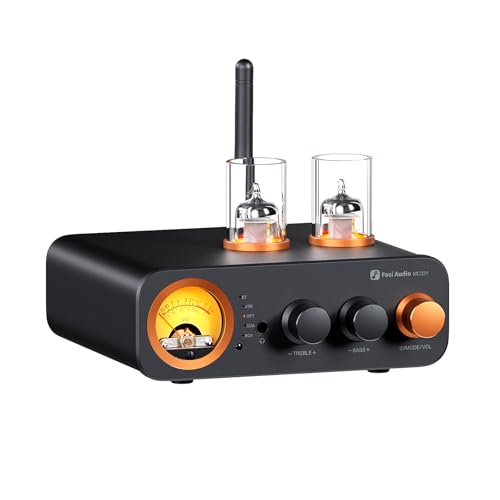
Versatile Tube All-in-One – Fosi Audio MC331 Tube DAC Amp
The Fosi Audio MC331 suits audiophiles who want a compact power amplifier for audiophiles with source switching, DAC functionality, tube styling, and headphone support in one chassis. Its 105W x2 output at 4Ω is intended to drive bookshelf speakers, while Bluetooth, USB, optical, coaxial, and RCA inputs simplify system setup.
Best For: Desktop listeners and compact stereo systems that need speaker amplification, digital inputs, and headphone connectivity.
Pros:
- Combines a DAC, integrated amplifier, preamplifier, and headphone amplifier.
- Offers Bluetooth, USB, optical, coaxial, and RCA inputs.
- Provides up to 105W x2 at 4Ω for bookshelf speakers.
- Replaceable tubes, remote control, VU meter, and tone controls add flexibility.
Cons:
- Its all-in-one design may be less suitable for listeners wanting separate components.
- Tube-based styling and replaceable tubes may not appeal to those seeking a purely solid-state presentation.
The MC331 is a practical choice when convenience matters as much as amplification. It offers unusually broad connectivity and useful headphone support while maintaining a compact footprint and distinctive tube-and-VU-meter presentation.
Warm Class A Specialist – Nobsound NS-02G PRO Stereo Amplifier
The Nobsound NS-02G PRO is a straightforward power amplifier for audiophiles who prefer a single-ended Class A design and an analog-focused system. It provides 30W x2 at 8Ω or 42W x2 at 4Ω, with dual RCA inputs and a symmetrical circuit intended to support clean imaging and channel balance.
Best For: Nearfield or home listeners using bookshelf and moderately demanding floor-standing speakers with RCA source components.
Pros:
- Single-ended Class A design emphasizes warm, natural tonality.
- Dual RCA inputs allow two source devices to remain connected.
- Symmetrical circuit design is intended to reduce phase distortion.
- Includes a toroidal transformer, 40,000μF capacitors, Toshiba transistors, and an ALPS potentiometer.
Cons:
- Output is lower than the other amplifiers in this roundup.
- Connectivity is limited to dual RCA inputs, with no listed digital or XLR inputs.
- Its 100V operating specification may require careful system compatibility checking.
The NS-02G PRO is aimed at listeners who value Class A character and a simple analog signal path over maximum wattage or digital convenience. Its output is best matched with suitable bookshelf speakers or efficient floor-standing models.
How We Picked the Best Power Amplifier for Audiophiles
We evaluated these amplifiers by looking at power delivery, amplifier topology, connectivity, system flexibility, and likely speaker compatibility. The selection covers traditional Class A and Class AB designs, efficient GaN and Class D models, tube and hybrid amplifiers, and integrated units with built-in source features.
Specifications such as continuous power, channel count, signal-to-noise ratio, distortion, damping factor, input type, and amplification mode helped identify each model’s strengths. Because published ratings can vary by impedance and test conditions, treat them as comparison points rather than guarantees of sound quality in every system.
Quick Comparison
| Best For | Recommended Type | What to Prioritize |
|---|---|---|
| High-power stereo listening | Class AB or GaN/Class D | Current delivery, thermal performance, balanced inputs |
| Warm, tactile presentation | Tube or hybrid | Tube design, speaker sensitivity, maintenance needs |
| Home theater expansion | Multichannel power amplifier | Channel count, rated output, processor compatibility |
| Desktop or compact systems | Integrated Class D or hybrid | Size, DAC/Bluetooth support, headphone connectivity |
| Efficient bookshelf speakers | Low- to mid-power Class A or tube | Noise floor, impedance matching, input simplicity |
Key Buying Factors for a Power Amplifier for Audiophiles
Power and Speaker Matching
Check your speakers’ nominal impedance, sensitivity, and recommended amplifier range before buying. Hard-to-drive or low-sensitivity speakers generally benefit from stronger current reserves and more headroom. High-sensitivity speakers may sound excellent with lower-powered tube or Class A designs, provided the amplifier is stable at the speaker’s impedance.
Amplifier Topology
Class A models emphasize continuously active output stages but can run hot and consume more energy. Class AB offers a practical balance of power, efficiency, and familiar hi-fi performance. Class D and GaN designs are compact and efficient, making them useful when high output and low heat matter. Tube and hybrid amplifiers can add a distinctive presentation, but tubes may require eventual replacement.
Inputs, System Role, and Features
A true power amplifier usually needs a separate preamp or source with volume control. Integrated amplifiers combine amplification with preamp functions and may add Bluetooth, DAC, phono, or headphone outputs. Confirm whether you need RCA, XLR, mono-bridge, Bluetooth, or digital inputs before choosing.
Noise, Heat, and Placement
Low noise and distortion matter most in revealing systems, while adequate ventilation is essential for Class A, Class AB, and tube equipment. Leave clearance around the chassis and avoid stacking heat-sensitive components directly on top.
Who Should Buy Which Power Amplifier for Audiophiles?
Choose a high-output Class AB or GaN/Class D model if you want authoritative dynamics with demanding speakers. A multichannel amplifier is the logical choice for expanding a home theater processor. Tube and hybrid options suit listeners who value a more traditional design and engaging presentation, especially with efficient speakers. Compact integrated models are best for desktop setups, small rooms, and buyers who want fewer separate components. Finally, prioritize balanced inputs and substantial power reserves when building a larger, low-noise two-channel system.