Powered KVM extenders make it possible to control a computer from a remote workstation while sending video, keyboard, and mouse signals over standard network cabling. They are useful for server rooms, control desks, classrooms, digital signage, and workstations where the computer must stay out of sight or at a distance.
This roundup compares 10 options across 4K and 1080p support, USB connectivity, cable distance, signal formats, power requirements, and installation features such as loop-out, EDID, IR, and IP-based extension.
Best 10 Powered Kvm Extenders Picks for 2026
Best 4K Single-Power Pick
4K HDMI KVM Extender with Loop Out
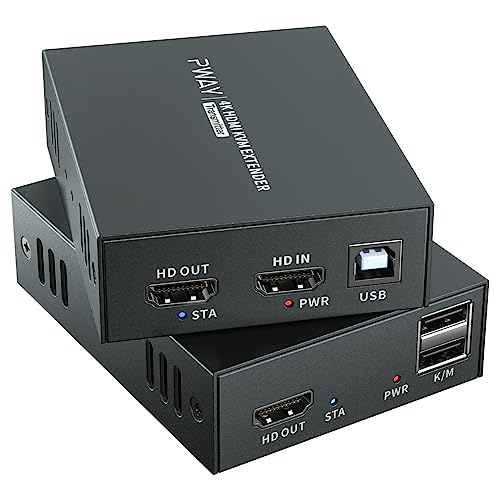
- 4K60 video over Cat6/Cat7 up to 196 feet
- USB keyboard-and-mouse control
- HDMI loop out and single-power POC
Best For: 4K installations needing local and remote viewing
Best Long-Range 1080p Value
AV Access 80M HDMI KVM Extender
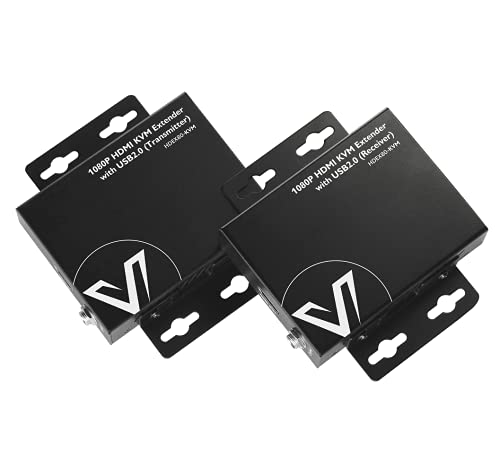
- 1080p60 extension up to 260 feet
- Two USB 2.0 ports for KVM control
- Two-way PoE and plug-and-play setup
Best For: Long-distance 1080p PC, DVR, and NVR control
Best Premium 4K Distance
OREI 400ft HDBaseT KVM Extender

- 4K60 4:4:4 over up to 400 feet
- HDMI 2.0b, 18Gbps, and HDCP 2.2
- Two-way IR and USB KVM support
Best For: Long-range 4K AV and gaming installations
Best Legacy VGA Console Extender

- USB KVM extension up to 500 feet
- Supports up to 1920 x 1200 VGA
- Dual-console operation with included cables
Best For: Legacy VGA servers and remote console access
Best High-Refresh Pick

- 4K@60Hz and high-refresh support
- Four USB device ports
- One-way PoC simplifies power
Best For: Gaming and performance-focused remote workstations
Best Professional AV Pick

- 70m transmission over Cat6/6A/7
- HDMI loop-out for local monitoring
- Broad multichannel audio support
Best For: Control rooms and professional AV installations
Best Long-Distance Value

- Up to 120m over Cat5e/6/7
- 1080p@60Hz support
- Loop-out and reset function
Best For: Long-distance classrooms, conference rooms, and home theaters
Best for 4K HDBaseT Control

- 4K@60Hz video up to 100m
- Four USB 2.0 device ports
- RS232, audio, EDID, and PoH support
Best For: Professional point-to-point KVM installations
Best for Networked Expansion

- 4K@30Hz video over Ethernet
- Works point-to-point or through Gigabit switches
- Zero-latency USB control up to 120m over Cat5e
Best For: Scalable network-based KVM deployments
Best for Maximum Distance

- Up to 984ft/300m over Cat5e or Cat6
- Supports 1920×1200@60Hz
- Remote keyboard and mouse control
Best For: Long-range legacy VGA computer systems
Best 4K Single-Power Pick – 4K HDMI KVM Extender with Loop Out
This powered KVM extender is a strong choice when you need 4K video and remote keyboard-and-mouse control over a single Cat6 or Cat7 cable. It reaches up to 196 feet, adds transmitter-side HDMI loop out, and uses POC technology to reduce power-cable clutter.
Best For: Offices, control rooms, classrooms, security systems, studios, and home theaters that need 4K60 extension with local and remote viewing.
Pros:
- Supports 4K at 60Hz and multiple common HDMI formats.
- Extends HDMI and USB KVM control up to 196 feet over Cat6/Cat7.
- Includes HDMI loop out, EDID, metal housing, and single-power POC operation.
Cons:
- Requires a compatible Ethernet cable run and HDMI/USB connections.
- Its stated range is shorter than some 1080p-focused extenders.
Choose this model when image quality and installation simplicity matter more than maximum distance. The loop-out connection is especially useful for monitoring the source locally while controlling it from a remote display.
Best Long-Range 1080p Value – AV Access 80M HDMI KVM Extender
For dependable 1080p KVM extension over a longer cable run, this powered KVM extender sends HDMI and USB signals up to 260 feet through Cat5e, Cat6, Cat6a, or Cat7 cable. Its plug-and-play design and two-way PoE help simplify installation.
Best For: Remote control of PCs, DVRs, and NVRs in offices, security areas, and equipment rooms where 1080p60 is sufficient.
Pros:
- Extends 1080p at 60Hz and USB signals up to 260 feet.
- Provides two USB 2.0 ports for remote keyboard and mouse control.
- Supports two-way PoE, a compact metal enclosure, and multiple operating systems.
Cons:
- Limited to 1080p rather than 4K output.
- The manufacturer recommends installing the power adapter at the receiver side.
This is a practical distance-first option for users who do not need 4K. It covers a broad range of Ethernet cable categories and adds surge and ESD protection for a more installation-friendly setup.
Best Premium 4K Distance – OREI 400ft HDBaseT KVM Extender
This powered KVM extender targets demanding 4K installations, combining HDBaseT transmission over up to 400 feet with USB KVM functionality and two-way IR. Its listed HDMI 2.0b feature set supports high-bandwidth video and several HDR and audio formats.
Best For: Long-distance 4K setups involving gaming consoles, professional displays, or equipment that benefits from HDR, advanced audio, and remote control.
Pros:
- Supports 4K60 4:4:4, HDMI 2.0b, 18Gbps, and HDCP 2.2.
- Offers up to 400 feet of HDBaseT extension.
- Includes USB 1.1 KVM, two-way IR, HDR support, and broad audio compatibility.
Cons:
- The supplied notes do not specify the required cable category or power-delivery method.
- USB KVM is listed as USB 1.1, which may be less suitable for high-speed peripherals.
Consider this model when maximum stated range and high-quality 4K compatibility are priorities. Its feature set is more specialized than a basic extender, making it a better fit for advanced AV systems than simple office connections.
Best Legacy VGA Console Extender – ATEN CE700A USB KVM Extender
The ATEN CE700A is a powered KVM extender for systems that still use VGA video and USB consoles. It supports remote access up to 500 feet, includes separate power adapters and KVM cables, and allows local and remote users to control the same computer system.
Best For: Legacy computers, server rooms, and control environments using VGA monitors, USB keyboards, and USB mice.
Pros:
- Extends USB KVM access up to 500 feet.
- Supports resolutions up to 1920 x 1200.
- Includes local and remote console operation, ESD and surge protection, cables, power adapters, and rack hardware.
Cons:
- Uses VGA rather than HDMI, so it is not suited to modern HDMI-only displays.
- Requires two power adapters for the local and remote units.
- It is designed around legacy USB/VGA equipment rather than 4K video.
This is the sensible pick for extending an existing VGA-based console without replacing the source hardware. Its dual-console design and included installation accessories make it well suited to rack-mounted or server-room deployments.
Best High-Refresh Pick – 50m 4K Gaming KVM Extender
For gaming setups, home offices, and studios, this powered KVM extender sends HDMI and USB control signals up to 50m over Ethernet while supporting detailed 4K video and high refresh rates. Its four USB device ports and one-way PoC power design help keep a remote workstation practical and tidy.
Best For: Competitive gaming, remote workstations, CCTV monitoring, and setups that need 4K at 60Hz or high-refresh 1080p video.
Pros:
- Supports 4K@60Hz 4:4:4, 1080p@240Hz, and 2K@144Hz.
- Provides four USB device ports for keyboards, mice, drives, cameras, and conferencing equipment.
- One power adapter can power both units through one-way PoC.
- Includes independent EDID control and Phoenix audio de-embedding.
Cons:
- USB connectivity is rated at USB 2.0 speeds rather than newer USB standards.
- The maximum extension distance is 50m, shorter than some long-distance alternatives.
This is the strongest choice when smooth motion, detailed desktop text, and broader USB access matter more than maximum cable distance.
Best Professional AV Pick – 70m 4K HDMI USB KVM Extender
This powered KVM extender is designed for control rooms, offices, classrooms, and other professional environments requiring remote HDMI and USB access over Cat6, Cat6A, or Cat7 cable. It combines 4K video, HDMI loop-out, multichannel audio support, and flexible PoC power.
Best For: Control rooms, security monitoring, professional AV installations, and workstations needing local and remote display monitoring.
Pros:
- Extends HDMI and USB signals up to 70m over Cat6/6A/7 cable.
- Supports 4K@30Hz with 4:4:4 color and HDCP 1.4.
- HDMI loop-out enables local display monitoring without a separate splitter.
- Supports PCM 7.1, Dolby TrueHD, Dolby Atmos, DTS-HD Master Audio, and DTS:X.
Cons:
- 4K video is limited to 30Hz, making it less suitable for high-refresh gaming.
- USB extension is specified for standard keyboard and mouse use through USB 1.1.
Choose this model for installation flexibility and AV compatibility, especially when local monitoring and long-distance 4K distribution are more important than gaming refresh rates.
Best Long-Distance Value – 120m 1080p HDMI KVM Extender
For buyers prioritizing reach and straightforward 1080p control, this powered KVM extender sends HDMI and USB signals up to 120m over Cat5e, Cat6, or Cat7 cable. It includes a local loop-out connection and supports basic keyboard and mouse control for classrooms, conference rooms, and home theaters.
Best For: Long-distance 1080p installations that use standard keyboards and mice and have power available at both ends.
Pros:
- Reaches up to 120m over compatible UTP Ethernet cable.
- Supports 1080p at 60Hz with backward compatibility for lower resolutions.
- HDMI loop-out provides convenient local monitoring.
- Includes a reset button, status indicators, and broad Windows, Mac OS, and Linux compatibility.
Cons:
- Requires separate power connections at both the transmitter and receiver.
- USB 1.1 support is limited to standard keyboards and mice; gaming peripherals are not supported.
- Video output is limited to 1080p rather than 4K.
This is a practical reach-first option for basic KVM control, but buyers should plan for dual-end power and avoid expecting support for advanced USB accessories.
Best for 4K HDBaseT Control – 4K HDMI KVM Extender
This powered KVM extender is a strong choice for remotely controlling a computer over a dedicated Cat6, Cat6a, or Cat7 cable. It combines 4K video extension with USB 2.0, audio, and RS232 pass-through for organized server rooms, offices, CCTV systems, and industrial control installations.
Best For: Professional point-to-point installations that need 4K video, remote USB control, and simplified power delivery over distances up to 100 meters.
Pros:
- Extends 4K@60Hz video up to 100m/330ft over one compatible cable.
- Provides four USB device ports for keyboards, mice, storage, cameras, and other peripherals.
- Supports RS232, analog stereo audio, EDID control, and PoH from a single power supply.
- Includes a metal design, LED indicators, plug-and-play setup, and a one-year warranty.
Cons:
- Uses a dedicated point-to-point HDBaseT connection rather than an existing IP network.
- 4K transmission is specified at 4:2:0, while 1080p supports up to 120Hz.
For buyers prioritizing high-resolution video and broad peripheral support, this is one of the more feature-rich powered KVM extenders in the group. Its PoH design can also help reduce cable clutter in rack and control-room installations.
Best for Networked Expansion – 4K HDMI KVM Extender Over IP
This powered KVM extender uses Ethernet cabling or a compatible Gigabit network to carry HDMI video and USB control between locations. It suits installations where existing Cat5e, Cat6, Cat6a, or Cat7 infrastructure can reduce rewiring and make future expansion easier.
Best For: Server rooms, control centers, classrooms, and distributed workstations that need flexible network-based KVM extension up to 120 meters over Cat5e or up to 150 meters over higher-grade cable.
Pros:
- Extends 4K video and USB 2.0 control over existing Ethernet infrastructure.
- Supports direct connections or compatible Gigabit Ethernet switches for scalable deployments.
- Provides zero-latency operation for responsive keyboard and mouse control.
- Carries multichannel digital audio, including PCM up to 7.1-channel and several Dolby and DTS formats.
Cons:
- Maximum listed video resolution is 4K@30Hz rather than 4K@60Hz.
- The supplied notes list three USB device ports on the receiver, fewer than some dedicated KVM models.
- Networked installations require compatible Gigabit Ethernet equipment when switches are used.
This model stands out among powered KVM extenders for installation flexibility. Its ability to use existing network cabling makes it especially practical when computers and workstations are spread across rooms or when the system may need to grow later.
Best for Maximum Distance – 1080p VGA USB KVM Extender
This powered KVM extender is designed for long-distance VGA installations where reliable remote keyboard and mouse control matters more than modern HDMI resolution. It sends up to 1080p video over a single Cat5e or Cat6 cable and reaches as far as 984 feet/300 meters.
Best For: Legacy computer systems, control areas, and commercial or industrial setups that need extended VGA connectivity over very long cable runs.
Pros:
- Supports resolutions up to 1920×1200@60Hz.
- Reaches up to 984ft/300m using one Cat5e or Cat6 UTP/FTP cable.
- Extends keyboard and mouse data for remote PC operation.
- Includes 8KV ESD protection, smart gain control, and a one-year hardware warranty with lifetime technical support.
Cons:
- Uses VGA rather than HDMI and is limited to 1080p-class video.
- Requires cabling that follows the EIA/TIA 568B standard for the stated setup.
- Its compatibility is aimed at computers with VGA, USB, or Ethernet ports rather than newer HDMI-only systems.
Choose this TESmart unit when cable distance is the primary concern and the source equipment still uses VGA. It is less suitable for new 4K systems, but its 300-meter range makes it a practical option for legacy powered KVM extender installations.
How We Picked the Best Powered Kvm Extenders
We selected these Powered Kvm Extenders based on the features that most affect real-world installation and performance: supported resolution and refresh rate, maximum transmission distance, video interface, USB support, power design, cabling requirements, and setup flexibility. The list includes HDMI and VGA models, point-to-point and IP-based designs, and options ranging from compact desktop installations to long-distance server-room deployments.
Specifications such as 4K at 60Hz, HDR, USB 2.0, EDID management, loop-out, IR control, and Power over Cable can significantly change how an extender fits your system. Always confirm that the transmitter, receiver, source, display, and cable category support the same intended operating mode.
Quick Comparison
| Best For | What to Prioritize |
|---|---|
| Modern 4K workstation | HDMI 2.0-class support, 4K at 60Hz, and adequate USB bandwidth |
| Long-distance installation | Published range, quality Cat6 or Cat6a cabling, and stable power at both ends |
| Simple office or classroom setup | Plug-and-play point-to-point extension with minimal configuration |
| Server-room management | Reliable USB keyboard and mouse control, EDID handling, and local loop-out |
| Existing VGA equipment | A dedicated VGA KVM extender rather than an HDMI converter chain |
| Multi-location distribution | An IP-based extender designed for network switching and addressing |
Key Buying Factors for Powered Kvm Extenders
Resolution, Refresh Rate, and Color
Choose an extender that matches your actual display workload. Office applications may work well at 1080p, while design, video, and gaming setups benefit from 4K at 60Hz. Check whether the listed 4K mode supports the desired chroma format, HDR, and refresh rate rather than assuming every feature works simultaneously.
Distance and Cable Quality
Transmission distances are typically based on properly terminated Cat5e, Cat6, Cat6a, or Cat7 cable. Interference, patch panels, wall plates, and cable quality can reduce the usable range. For permanent runs, Cat6a is often a sensible choice when the installation budget allows it.
USB and KVM Behavior
Verify which USB devices are supported. Keyboard and mouse control requires less bandwidth than storage devices, touchscreens, webcams, or printers. Some extenders provide USB 2.0 connectivity, while others are intended primarily for HID peripherals. Also check whether switching is included or whether the product simply extends one computer’s console.
Power, EDID, and Installation Features
Powered models generally provide more dependable signal handling over longer runs. Single-power designs can simplify installation, while separate adapters may offer greater flexibility. EDID support helps the source recognize the display correctly, and loop-out is valuable when a local monitor must remain connected.
Who Should Buy Which Powered Kvm Extenders?
Choose a 4K HDMI model for current desktops, media systems, and high-resolution displays. Select a long-range unit when the remote console is far from the source, but plan the cable route carefully and allow for installation losses. An IP-based model is the better fit when extension must pass through an Ethernet network rather than a dedicated cable. Buyers managing older computers or monitors should choose a VGA-specific extender instead of relying on adapters. For the simplest deployment, look for a point-to-point HDMI KVM extender with USB support, included power supplies, and clear plug-and-play instructions.