Finding dependable wireless hardware for Linux can be harder than comparing speed ratings alone. Driver support, kernel compatibility, chipset behavior, and the adapter’s intended use all matter.
This roundup compares 10 WiFi adapters for Linux across budget, dual-band, WiFi 6, and WiFi 6E categories, helping you choose a model that fits your distribution, hardware, and network.
Best 10 Wifi Adapters for Linux Picks for 2026
Best Linux WiFi 6E Pick

- Wi-Fi 6E tri-band connectivity
- Plug-and-play on Linux kernel 5.18+
- Dual antennas with USB 3.0
Best For: Recent Linux systems needing high-speed 6 GHz wireless
Best Windows-Only Compact Pick

- Compact low-profile USB design
- Plug-and-play on Windows 10/11
- Dual-band 2.4 GHz and 5 GHz
Best For: Windows users upgrading an older desktop or laptop
Best Value Linux AC Adapter
- Linux plug-and-play on kernel 6.2+
- AC1200 dual-band performance
- USB 3.0 with internal antennas
Best For: Everyday Linux networking on PCs and Raspberry Pi systems
Best High-Gain Windows Adapter

- Adjustable 5 dBi high-gain antenna
- Dual-band AC600 connectivity
- Supports Windows 7 through 11
Best For: Windows users needing flexible antenna positioning and reception
Best Plug-and-Play Pick

- Plug-and-play with kernel 6.2 or newer
- Dual-band speeds up to 650 Mbps
- Adjustable 5 dBi external antenna
Best For: Linux PCs and Raspberry Pi systems needing a flexible dual-band upgrade
Best Compact Budget Pick

- Tiny nano-sized USB design
- Supports older Linux kernels
- 2.4 GHz wireless N up to 150 Mbps
Best For: Basic connectivity on older Linux systems and compact desktop setups
Best Linux Plug-and-Play Pick

- Native Linux support for kernels 4.2+
- Works with Tails and Raspberry Pi
- 2.4 GHz speeds up to 150 Mbps
Best For: Simple Linux and Tails connectivity
Best Dual-Band Value

- Dual-band 2.4 GHz and 5 GHz support
- AC600-rated wireless performance
- Supports Ubuntu 22.04 and several platforms
Best For: Older PCs needing flexible dual-band Wi-Fi
Best WiFi 6E Upgrade

- Tri-band 2.4/5/6 GHz WiFi 6E support
- Compatible with many Linux distributions
- Dual adjustable antennas and USB 3.0
Best For: Linux users with WiFi 6E routers
Best Linux WiFi 6E Pick – BrosTrend AXE3000 AX9L
If you need one of the fastest wifi adapters for Linux, the BrosTrend AXE3000 AX9L is a strong choice for newer systems. It supports Linux distributions running kernel 5.18 or newer and adds tri-band Wi-Fi 6E connectivity through USB 3.0.
Best For: Linux users with recent kernels who want 6 GHz support, long-range coverage, and high throughput for large transfers, server access, or remote work.
Pros:
- Plug-and-play support across Linux distributions with kernel 5.18 or newer.
- Tri-band Wi-Fi 6E supports up to 1,201 Mbps on both 6 GHz and 5 GHz.
- Dual adjustable antennas and Beamforming help improve coverage.
- Supports x86 and ARM hardware, including Raspberry Pi 2 and newer.
Cons:
- Older Linux kernels are not supported.
- 6 GHz availability depends on a recent Linux distribution or Windows 11.
- Windows requires a driver.
The AX9L is the most capable option here for compatible Linux installations, especially when 6 GHz and USB 3.0 performance matter. Check your kernel version before buying.
Best Windows-Only Compact Pick – Plugable AX180
The Plugable AX180 is a compact Wi-Fi 6 USB adapter for Windows 10 and 11, but it is not suitable if you specifically need wifi adapters for Linux. Its low-profile design works well for everyday browsing, meetings, and streaming on compatible PCs.
Best For: Windows 10 or 11 desktop and laptop users who want a small dual-band adapter for upgrading an older computer.
Pros:
- Driverless plug-and-play setup on Windows 10 and 11 when an active network connection is available.
- Compact design can remain connected without blocking adjacent ports.
- Dual-band operation provides a 2.4 GHz range option and a faster 5 GHz band.
- Includes an offline driver for managed Windows PCs.
Cons:
- Linux, macOS, ChromeOS, Windows on ARM, TVs, and consoles are not supported.
- USB 2.0 limits real-world speeds to approximately 200–350 Mbps.
- Not a Linux-compatible choice for this roundup.
Although its compact form and simple Windows setup are appealing, the lack of Linux support makes the AX180 a poor fit for Linux users. Consider it only if your computer runs Windows 10 or 11.
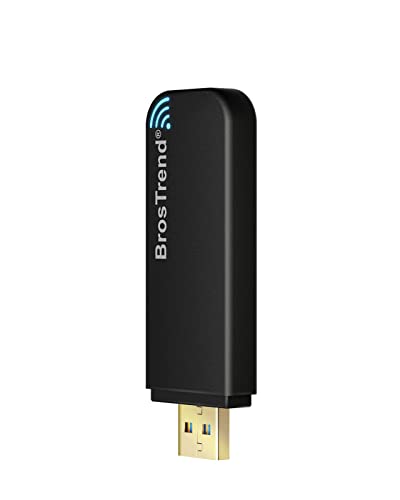
Best Value Linux AC Adapter – BrosTrend AC1200
The BrosTrend AC1200 is a practical option among wifi adapters for Linux when you want dual-band wireless without needing Wi-Fi 6E. It works out of the box on Linux kernels 6.2 and newer, while a manual installer supports certain Debian-based systems with older kernels.
Best For: Linux desktop, laptop, and Raspberry Pi users who need dependable 2.4 GHz and 5 GHz connectivity for streaming, browsing, and general networking.
Pros:
- Plug-and-play support for Linux distributions running kernel 6.2 or newer.
- Manual driver support is available for Debian-based kernels 4.4–7.0.
- AC1200 speeds reach up to 867 Mbps on 5 GHz and 300 Mbps on 2.4 GHz.
- USB 3.0 and dual internal antennas support faster, more stable connections.
Cons:
- Older kernels may require manual driver installation.
- Bluetooth is not supported.
- It uses Wi-Fi 5 rather than newer Wi-Fi 6 or 6E technology.
This adapter balances broad Linux compatibility with useful AC1200 performance. It is a sensible pick for users who want straightforward dual-band wireless and do not need the latest Wi-Fi standard.
Best High-Gain Windows Adapter – TP-Link Archer T2U Plus
The TP-Link Archer T2U Plus offers an adjustable 5 dBi antenna and dual-band AC600 connectivity, making it useful for improving wireless reception on compatible Windows PCs. However, it is not a Linux-supported model, so it should not be your first choice among wifi adapters for Linux.
Best For: Windows desktop and laptop users who prioritize antenna adjustability and improved reception over maximum wireless speed.
Pros:
- Dual-band speeds reach up to 433 Mbps on 5 GHz and 200 Mbps on 2.4 GHz.
- High-gain 5 dBi antenna can be rotated toward the router.
- Supports Windows 11, 10, 8.1, 8, 7, and XP.
- Supports 802.11ac for faster connections than older wireless N adapters.
Cons:
- The supplied compatibility information does not list Linux support.
- Driver download and installation are required.
- Lower maximum speeds than the BrosTrend Wi-Fi 5 and Wi-Fi 6E options.
The Archer T2U Plus is appealing for Windows users dealing with weak reception because its antenna can be repositioned. For Linux, choose a model with explicitly stated kernel support instead.
Best Plug-and-Play Pick – AC650 Linux WiFi Adapter
If you want one of the more straightforward wifi adapters for Linux, the BrosTrend AC650 is built around Linux compatibility. It works with distributions using kernel 6.2 or newer without a separate driver, while the included installer supports certain Debian-based systems with older kernels.
Best For: Linux desktop users, Raspberry Pi owners, and anyone needing dual-band WiFi with an adjustable external antenna.
Pros:
- Plug-and-play support on Linux kernel 6.2 and newer.
- Supports numerous distributions, including Ubuntu, Debian, Raspberry Pi OS, Kali Linux, Fedora, and Arch Linux.
- Dual-band AC650 connectivity with up to 433 Mbps on 5 GHz and 200 Mbps on 2.4 GHz.
- Adjustable 5 dBi high-gain antenna can help improve signal stability.
Cons:
- Older-kernel support requires manual driver installation and is limited to specified Debian-based systems.
- Uses a USB 2.0 interface.
This adapter is a practical all-around Linux upgrade when broad distribution support and flexible antenna positioning matter more than the newest WiFi standard.
Best Compact Budget Pick – TL-WN725N Nano WiFi Adapter
The TP-Link TL-WN725N is a tiny, simple option among wifi adapters for Linux. It supports older Linux kernels from 2.6.18 through 4.4.3, but driver installation may be required. Its 2.4 GHz-only design keeps the adapter affordable and compact.
Best For: Users with older Linux systems who want a low-profile adapter for basic browsing, streaming, and internet calls.
Pros:
- Nano-sized design can remain plugged in with minimal protrusion.
- Supports Linux kernels 2.6.18–4.4.3, along with older Windows and macOS versions.
- Provides wireless N speeds up to 150 Mbps on the 2.4 GHz band.
- Includes a two-year warranty and free 24/7 technical support.
Cons:
- 2.4 GHz only; it does not support 5 GHz WiFi.
- Driver installation may be required for Linux.
- Its 150 Mbps maximum is below the other adapters in this roundup.
The TL-WN725N makes the most sense for older hardware or basic connectivity needs where a nearly invisible adapter is more important than dual-band speed.
Best High-Speed WiFi 6E Pick – AXE5400 Tri-Band Adapter
For demanding Linux workloads, the BrosTrend AXE5400 is the performance-focused choice among these wifi adapters for Linux. It adds WiFi 6E tri-band connectivity, including the 6 GHz band, but requires the Linux driver to be installed before plugging in the adapter and is limited to supported distributions.
Best For: Compatible Debian-based Linux systems handling large transfers, high-speed downloads, or latency-sensitive tasks.
Pros:
- WiFi 6E tri-band support with up to 2,402 Mbps on both 6 GHz and 5 GHz, plus 574 Mbps on 2.4 GHz.
- Supports many recent Ubuntu, Debian, Raspberry Pi OS, Linux Mint, and related distributions.
- Dual adjustable antennas can improve reception and link quality.
- Includes WPA3 security, USB 3.0, OFDMA, and MU-MIMO support.
Cons:
- Driver installation is required before connecting the adapter, and internet access is needed.
- Not compatible with several distributions, including Arch Linux, Fedora Workstation, Kali Linux, Manjaro, and openSUSE Leap.
- 6 GHz availability depends on using a recent supported Linux distribution.
This is the strongest option for compatible systems, but its distribution restrictions and pre-installation requirement make checking Linux support essential before buying.
Best Linux Plug-and-Play Pick – MT7601U WiFi Adapter
If you want one of the more straightforward wifi adapters for linux, this compact 2.4 GHz USB dongle is built around the MediaTek MT7601U chipset. It is intended to work with Linux kernels 4.2 and newer and supports Ubuntu, Debian, Fedora, Mint, Arch, and other distributions.
Best For: Linux users who prioritize simple setup, Tails compatibility, and dependable everyday 2.4 GHz connectivity.
Pros:
- Native driver support for Linux kernels 4.2 and newer.
- Compatible with Tails, Windows 7–11, Android via OTG, macOS, and Raspberry Pi.
- Includes an antenna and supports up to 150 Mbps over 802.11b/g/n networks.
- Supports WEP, WPA, and WPA2 security.
Cons:
- Limited to the 2.4 GHz band and a stated maximum of 150 Mbps.
- Older macOS versions may require drivers.
This adapter makes the most sense for Linux desktops, Tails setups, and basic wireless access rather than high-throughput dual-band networking. Its Linux-focused MT7601U platform and included antenna are the main reasons to consider it.
Best Dual-Band Value – AC600 USB WiFi Adapter
This AC600 dongle is a practical option when you need dual-band connectivity from a desktop or laptop. Among wifi adapters for linux, it stands out for supporting both 2.4 GHz and 5 GHz networks, with compatibility listed for Ubuntu 22.04, selected newer Linux environments, Windows, and older macOS versions.
Best For: Users upgrading an older PC or laptop who want 2.4/5 GHz support and broad stated operating-system compatibility.
Pros:
- Supports dual-band 2.4 GHz and 5 GHz Wi-Fi with AC600-rated performance.
- Includes an external antenna and can operate as a hotspot through soft AP mode.
- Lists compatibility with Ubuntu 22.04, Armbian, Windows, and macOS 10.9–10.13.
- USB 2.0 design works with desktops, laptops, and Raspberry Pi setups.
Cons:
- Some operating systems require driver installation from the included mini CD or a download.
- Linux compatibility is distribution and kernel specific rather than universal.
- The listed warranty is only one month.
Choose this model if dual-band flexibility matters more than a completely driver-free Linux setup. Before buying, verify your distribution and kernel against the supplied compatibility information and make sure you have a way to obtain the driver.
Best WiFi 6E Upgrade – Panda PAU0F AXE3000
The Panda PAU0F is the performance-oriented choice in this group of wifi adapters for linux. Its USB 3.0 connection, dual adjustable antennas, and tri-band support cover 2.4 GHz, 5 GHz, and the dedicated 6 GHz WiFi 6E band when paired with a compatible router.
Best For: Linux users with WiFi 6E routers who want access to the 6 GHz band, higher throughput, and adjustable antennas.
Pros:
- Supports tri-band 2.4/5/6 GHz WiFi 6E connectivity.
- Works with many listed Linux distributions, including Ubuntu, Mint, Fedora, Kali, and Raspbian.
- Dual adjustable antennas help users locate a stronger connection and signal range.
- Supports WEP, WPA, WPA2, and WPA3 security standards.
Cons:
- 6 GHz operation requires a compatible WiFi 6E router.
- Windows 11 is supported, but Windows 10 is not listed as compatible.
- Virtual-machine guest OS use may require contacting Panda Wireless for guidance.
This is the strongest fit for a modern Linux system and a WiFi 6E network, especially where 6 GHz access and lower-latency throughput are priorities. It is less compelling for users with only older 2.4 GHz or 5 GHz routers.
How We Picked the Best Wifi Adapters for Linux
We focused on adapters with clearly identified Linux compatibility, broad support for distributions such as Ubuntu, Mint, Debian-based systems, Kali, Raspberry Pi OS, and other popular platforms. We also considered chipset and kernel requirements, wireless standard, band support, USB interface, physical design, and the practical reputation of each product category.
Because Linux support can vary by kernel and distribution, compatibility claims should be checked against your exact setup before purchase. A plug-and-play claim is most useful when it specifies supported kernels or operating systems.
Quick Comparison
| Type | Best For | What to Look For |
|---|---|---|
| Compact N150 adapter | Basic browsing and troubleshooting | Simple drivers, small size, 2.4GHz support |
| AC600 dual-band adapter | Everyday desktops and laptops | 2.4GHz and 5GHz support, Linux driver availability |
| AC1200 or AX180 adapter | Streaming and faster home networks | USB 3.0, supported chipset, suitable kernel |
| AX3000 or AXE5400 adapter | High-speed WiFi 6 or 6E networking | 6GHz support where available, newer kernel compatibility |
Key Buying Factors for Wifi Adapters for Linux
Driver and Kernel Support
Prioritize adapters that name your distribution and kernel range. Newer WiFi 6E hardware may need a recent kernel, firmware package, or an out-of-tree driver, while older 2.4GHz models can be easier to configure on legacy systems.
Wireless Standard and Bands
Dual-band AC adapters provide access to less-congested 5GHz networks. WiFi 6 models can improve efficiency on compatible routers, while WiFi 6E adds the 6GHz band—but only when your router, region, operating system, and adapter all support it.
USB Speed, Antennas, and Placement
USB 3.0 is preferable for faster adapters, especially during large downloads or local transfers. External antennas or a USB extension cable can improve placement and reception on desktop PCs. Nano adapters are convenient but may sacrifice range and sustained performance.
Security and Intended Workload
For ordinary internet access, prioritize stable connectivity and current security support. If you use Kali, Tails, or other specialized distributions, verify monitor-mode, packet-injection, and chipset support separately; these features are not guaranteed by a general Linux compatibility claim.
Who Should Buy Which Wifi Adapters for Linux?
Choose a compact N150 model for a low-cost backup connection, lightweight browsing, or older hardware. Choose AC600 for a balanced everyday upgrade when you need both 2.4GHz and 5GHz. Choose AC1200 or AX180 for streaming, gaming, and faster broadband on a compatible USB port.
Choose AX3000 or AXE5400 if you have a modern WiFi 6 or WiFi 6E router and want higher throughput or better network efficiency. These models make the most sense for newer kernels and users willing to confirm firmware and driver requirements. For Raspberry Pi, Odroid, or similar systems, check power limits, architecture support, and available USB bandwidth before ordering.