VCA compressors remain a reliable choice when you need fast, repeatable dynamics control without sacrificing punch or clarity. They can tighten a stereo bus, smooth vocals, control peaks, or add familiar console-style glue.
This roundup compares 10 VCA audio compressors across studio, rackmount, 500-series, live, and streaming applications, with attention to controls, connectivity, flexibility, and practical value.
Best 10 Vca Audio Compressors Picks for 2026
Warm Audio Bus-Comp

- Stereo VCA bus compression
- Five ratios and sidechain filter
- CineMag transformers included
Best For: Hardware mixing and recording setups
Behringer Composer Pro-XL
2-Channel Compressor with De-Esser

- Compressor, limiter, and gate
- Built-in de-esser
- Two-channel processing
Best For: Versatile audio production and mixing
dbx 560A
Compact Analog VCA Compressor/Limiter

- 500 Series, one-slot format
- OverEasy and hard-knee curves
- Detailed LED metering
Best For: Portable, studio, and broadcast processing
SSL BusPlus

- SSL circuit with 2181 THAT VCAs
- Four stereo and mono operating modes
- Three compression coloration options
Best For: Flexible mix-bus shaping
Analog Recall Specialist
WesAudio Dione 500 Stereo Compressor
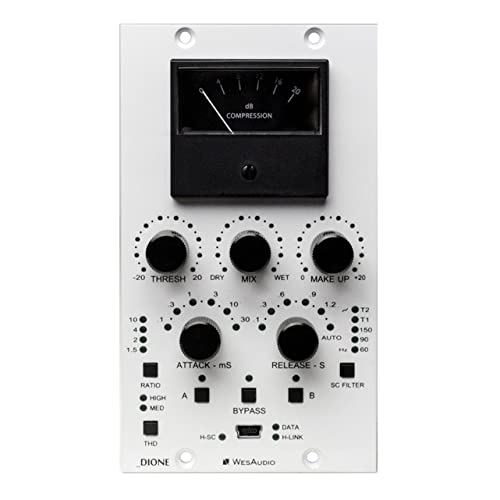
- Analog 500-series bus compressor
- Digital recall for repeatable settings
- Compact 1.7-pound design
Best For: Engineers wanting analog bus compression with digital recall
SSL Glue and Punch
Solid State Logic THE BUS+ Compressor

- 2181 THAT VCA-based analogue performance
- Four modes and three coloration options
- Built-in Dynamic Analogue Equalizer
Best For: Mix engineers wanting versatile SSL-style bus processing
Dual-Channel Control
Professional 1U VCA Compressor

- Dual-channel compression with Overeasy mode
- Built-in noise gate and LED monitoring
- XLR/TRS I/O with sidechain insert
Best For: Studio, live, and streaming dynamics control
Transformer-Driven Bus Control
Successor Stereo Bus Compressor

- Carnhill transformer-balanced I/O
- Stereo bus compression
- Stepped diode-bridge controls
Best For: Classic analog stereo bus processing
Versatile Vocal Dynamics

- Dual-channel Overeasy compression
- Noise gate and LED metering
- XLR/TRS I/O with sidechain insert
Best For: Vocals, live sound, and streaming
Flexible Stereo Shaping

- Peak/RMS detection
- Sidechain high-pass filter
- Dry/wet blend and knee controls
Best For: Detailed stereo dynamic shaping
Warm Audio Bus-Comp – Stereo VCA Bus Compressor
The Warm Audio Bus-Comp is a hardware stereo VCA bus compressor aimed at mixing and recording setups. Its five ratios, sidechain input filter, and CineMag transformers give it useful control options for shaping a stereo mix bus.
Best For: Mix engineers seeking a stereo VCA compressor with transformer-based character and sidechain filtering.
Pros:
- Stereo VCA bus compression in a dedicated hardware unit
- Five compression ratios for flexible dynamics control
- Sidechain input filter and CineMag transformers included
Cons:
- At 9.7 pounds, it is less convenient for highly portable setups
- Its corded-electric design requires a dedicated power connection
Choose this model if you want a classic-style, metal hardware compressor with transformer features and practical bus-processing controls. It is especially suited to fixed recording or mixing environments.
Behringer Composer Pro-XL – 2-Channel Compressor with De-Esser
The Behringer Composer Pro-XL MDX2600 is a two-channel compressor, limiter, and gate with a de-esser. For buyers comparing vca audio compressors, it offers a broad dynamics-processing feature set for audio production, mixing, and mastering.
Best For: Budget-conscious users who need two-channel compression alongside limiting, gating, and de-essing.
Pros:
- Combines compressor, limiter, and gate functions
- Includes de-esser functionality
- Two-channel design for flexible processing
- Listed with a two-year warranty
Cons:
- The supplied notes do not specify detailed VCA topology or ratio controls
- Its rack-style dimensions may be less suitable for compact desktop setups
The Composer Pro-XL is a practical choice when one unit needs to cover several dynamics duties. Its feature mix makes it more of an all-purpose processor than a narrowly focused bus compressor.
Dbx 560A – Compact Analog VCA Compressor/Limiter
The dbx 560A is a compact 500 Series stereo compressor/limiter using analog VCA compression. It pairs switchable OverEasy and hard-knee curves with wide-ranging controls, making it suitable for portable, tour, studio, and broadcast applications.
Best For: 500 Series users who want compact VCA compression from subtle vocal smoothing through hard-hitting drum processing.
Pros:
- Analog VCA compression from dbx, identified in the notes as the inventors of the technology
- Switchable OverEasy and hard-knee compression curves
- 19-segment level indicators and gain-reduction monitoring
- Supports compression through brick-wall peak limiting and Infinity+ negative ratios
Cons:
- It occupies one 500 Series rack slot rather than functioning as a standalone rack unit
- The supplied notes list an RCA connector, which may require compatibility checking
This is a strong fit for buyers prioritizing a compact 500 Series format and detailed metering. Its curve options and broad compression range cover both transparent control and more aggressive effects.
SSL BusPlus – Versatile SSL Bus Compressor
The Solid State Logic BusPlus is a versatile bus compressor built around an authentic SSL circuit with high-performance 2181 THAT VCAs. It provides four operating modes, expanded attack and release options, and three compression colorations for more control over stereo and multi-format bus processing.
Best For: Mixers who want an SSL-style bus compressor with stereo, dual-mono, Mid-Side, and coloration options.
Pros:
- Uses an SSL Bus Compressor circuit with 2181 THAT VCAs
- Offers Classic Stereo, S/C Stereo, Dual Mono, and Mid-Side modes
- Includes additional attack and release options, including Auto 2
- Provides three distinct compression coloration options
Cons:
- At 7.03 kg, it is comparatively heavy for a portable setup
- The supplied notes list a one-year warranty
The BusPlus stands out when flexibility matters as much as familiar SSL bus-compression behavior. Its multiple modes and coloration choices make it a particularly adaptable option for detailed mix-bus shaping.
Analog Recall Specialist – WesAudio Dione 500 Stereo Compressor
The WesAudio DIONE is a 500-series analog bus compressor with digital recall, making it a practical choice for engineers who want traditional compression hardware while retaining convenient setting recall. Among VCA audio compressors, it stands out for hybrid analog-and-digital workflow potential in a compact format.
Best For: Mix engineers seeking an analog 500-series bus compressor with digital recall.
Pros:
- Analog 500-series bus compression design.
- Digital recall supports repeatable workflows.
- Compact 1.7-pound form factor.
Cons:
- 500-series format requires a compatible rack or chassis.
- The supplied details do not specify connectivity or detailed controls.
The DIONE is a focused option for studios already invested in 500-series hardware. Choose it when analog bus compression and recallability matter more than an extensive list of documented onboard features.
SSL Glue and Punch – Solid State Logic THE BUS+ Compressor
Solid State Logic THE BUS+ is a feature-rich stereo compressor built around 2181 THAT VCAs. For shoppers comparing VCA audio compressors, it combines SSL-style mix-bus glue and punch with four operating modes, three compression coloration options, and additional processing through its Dynamic Analogue Equalizer.
Best For: Mix engineers who want SSL-style bus compression with multiple coloration and processing options.
Pros:
- Uses 2181 THAT VCAs for analogue performance.
- Offers four modes and three compression coloration options.
- Includes the Dynamic Analogue Equalizer and XLR/USB connectivity.
Cons:
- Its many modes and processing tools may be more than a minimalist setup needs.
- The supplied details do not specify dimensions or weight.
THE BUS+ is the strongest fit here for users who want more than basic compression. Its combination of SSL bus character, selectable coloration, and D-EQ makes it a versatile centerpiece for mix-bus processing.
Dual-Channel Control – Professional 1U VCA Compressor
This professional dual-channel rackmount compressor is designed for studio, live, and streaming duties. Its classic VCA circuitry, Overeasy compression, auto attack and release settings, noise gate, LED monitoring, and sidechain insert give it a practical feature set for managing vocals and other dynamic sources.
Best For: Studio, live, and streaming setups needing dual-channel compression with gating and sidechain routing.
Pros:
- Dual-channel design for controlling multiple sound sources.
- Includes Overeasy compression, auto attack/release, and a noise gate.
- XLR/TRS I/O and sidechain insert support flexible routing.
- LED indicators show gain reduction, compression, and gate thresholds.
Cons:
- The supplied details do not identify the manufacturer or model name.
- Its 1U rackmount format is less suitable for portable setups.
- The supplied notes do not specify the exact compression ratio range.
This unit is a practical choice when straightforward dynamics control and connectivity are priorities. It is especially appealing for vocal chains and live or streaming rigs that benefit from integrated gating and sidechain access.
Transformer-Driven Bus Control – Successor Stereo Bus Compressor
For a classic approach to vca audio compressors, the Successor Stereo Bus Compressor combines stereo bus compression with Carnhill transformer-balanced I/O and a diode-bridge design. Its stepped controls support repeatable settings in analog mixing workflows.
Best For: Stereo bus processing and classic analog mixing setups.
Pros:
- Carnhill transformer-balanced input and output.
- Stereo bus compressor with a classic analog design.
- Stepped controls help with consistent, repeatable adjustments.
Cons:
- Its diode-bridge design may be less suitable for users seeking a modern, highly flexible compressor.
- Included components are limited to the main device.
The Successor is a focused choice for engineers who want transformer-balanced connectivity and stepped analog control rather than a feature-heavy rack unit.
Versatile Vocal Dynamics – Dual-Channel VCA Compressor
This dual-channel unit is a practical option among vca audio compressors for vocals, live sound, streaming, and studio use. It combines Overeasy compression, adjustable attack and release, LED metering, a noise gate, and sidechain connectivity in a rackmount format.
Best For: Vocal processing, voiceovers, live systems, streaming, and dual-channel rack setups.
Pros:
- Dual-channel compression with adjustable attack and release.
- XLR and 1/4-inch TRS inputs and outputs for flexible integration.
- Built-in noise gate, LED metering, and sidechain insert.
- Includes a two-year warranty.
Cons:
- Its 110-volt corded-electric power requirement may limit deployment in some regions.
- The feature set may be more than needed for a simple single-channel setup.
Choose this compressor when connection flexibility and extra dynamics tools matter. The sidechain, gate, and dual-channel layout make it especially adaptable for vocal and live-production workflows.
Flexible Stereo Shaping – 7721 Stereo VCA Compressor
The 7721 Stereo VCA Compressor offers practical control for engineers comparing vca audio compressors for stereo sources. Its peak/RMS detection, sidechain high-pass filter, soft/hard knee switch, dry/wet blend, and ratio controls support detailed dynamic shaping.
Best For: Stereo processing where detection, blending, and knee-shape controls are priorities.
Pros:
- Peak/RMS detection supports different compression responses.
- Sidechain high-pass filter helps tailor detector behavior.
- Soft/hard knee, ratio, and dry/wet blend controls add flexibility.
- Two-channel design with RCA and XLR audio inputs.
Cons:
- At 13.5 pounds, it is relatively heavy for a rack-based processor.
- The supplied specifications do not identify supported software updates.
With multiple detection and blend options, the 7721 is suited to users who want more control over stereo compression behavior. Its RCA and XLR inputs also accommodate different connection environments.
How We Picked These Vca Audio Compressors
We selected models that represent the main ways buyers use VCA compression: stereo bus processing, vocal and channel control, portable or live-rack setups, 500-series systems, and affordable studio rigs. We considered compression controls, metering, sidechain options, connectivity, format, channel flexibility, and whether each unit suits transparent control or more characterful bus processing.
Because specifications and pricing can change, confirm the current feature set and dimensions before ordering—especially for rack units, 500-series modules, and products sold under broad marketplace descriptions.
Quick Comparison
| Best For | What to Prioritize | Useful Format |
|---|---|---|
| Stereo mix bus | Linkable channels, flexible attack and release, accurate metering | 2-channel rack or desktop |
| Vocals and single channels | Reliable threshold, ratio, makeup gain, and peak control | Mono or dual-channel rack |
| 500-series systems | Module compatibility, stereo linking, rear-panel access | 500-series |
| Live and streaming | Simple controls, robust construction, useful I/O, low setup complexity | Rackmount or desktop |
| Budget systems | Noise performance, sidechain access, metering, and warranty support | Rack or compact processor |
Key Buying Factors for Vca Audio Compressors
Channel Layout and Stereo Linking
For a mix bus, choose a true stereo processor or a dual-channel unit with reliable link controls. Linked compression helps preserve the stereo image, while independent channels are more useful for separate vocals, instruments, or parallel processing.
Control Range and Timing
Attack and release controls determine whether transients remain lively or become more controlled. A wide ratio range and an adjustable threshold provide greater flexibility, while auto-release or program-dependent options can simplify bus compression.
Sidechain and Filtering
Sidechain filtering can prevent bass-heavy material from making the compressor pump. External sidechain inserts are valuable for ducking, de-essing experiments, and specialized control, but they may be unnecessary if your workflow only requires straightforward compression.
Metering, Headroom, and Connectivity
Look for clear gain-reduction and output meters, balanced inputs and outputs where possible, and enough headroom for professional levels. XLR and TRS connections can make a unit easier to integrate into studio patchbays, interfaces, mixers, and live systems.
Extra Processing
Noise gates, de-essers, limiters, and mix controls can expand a compressor’s usefulness, particularly for vocals, streaming, and live sound. However, additional features should not replace solid compression controls and dependable signal handling.
Who Should Buy Which Vca Audio Compressors?
Choose a Stereo Bus Compressor for Mix Glue
Producers and engineers shaping full mixes should prioritize a stereo VCA design with channel linking, precise timing controls, and useful metering. These features make subtle cohesion easier without forcing heavy pumping.
Choose a Dual-Channel Rack Unit for Flexible Tracking
Studios recording vocals, bass, guitars, or keyboards may get more value from two independent channels, especially when the unit includes sidechain access, a gate, or a limiter.
Choose a 500-Series Compressor for Modular Rigs
If you already own a compatible lunchbox, a 500-series compressor can save space and fit naturally into a modular recording setup. Confirm power requirements and stereo-linking behavior before buying.
Choose a Feature-Rich Budget Unit for Live or Streaming Work
Live operators and streamers often benefit from simple metering, dependable peak control, and useful vocal-processing extras. Prioritize easy setup and appropriate balanced connectivity over boutique features you will rarely use.