The best compact headphone amplifiers make it easier to share one audio source, drive demanding headphones, or add useful controls to a desktop or portable setup without sacrificing valuable space.
This roundup covers simple multi-output splitters, portable rechargeable amps, and compact DAC-equipped models so you can match the amplifier to your headphones, source, and listening habits.
Best 10 Compact Headphone Amplifiers Picks for 2026
Session Splitter

- Four outputs with independent level controls
- Supports 1/4-inch and 1/8-inch source connections
- Compact metal chassis for desks, racks, or stands
Best For: Shared monitoring in tracking sessions and rehearsals
Desktop DAC Hub
Fosi Audio Q4 DAC Headphone Amp

- USB, optical, and coaxial digital inputs
- 24-bit/192kHz support with RCA and 3.5mm outputs
- Bass and treble controls in a metal tabletop design
Best For: Desktop and home stereo systems needing digital inputs
Four-Channel Monitor Amp
LZSIG LHA2 Headphone Amplifier
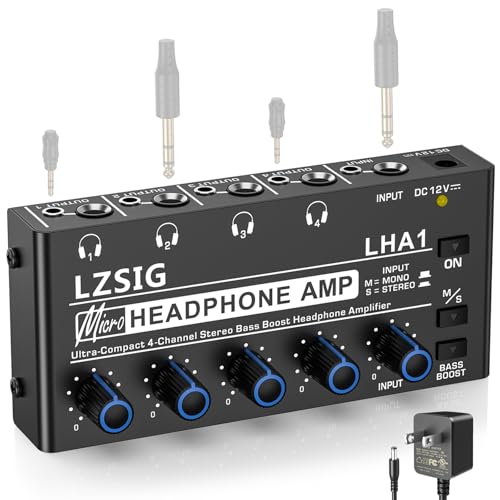
- Four independent outputs for 32–100Ω headphones
- Stereo/mono switching and bass-boost function
- Metal chassis with durable control knobs
Best For: Home studios and shared monitoring with up to four listeners
Portable Monitor Amp
Donner EM1 Portable Headphone Amplifier

- Up to 12 hours of rechargeable battery operation
- XLR and TRS inputs with 3.5mm output
- Belt-pack clip for mobile monitoring
Best For: Portable personal monitoring for musicians and performers
Best Multi-Listener Pick

- Four stereo headphone outputs
- Independent volume for each listener
- Compact studio monitoring design
Best For: Shared recording and playback sessions
Best Portable Option
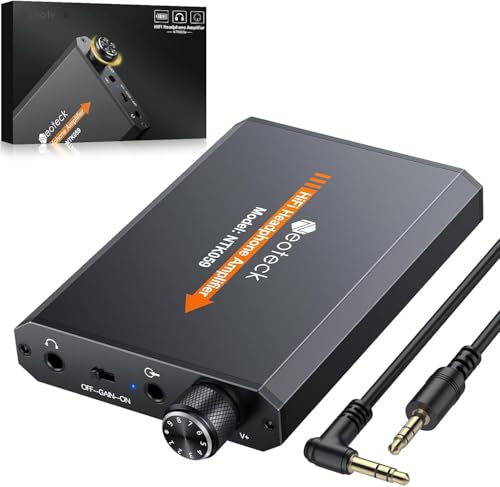
- Supports 16–300Ω headphones
- Rechargeable battery with 12+ hours of use
- Compact aluminum body with gain switch
Best For: Travel and mobile listening
Best Desktop Audiophile Pick

- Class A desktop headphone amplifier
- 3.5mm and 6.35mm headset support
- Replaceable op-amp socket for upgrades
Best For: Desktop systems and high-impedance headphones
Best Rechargeable Option
eSynic 16-600Ω Portable Headphone Amplifier

- Supports 16-600Ω headphones
- Two-stage gain switch
- 12+ hours of rechargeable playback
Best For: Portable listeners using varied headphone impedances
Best for Shared Monitoring
Pyle PHA40 4-Channel Headphone Amplifier

- Powers four headphones
- Independent volume controls
- Compact corded design
Best For: Studios and recording sessions with multiple listeners
Best Budget Hi-Fi Pick
LVY A010 Portable Headphone Amplifier
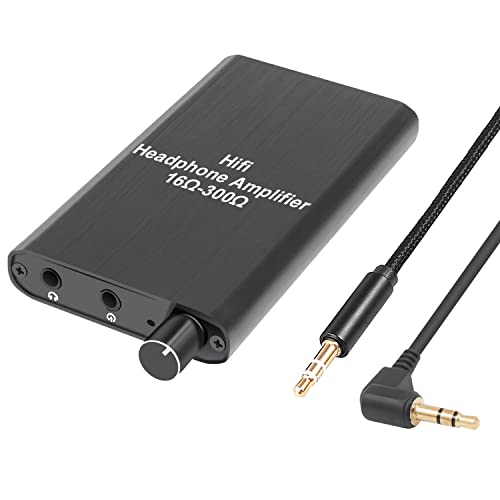
- Supports 16-300Ω headphones
- Two-stage gain control
- Rechargeable 3.5mm design
Best For: Everyday portable listening with phones and laptops
Session Splitter – Mackie HM-4
The Mackie HM-4 is a straightforward choice among compact headphone amplifiers when several people need to monitor the same source. Its four outputs provide separate level controls, while the small metal chassis is easy to place on a desk, rack, or stand.
Best For: Tracking sessions, rehearsals, and shared monitoring with up to four listeners.
Pros:
- Four independent headphone outputs with individual volume controls
- Accepts 1/4-inch or 1/8-inch source connections
- Compact metal build can be secured with Velcro
- Plug-and-play operation with corded power
Cons:
- Designed for distribution rather than digital conversion or tone shaping
- Power source is corded electric
The HM-4 keeps the setup simple: connect a source, plug in up to four headphones, and let each listener set a comfortable level. It is a practical multi-listener amp for basic studio and rehearsal workflows.
Desktop DAC Hub – Fosi Audio Q4 DAC Headphone Amp
The Fosi Audio Q4 combines a headphone amplifier with a compact DAC for computer, TV, and desktop stereo systems. USB, optical, and coaxial inputs give it broader connectivity than a basic splitter, while RCA and 3.5mm outputs support headphones and powered audio equipment.
Best For: Desktop listening setups that need digital inputs, headphone output, and simple tone controls.
Pros:
- USB, optical, and coaxial inputs
- RCA and 3.5mm outputs for headphones, speakers, or amplifiers
- Supports 24-bit/192kHz audio
- Bass, treble, and smooth volume controls
Cons:
- No microphone input
- Not intended as a multi-listener headphone splitter
Choose the Q4 when your system needs digital-to-analog conversion as well as headphone amplification. Its metal tabletop design and included cables make it a convenient entry-level hub for a compact desktop or home stereo.
Four-Channel Monitor Amp – LZSIG LHA2 Headphone Amplifier
The LZSIG LHA2 is one of the more feature-rich compact headphone amplifiers for shared studio monitoring. It drives up to four pairs of 32–100Ω headphones, gives every listener an independent level control, and adds stereo/mono switching plus a bass-boost function.
Best For: Home studios, stage applications, and group monitoring with multiple headphone types.
Pros:
- Four outputs with independent volume controls
- Compatible with 3.5mm and 6.35mm TS or TRS plugs
- Stereo/mono switch and selectable bass boost
- Metal chassis and heavy-duty control knobs
Cons:
- It is a headphone amplifier, not a mixer
- Designed around 12V power
- Bass boost changes the tonal balance rather than providing neutral-only operation
The LHA2 suits setups where flexibility and durability matter more than the simplest possible splitter. Its channel controls and format switching make it useful for personal or shared monitoring, while the metal enclosure is suited to regular session use.
Portable Monitor Amp – Donner EM1 Portable Headphone Amplifier
The Donner EM1 takes compact headphone amplifiers in a portable direction, using a rechargeable battery and belt-pack clip for mobile monitoring. Its XLR and TRS inputs, stereo/mono switch, and 3.5mm output are aimed at in-ear and on-ear monitor use rather than microphone capture.
Best For: Musicians and performers who need a portable personal monitor amplifier for professional headphones or IEMs.
Pros:
- Rechargeable Li-ion battery provides up to 12 hours of operation
- XLR and TRS inputs with a locking connector mechanism
- Stereo/mono source switch
- Metal belt-pack clip and compact design
Cons:
- Does not support microphones
- Provides a personal monitor output rather than four shared headphone channels
- Its feature set is focused on analog monitoring, not digital conversion
The EM1 is a strong fit when portability and battery operation are priorities. It offers a practical way to boost and control a personal monitor feed in live or mobile settings, provided your headphones and source use the supported connections.
Best Multi-Listener Pick – Behringer HA400
If you need compact headphone amplifiers for recording sessions, rehearsals, or shared playback, the Behringer HA400 is built to distribute one stereo source to four listeners. Each output has its own level control, making it practical when users prefer different headphone volumes.
Best For: Small studios, bands, and monitoring setups where up to four people need independent headphone volume control.
Pros:
- Provides four stereo headphone outputs with separate volume controls.
- Works with practically any headphones and suits interfaces, mixers, and studio equipment.
- Uses low-noise 4580 operational amplifiers and includes a 12V DC adapter.
Cons:
- Requires a DC power supply, so it is not intended for mobile listening.
- Its four-channel studio design is more specialized than a simple single-headphone amplifier.
The HA400 is a straightforward choice when the priority is sharing a stereo mix among several listeners. Its compact enclosure and four independent outputs offer useful monitoring flexibility without the complexity of a larger distribution system.
Best Portable Option – Neoteck 16-300Ω Headphone Amp
Among compact headphone amplifiers for travel, the Neoteck combines a smartphone-sized aluminum body with rechargeable power and a selectable two-stage gain switch. Its 3.5mm connections and broad stated impedance range make it suitable for phones, laptops, media players, and headphones from 16 to 300 ohms.
Best For: Mobile listeners who want a rechargeable amplifier with volume control and support for low-, mid-, and high-impedance headphones.
Pros:
- Supports headphones rated from 16 to 300 ohms.
- Offers a two-stage gain switch, volume adjustment, and 3.5mm audio connections.
- Rechargeable 1500mAh battery provides more than 12 hours of continuous use, according to the supplied specifications.
- Lightweight aluminum design is sized for portable use.
Cons:
- Uses 3.5mm connections rather than the 6.35mm input or output found on some desktop equipment.
- Battery operation means it requires periodic charging.
The Neoteck makes the most sense when portability is central to the buying decision. Its gain selection and impedance compatibility add flexibility, while the rechargeable battery avoids relying on a wall outlet during everyday mobile use.
Best Desktop Audiophile Pick – Douk Audio U3
For desktop systems, the Douk Audio U3 is one of the compact headphone amplifiers aimed at listeners who want stronger drive and a more hands-on design. It accepts RCA input, supports both 3.5mm and 6.35mm headsets, and uses a Class A circuit with a replaceable op-amp socket.
Best For: Home or office desktop users driving demanding headphones and interested in experimenting with op-amp upgrades.
Pros:
- Provides 3.5mm and 6.35mm headphone connections for flexible headset compatibility.
- Class A design with a TI NE5532 op amp and transistor current circuit is specified for low distortion and strong drive power.
- Wide 5–20V DC input range and RCA input suit desktop audio systems.
- Pluggable op-amp socket adds upgrade and DIY flexibility.
Cons:
- Designed for powered desktop use rather than portable listening.
- Its upgradeable op-amp design may be unnecessary for users seeking a simple plug-and-play amplifier.
The U3 stands out for desktop listeners who value connection flexibility and customization. Its stated 1300mW maximum output and high-impedance headphone compatibility make it especially appealing for users who want additional drive from a compact home audio component.
Best Rechargeable Option – eSynic 16-600Ω Portable Headphone Amplifier
If you need compact headphone amplifiers for both sensitive in-ear headphones and higher-impedance monitoring models, the rechargeable eSynic is a versatile choice. Its two-stage gain switch supports 16-600Ω headphones, while the aluminum enclosure and 3.5mm connectivity suit portable listening setups.
Best For: Portable listeners and headphone users who want broad impedance support, rechargeable operation, and adjustable gain.
Pros:
- Supports a wide 16-600Ω impedance range.
- Provides low/high gain settings for different headphones.
- Offers 12+ hours of playback and an aluminum enclosure.
- Includes two 3.5mm audio cables.
Cons:
- Uses 3.5mm analog connections rather than digital inputs.
- Its single-channel design is intended for one listener.
With 80mW maximum output, low stated distortion, and rechargeable convenience, the eSynic is a strong all-around option for compact headphone amplifier users who need flexibility across several headphone types.
Best for Shared Monitoring – Pyle PHA40 4-Channel Headphone Amplifier
Among compact headphone amplifiers, the Pyle PHA40 stands out as a distribution solution rather than a personal portable amp. It can power up to four headphones at once, with separate volume controls for each listener and 1/4-inch TRS connections for studio or stage use.
Best For: Home studios, recording sessions, and small performance setups where several people need to monitor the same source.
Pros:
- Drives up to four pairs of headphones simultaneously.
- Provides independent volume controls for each output.
- Uses four 1/4-inch stereo headphone outputs.
- Compact design measures approximately 4.07 × 1.18 × 2.24 inches.
Cons:
- Requires corded electric power.
- Uses 1/4-inch connections, so adapters may be needed for smaller plugs.
- It is designed for shared monitoring, not battery-powered personal listening.
The PHA40 is the practical pick when multiple listeners need independent level control from one source. Its compact form makes it easy to add to a studio or mobile monitoring rig, though it is less suited to everyday phone listening.
Best Budget Hi-Fi Pick – LVY A010 Portable Headphone Amplifier
The LVY A010 is one of the more straightforward compact headphone amplifiers for phones, computers, and other 3.5mm devices. Its two-stage gain switch is designed for 16-300Ω headphones, while the rechargeable format adds portability for everyday listening.
Best For: Users seeking a small, rechargeable 3.5mm amplifier for portable devices and headphones up to 300Ω.
Pros:
- Supports headphones with 16-300Ω impedance.
- Includes a two-stage gain switch.
- Offers stated SNR above 120dB and 0.004% distortion.
- Compatible with MP3 players, phones, laptops, and other 3.5mm devices.
Cons:
- Rated battery use is more than five hours, shorter than some rechargeable alternatives.
- Its 3.5mm auxiliary design does not provide digital audio inputs.
- It supports a narrower impedance range than the eSynic model.
With a small footprint, two gain levels, and broad 3.5mm compatibility, the LVY A010 is a sensible entry-level choice for portable amplification. Consider it when convenience matters more than extended battery life or high-impedance support beyond 300Ω.
How We Picked These Compact Headphone Amplifiers
We selected models across the main use cases buyers encounter: shared listening, desktop headphone amplification, portable playback, and digital-to-analog conversion. We considered channel count, input and output compatibility, portability, power requirements, gain controls, impedance support, and the practical needs of headphones and earphones.
Specifications should be checked against your equipment before purchase. In particular, confirm whether a model uses 3.5mm or 6.35mm connections, requires a power adapter or USB supply, and supports the headphone impedance you plan to use.
Quick Comparison
| Best For | What to Prioritize | Suitable Types |
|---|---|---|
| Sharing one source | Multiple independent outputs and simple volume control | Four-channel headphone amplifiers |
| Desktop listening | Stable power, RCA or USB connectivity, and clean gain | Desktop amps and DAC/amp combinations |
| Travel and mobile use | Rechargeable battery, low weight, and 3.5mm input/output | Portable headphone amplifiers |
| High-impedance headphones | Output power, gain switching, and broad impedance support | Gain-equipped portable or desktop models |
Key Buying Factors for Compact Headphone Amplifiers
Connections and Source Compatibility
Start with the source you will use most. A phone, tablet, or MP3 player commonly needs a 3.5mm connection, while desktop equipment may use RCA, USB, or a 6.35mm headphone plug. A DAC-equipped amplifier can be useful when connecting a computer digitally, but a basic analog amp is often sufficient when your source already has a suitable headphone output.
Number of Outputs
Choose a single-output unit for personal listening and a multi-channel model when several people need to hear the same source. Four-channel amplifiers are convenient for music practice, recording, classrooms, and small production setups. Separate volume controls are especially helpful when listeners use different headphones.
Power, Gain, and Headphone Impedance
Low-impedance earphones generally do not require much amplification, while some high-impedance headphones benefit from more voltage and a gain switch. Avoid using high gain by default with sensitive earphones because it can make volume control less precise and increase the risk of excessive loudness. Check the stated impedance range and power requirements before buying.
Portability and Controls
Rechargeable models are better suited to mobile listening, provided battery runtime and charging convenience meet your needs. Desktop units can offer more stable power and easier access to controls. Bass boost, tone controls, and independent volume knobs are useful only if they fit your listening preferences and setup.
Who Should Buy Which Compact Headphone Amplifiers?
Choose a four-channel amplifier if your priority is sharing one source with multiple listeners or monitoring several headphones at once. Choose a desktop DAC/amp if you mainly listen from a computer and want digital input or a more organized workstation. Choose a rechargeable portable amp for phones, players, and mobile monitoring. Choose a gain-equipped model if you switch between sensitive earphones and higher-impedance headphones.