A four-bay enclosure gives you more room to balance capacity, redundancy, performance, and future expansion than a typical two-drive system. The right choice depends on whether you need a complete network-attached server, a simple USB storage box, or a DIY chassis for custom hardware.
Our 2026 roundup covers full NAS systems, direct-attached storage enclosures, and a DIY option. Compare connectivity, RAID support, drive compatibility, cooling, software, and upgrade potential before choosing the best fit for your data and workflow.
Best 10 Nas Enclosure with Four Bays Picks for 2026
Best All-Around Home NAS

- Intel N100 and 8GB RAM for everyday NAS tasks
- Four SATA bays with RAID 0, 1, or 5 support
- Dual 2.5GbE, 4K HDMI, and two M.2 slots
Best For: Families and home-office users seeking a flexible private cloud
Best USB-C DAS
SABRENT DS-SC4B 4-Bay Enclosure
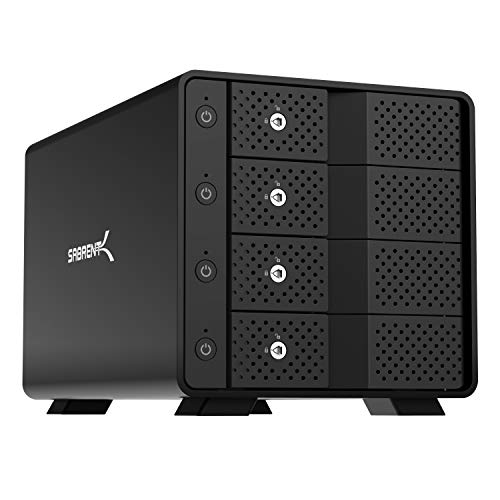
- USB-C 10Gbps direct-attached storage
- Four independent SATA drive connections
- Trayless hot-swap bays with active cooling
Best For: Computer users needing four-drive JBOD storage
Best for Power Users

- Core i3-1315U with expandable DDR5 memory
- 10GbE plus 2.5GbE for high-speed networking
- Supports RAID 0, 1, 5, 10, Docker, and VMs
Best For: Developers, IT professionals, and demanding small teams
Best Quiet DAS
TerraMaster D4-320 4-Bay Enclosure

- USB 3.2 Gen 2 Type-C up to 10Gbps
- Hot-swappable, tool-free individual drive bays
- Temperature-controlled cooling and quieter operation
Best For: Quiet plug-and-play storage expansion for a computer
Best for Creators

- Ryzen processor with expandable 8GB RAM
- Dual 10GbE and SSD expansion
- Supports media, Docker, VMs, and surveillance
Best For: Creators and advanced users needing fast, expandable local storage
Best DAS Expansion
QNAP TR-004 4-Bay RAID Enclosure
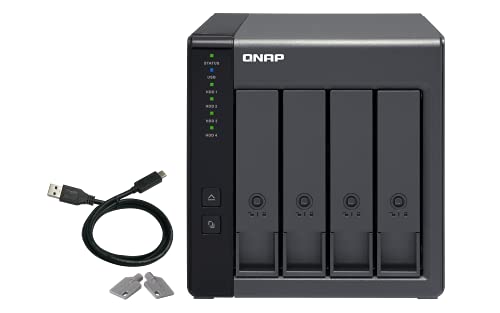
- USB Type-C direct-attached storage
- Hardware RAID 0, 1, 5, JBOD, and single disks
- Lockable, diskless four-bay design
Best For: USB storage expansion and backup for computers or compatible QNAP NAS devices
Best for Beginners

- Automatic photo backup with AI albums
- 8GB RAM and 2.5GbE networking
- Simple cross-device private storage
Best For: Families, beginners, and remote workers building a private cloud
Fastest Versatile Pick

- Four SATA bays support 3.5-inch and 2.5-inch drives
- Up to 10Gbps USB-C and 4K HDMI output
- Automatic cooling with independent bay switches
Best For: Fast external storage and display connectivity
DIY NAS Builder's Choice
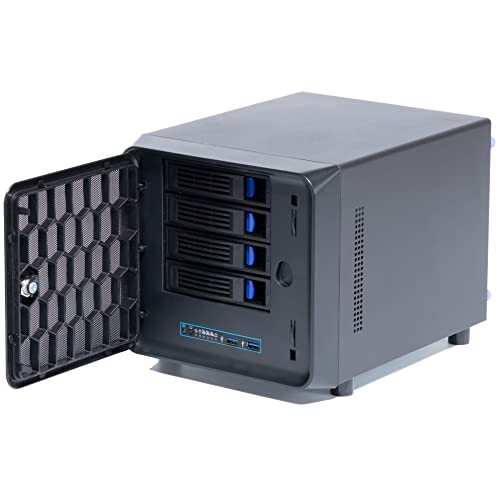
- Fits Mini-ITX motherboards
- Four front bays plus one internal 2.5-inch bay
- Supports Flex/1U PSU and one single-slot PCIe card
Best For: Custom NAS and private-cloud builds
Simple DAS Value Pick
CENMATE Aluminum 4-Bay Enclosure

- Supports four 2.5-inch or 3.5-inch SATA drives
- USB-A/C 3.0 with up to 5Gbps transfer rates
- Tool-free hot swapping and built-in cooling fan
Best For: Plug-and-play direct-attached storage expansion
Best All-Around Home NAS – Zero1 Pro 4-Bay NAS
If you want a true nas enclosure with four bays for household backups, private cloud storage, and media access, the Yxk Zero1 Pro is a capable starting point. Its Intel N100 processor, 8GB of RAM, dual 2.5GbE ports, and four SATA bays provide a practical foundation, though drives must be purchased separately.
Best For: Families, home-office users, and beginners who want guided NAS setup with room for Docker apps or a customized operating system.
Pros:
- Guided mobile-app setup and remote access without a monthly storage subscription.
- Four SATA bays support up to 144TB of combined raw capacity with compatible drives, plus RAID 0, 1, or 5.
- Intel N100, 8GB DDR4 RAM, dual 2.5GbE, 4K HDMI, and two M.2 NVMe slots suit home-server workloads.
Cons:
- Diskless design means HDDs or SSDs must be purchased separately.
- RAID, Docker, and third-party operating-system compatibility may require additional setup and configuration.
The Zero1 Pro balances approachable setup with useful expansion for a home lab. It is especially appealing if you want a four-bay NAS that can begin with family backups and grow into a media server or Docker host.
Best USB-C DAS – SABRENT DS-SC4B 4-Bay Enclosure
The SABRENT DS-SC4B is a four-bay external drive enclosure rather than a network-attached server. For buyers comparing a nas enclosure with four bays, it is worth considering only if direct-attached storage over USB-C meets your needs.
Best For: Windows, macOS, or Linux users who want four independently accessible SATA drives connected directly to a computer.
Pros:
- USB-C 10Gbps connectivity and a dedicated controller for each bay.
- Trayless hot-swap design supports tool-free 3.5-inch drive insertion.
- Aluminum-and-metal housing, 92mm fan, per-bay switches, activity LEDs, and security features support practical desktop use.
Cons:
- It is JBOD direct-attached storage, not a NAS and not hardware RAID.
- Drives are not included.
- Network sharing and remote access depend on the connected computer or operating system.
Choose the DS-SC4B when simplicity and direct USB access matter more than built-in networking. It can consolidate four drives at a computer, but it should not be treated as a standalone NAS replacement.
Best for Power Users – UGREEN DXP4800 Pro 4-Bay NAS
The UGREEN DXP4800 Pro is a high-performance choice for demanding users shopping for a nas enclosure with four bays. Its Core i3-1315U processor, expandable DDR5 memory, fast networking, and support for containers and virtual machines are aimed at more advanced workloads than basic file storage.
Best For: IT professionals, developers, video editors, and growing teams running Docker, virtual machines, private services, or high-speed file transfers.
Pros:
- Intel Core i3-1315U processor, 8GB DDR5 RAM expandable to 96GB, and Intel UHD Graphics.
- Dual 10GbE and 2.5GbE networking can provide transfers up to 1.25GB/s under suitable conditions.
- Four-bay RAID support includes 0, 1, 5, and 10, with two PCIe 4.0 M.2 slots for cache or storage.
Cons:
- The supplied information does not indicate that drives are included, so storage costs are additional.
- Advanced features such as virtual machines, Docker, and multi-user permissions may be more than casual users need.
This is the strongest performance-oriented option in the group. Its expandable memory, 10GbE port, and virtualization support make it a better fit for technical users who expect their NAS to function as an IT and development hub.
Best Quiet DAS – TerraMaster D4-320 4-Bay Enclosure
The TerraMaster D4-320 is a quiet, plug-and-play direct-attached enclosure, not a standalone NAS. If your search for a nas enclosure with four bays is really about adding several drives to a Mac, Windows, or Linux computer, its USB 3.2 Gen 2 connection and hot-swappable bays are useful alternatives.
Best For: Users who want simple four-drive USB storage, tool-free installation, hot swapping, and quieter operation.
Pros:
- USB 3.2 Gen 2 Type-C provides up to 10Gbps connectivity with broad computer-interface compatibility.
- Supports four individual drives, including 3.5-inch SATA HDDs, 2.5-inch SATA HDDs, and 2.5-inch SATA SSDs.
- Tool-free push-lock trays, hot swapping, temperature-controlled cooling, and noise-dampening features improve convenience.
Cons:
- There is no RAID function; the four disks operate individually.
- It is DAS rather than a network-attached NAS, so shared or remote access requires the connected computer.
- Drives are not included.
The D4-320 is a sensible choice for straightforward local expansion and emphasizes easy drive management and reduced noise. Pick it over a true NAS only when direct USB storage is the intended setup.
Best for Creators – High-Speed 4-Bay NAS
The UGREEN DXP4800 GT is a powerful nas enclosure with four bays for creators, office teams, and advanced home users. Its Ryzen processor, expandable memory, dual 10GbE networking, and SSD support suit demanding transfers, media work, backups, and multi-user workloads.
Best For: Creators and technical users who need fast local storage, media workflows, Docker or virtual machines, and surveillance features.
Pros:
- Ryzen R2514 processor, 8GB expandable DDR4 RAM, and support for multitasking.
- Dual 10GbE networking, SSD expansion, and 4K HDMI support.
- Supports Docker, virtual machines, local surveillance, SD-card backup, and up to 144TB total capacity.
Cons:
- Drives are not included.
- Its advanced features may be more than beginners need.
- Surveillance Center supports ONVIF/RTSP cameras only.
Choose the DXP4800 GT when speed and expandability matter more than simplicity. It is particularly well suited to users building a versatile private media, backup, and self-hosting platform.
Best DAS Expansion – QNAP TR-004 4-Bay RAID Enclosure
QNAP TR-004 4 Bay USB Type-C Direct Attached Storage (DAS) with hardware RAID (Diskless)
Check Price On AmazonThe QNAP TR-004 is a direct-attached nas enclosure with four bays that connects over USB Type-C rather than operating as a standalone network NAS. It provides flexible hardware RAID storage for computers or compatible QNAP NAS devices.
Best For: Users who need a simple USB storage expansion, external backup enclosure, or hardware RAID solution for Windows, macOS, Linux, or a compatible QNAP NAS.
Pros:
- Supports RAID 0, 1, 5, JBOD, and individual disks.
- Works with Windows, macOS, Linux, and compatible QNAP NAS devices.
- Lockable bays and included USB Type-C to Type-A cable add practical convenience.
Cons:
- It is diskless and requires separately purchased drives.
- USB connectivity means it is not a standalone network NAS.
- NAS applications cannot be installed on the enclosure, and some QNAP models are unsupported.
The TR-004 is a practical choice when direct USB access and hardware RAID are the priority. Check QNAP compatibility carefully before using it as NAS expansion, since its storage pool cannot be combined with the connected NAS.
Best for Beginners – Easy 4-Bay Private Cloud
The UGREEN DH4300 Plus is an approachable nas enclosure with four bays for families, home users, and remote workers. It combines private local storage with automatic photo backup, AI-assisted album organization, broad device access, and a beginner-focused setup experience.
Best For: Beginners and families replacing cloud storage or scattered external drives with a private photo, media, and backup hub.
Pros:
- Automatic phone photo and video backup with AI album organization and duplicate removal.
- 8GB LPDDR4X RAM, a 2.5GbE port, Docker support, and 4K HDMI output.
- Access across Windows, macOS, Android, iOS, web browsers, and smart TVs.
- Local storage avoids recurring cloud fees and keeps data under user control.
Cons:
- Storage disks are not included.
- It supports Docker but not virtual machines.
- Its entry-level design may be less suitable for demanding professional workloads.
The DH4300 Plus emphasizes ease of use and family-friendly organization over advanced virtualization. It is a strong fit for users who want a straightforward private cloud with generous four-bay capacity and automated photo management.
Fastest Versatile Pick – WAVLINK 4-Bay USB-C Enclosure
For shoppers seeking a nas enclosure with four bays, the WAVLINK combines four SATA 6Gbps slots with USB-C 3.2 connectivity, support for 3.5-inch and 2.5-inch drives, and up to 128TB of stated capacity. It also adds HDMI output and automatic cooling for a flexible desktop storage setup.
Best For: Users who want fast external storage expansion with display connectivity and broad drive-format support.
Pros:
- Supports four 3.5-inch or 2.5-inch SATA HDDs/SSDs, with up to 4x32TB capacity.
- USB-C 3.2 offers data transfer speeds up to 10Gbps.
- Includes HDMI output up to 4K at 60Hz when the host supports video over USB-C.
- Aluminum construction, temperature-controlled dual fans, and independent bay power switches.
Cons:
- 2.5-inch drives require separate mounting brackets, which are not included.
- HDMI functionality depends on a compatible host USB-C video output and USB-C-to-C connection.
- This is presented as an enclosure/docking station rather than a complete NAS with built-in networking.
The WAVLINK is the most feature-rich option here for high-speed direct-attached storage, especially if 4K display output and flexible drive support matter. Confirm your host’s USB-C video compatibility before buying.
DIY NAS Builder's Choice – KCMconmey 4+1 Bay NAS Case
If you want a nas enclosure with four bays that can become a complete private-cloud or NAS system, this KCMconmey case is designed around a Mini-ITX motherboard rather than functioning as a ready-to-use external enclosure. It provides four front drive bays, one additional internal 2.5-inch bay, and expansion options for a custom build.
Best For: DIY builders assembling a compact NAS with their own motherboard, power supply, and operating system.
Pros:
- Supports a Mini-ITX motherboard measuring up to 6.7 x 6.7 inches.
- Provides four 2.5-inch/3.5-inch tray bays plus one internal 2.5-inch bay.
- Accepts Flex or 1U power supplies and one single-slot full-height PCIe card.
- Includes two front USB 3.0 ports and a replaceable 80mm chassis fan.
Cons:
- Requires a separate motherboard, power supply, drives, and NAS software.
- Its compatibility is limited to the specified Mini-ITX board and PSU dimensions.
- The listing describes a chassis with hot-swap backplane support, not a complete turnkey NAS.
This case offers the most flexibility for experienced builders, including room for a PCIe network or graphics card. It is less suitable if you want plug-and-play storage without sourcing and installing the remaining components.
Simple DAS Value Pick – CENMATE Aluminum 4-Bay Enclosure
The CENMATE is a straightforward nas enclosure with four bays for users who need expanded direct-attached storage rather than a networked NAS. It accepts 2.5-inch and 3.5-inch SATA drives, connects through USB-A or USB-C 3.0, and supports hot-swapping without requiring tools.
Best For: Desktop and laptop users seeking affordable, plug-and-play multi-drive storage over USB.
Pros:
- Supports four 2.5-inch or 3.5-inch HDDs/SSDs with stated capacity up to 80TB.
- USB 3.0 provides transfer speeds up to 5Gbps and includes USB-A/C cabling.
- Tool-free, hot-swappable drive access simplifies installation and replacement.
- Aluminum construction, a built-in fan, and a dedicated 12V power adapter support sustained use.
Cons:
- This is a DAS enclosure and does not provide RAID or NAS functionality.
- The fan is rated around 40–50 decibels, which may be noticeable in quiet spaces.
- Its 5Gbps USB 3.0 connection is slower than the WAVLINK’s 10Gbps USB-C interface.
CENMATE makes sense when simple USB storage expansion is the priority and networking or RAID is not required. Its broad drive support and hot-swap design are practical, but consider the stated fan noise for an office or bedroom setup.
How We Picked the Best Nas Enclosure with Four Bays
We evaluated each model by its intended role rather than treating every four-drive enclosure as interchangeable. Network-attached storage systems were judged on processor capability, memory, Ethernet performance, operating-system features, application support, and expandability. DAS models were compared for USB speed, RAID implementation, drive installation, compatibility, and ease of use.
We also considered practical ownership factors, including whether drives are included, cooling design, hot-swap access, noise considerations, power requirements, and the availability of 2.5-inch and 3.5-inch SATA support. A diskless model can be economical if you already own drives, but remember to budget for disks and verify compatibility before purchase.
Quick Comparison
- Complete network storage: The Yxk Zero1 Pro and UGREEN NAS models are designed to run independently on a network for backups, file sharing, media services, and remote access.
- USB DAS storage: SABRENT, TerraMaster, QNAP, WAVLINK, and CENMATE connect directly to a host computer and are generally simpler to deploy.
- Custom NAS builds: The DIY case is best for experienced users who want to select the motherboard, processor, operating system, and power supply.
- RAID planning: Hardware RAID or NAS software can provide redundancy, but RAID is not a backup. Keep a separate copy of important data.
Key Buying Factors for a Nas Enclosure with Four Bays
NAS or DAS?
A true NAS connects through Ethernet and can serve multiple devices without leaving a computer switched on. A DAS uses USB and is usually more straightforward for one workstation, but access and software features depend on the connected computer.
Connectivity and Performance
Check the actual network or USB standard, not only the headline speed. A 2.5GbE NAS needs compatible networking to outperform gigabit Ethernet, while a 10Gbps USB enclosure requires a suitably fast host port, cable, and drives. SSDs can benefit more from faster connections than mechanical hard drives.
Drive Support and RAID
Confirm support for 3.5-inch HDDs, 2.5-inch SATA drives, or both. Four bays commonly enable RAID 5 for a balance of capacity and redundancy, RAID 10 for performance and protection, or separate disks for flexible storage. Always check the enclosure’s supported RAID modes and maximum capacity.
Cooling, Access, and Software
Temperature-controlled fans, ventilation, tool-free trays, and hot-swap support affect long-term convenience and drive health. For a NAS, review the operating system, backup tools, user permissions, snapshots, containers, and media applications. For a DAS, prioritize stable drivers, clear status indicators, and dependable power management.
Who Should Buy Which Nas Enclosure with Four Bays?
Choose a full NAS if several people or devices need shared files, automated backups, media streaming, or remote access. A higher-powered UGREEN or Intel N100-based system suits demanding applications and multitasking, while an entry-level NAS is better for basic home storage and remote work.
Choose a USB enclosure if you want affordable bulk storage attached to a desktop or laptop with minimal setup. QNAP and similar RAID-capable options suit users who want hardware-managed storage, while simpler enclosures work well for individual drives or straightforward expansion.
Choose the DIY case if you already understand PC components and want maximum control over the operating system, networking, cooling, and future upgrades. It offers flexibility but requires more planning, assembly, troubleshooting, and compatibility checking than a finished product.